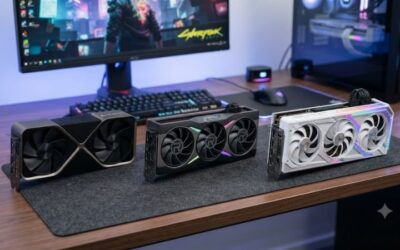
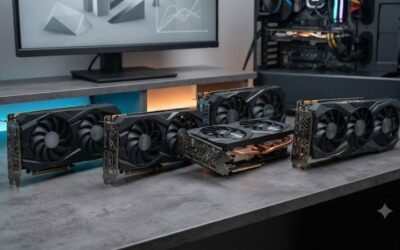
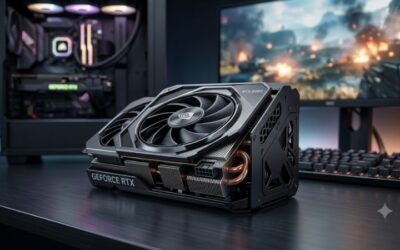
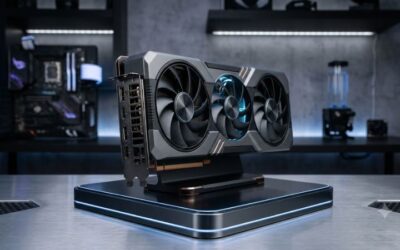
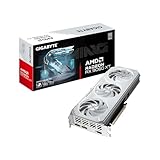
- Top Pick: GIGABYTE Radeon™ RX 9060 XT Gaming OC ICE 16G Graphics Card (16GB GDDR6, 128-bit, PCIe 5.0, HDMI/DP 2.1, 2 Slot, Hawk Fan, Server-Grade Thermal Gel, Reinforced Structure)
- Best Value: ASUS Dual Radeon RX 9060 XT 16GB GDDR6 Graphics Card, AMD, for Desktop (PCIe 5.0, HDMI 2.1b, DisplayPort 2.1a, 2.5-Slot, Axial-tech Fan, 0dB Technology, and More)
- Premium Choice: ASRock Radeon RX 9060 XT Challenger 16GB OC, RDNA 4, 3290MHz Boost, 16GB GDDR6 128-bit, PCIe 5.0, Dual Fans, 0dB Silent, LED Indicator, DisplayPort 2.1a, HDMI 2.1b
The overclocked (OC) editions of AMD’s RX 9060 XT and NVIDIA’s RTX 5060 Ti represent the factory-tuned versions of two of the most popular mainstream GPUs, squeezing extra clock speed out of the silicon for a bit more performance. If you’re building a 1080p or 1440p gaming rig and weighing these two OC cards, the decision hinges on VRAM, features, and how you actually play.
Both cards benefit from partner OC treatments with beefier coolers and higher boost clocks, and both bring current-generation architectures to the fight. But the underlying differences, AMD’s memory advantage versus NVIDIA’s ray tracing and DLSS 4, still decide the winner for any given buyer. Here’s the detailed comparison.


Prime
Top Rated
GIGABYTE Radeon RX 9060 XT Gaming OC 16G Graphics Card, PCIe 5.0, 16GB GDDR6, GV-R9060XTGAMING OC-16GD Video Card

As an Amazon Associate we earn from qualifying purchases at no extra cost to you. Product prices and availability are accurate as of the date shown and are subject to change.



🎮 Get More From Your Setup — Free
Prime Gaming gives you free PC games every month, in-game loot, and a free Twitch channel sub — plus fast free shipping on all the gear above. New members get a 30-day free trial.
Watch: RX 9060 Xt Vs RTX 5060 Ti Oc: Full Comparison — Video Review
Quick Verdict
The RX 9060 XT OC, particularly the 16GB versions, is the better all-around value, offering more VRAM headroom and strong raster performance for modern gaming. The RTX 5060 Ti OC wins if you prioritize ray tracing and DLSS 4, and its 16GB variant closes the memory gap. Both OC editions run cool and quiet; your feature priorities decide the winner.
AMD Radeon RX 9060 XT OC
Factory-overclocked RX 9060 XT cards like the GIGABYTE Gaming OC ICE 16G, ASUS Dual OC, and ASRock Challenger 16GB OC pair RDNA 4’s strong rasterization with higher boost clocks and robust cooling. The standout advantage remains memory: 16GB of GDDR6 gives these cards the headroom to keep textures loading smoothly in demanding modern titles where 8GB cards would struggle.
In traditional raster gaming at 1080p and 1440p, these OC editions frequently match or beat the RTX 5060 Ti while offering superior futureproofing thanks to that larger framebuffer. Ray tracing has improved on RDNA 4, though NVIDIA still leads in the heaviest ray-traced scenes. For most gamers focused on high frame rates and longevity, the 9060 XT OC is the smart pick.
NVIDIA GeForce RTX 5060 Ti OC
Overclocked RTX 5060 Ti cards, including the ASUS Dual 16GB OC and GIGABYTE Gaming OC 16G, lean on NVIDIA’s strengths: class-leading ray tracing and DLSS 4 AI upscaling, which boosts frame rates with excellent image quality. The Blackwell architecture is efficient, and the OC coolers keep these cards quiet under load with PCIe 5.0 and modern outputs.
Crucially, choosing a 16GB OC version eliminates the VRAM concern that dogs the 8GB model, putting it on equal memory footing with the AMD cards. If ray tracing, DLSS 4, or NVIDIA’s creator and streaming tools matter to you, the 5060 Ti OC is compelling. Just be sure to pick the 16GB variant for the best longevity.
Head-to-Head: Which Should You Buy?
- For best raster value: RX 9060 XT OC 16GB.
- For ray tracing and DLSS 4: RTX 5060 Ti OC.
- For content creation and streaming: the NVIDIA card’s encoder and software edge ahead.
- For futureproofing: both 16GB OC cards offer solid VRAM headroom.
- For the quietest, coolest running: both OC editions ship with premium coolers; compare specific models.
Related Guides
- Nvidia RTX 5090 Price Increases (2026)
- RTX 5070 Ti Laptop Sale (2026)
- Is RTX 5090 Worth It (2026)
- Nvidia Geforce RTX 5070 Super (2026)
Frequently Asked Questions
Is the factory OC worth paying for?
The performance uplift from a factory OC is usually modest, but OC editions typically come with better coolers and quieter operation, which is often the bigger benefit. It’s worth it if the price premium is small.
Should I get the 8GB or 16GB RTX 5060 Ti?
For futureproofing and 1440p gaming, choose the 16GB version. It removes the memory bottleneck that the 8GB model can hit in modern games, matching the AMD cards’ VRAM headroom.
Which is better for ray tracing?
The RTX 5060 Ti OC. NVIDIA retains a lead in heavy ray-traced scenes, and DLSS 4 helps recover the frame rate ray tracing costs. RDNA 4 has narrowed the gap but not fully closed it.
Do both support upscaling?
Yes. NVIDIA uses DLSS 4 and AMD uses FSR. DLSS 4 still holds a slight image-quality edge in many titles, but FSR is a strong, widely supported alternative that continues to improve.
Final Verdict
Between these two OC editions, the RX 9060 XT OC 16GB is the better pick for most gamers, delivering strong raster performance and generous VRAM for a competitive price. The RTX 5060 Ti OC, ideally in its 16GB form, is the choice for those who value ray tracing, DLSS 4, or NVIDIA’s creator tools. Compare current prices and specific cooler designs, then buy the one that fits how you play.
Top picks from this guide
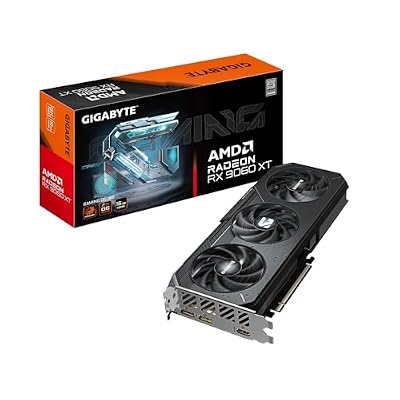 GIGABYTEGIGABYTE Radeon RX 9060 XT Gaming OC 16G Graphics Card,…$550 \xc2\xb7 98/100
 ASUSASUS Dual Radeon RX 9060 XT 16GB GDDR6 Gaming Graphics…$460 \xc2\xb7 97/100ASUSASUS Dual GeForce RTX 5060 Ti 16GB GDDR7 OC Edition…$777 \xc2\xb7 97/100PNYPNY NVIDIA GeForce RTX™ 5060 Ti 8GB OC Dual-Fan Graphics…$500 \xc2\xb7 96/100