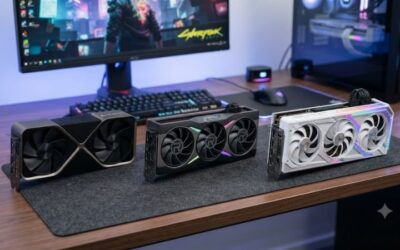
- Top Pick: ASUS Dual NVIDIA GeForce RTX 5060 Ti 16GB GDDR7 OC Edition Graphics Card, (PCIe 5.0, DLSS 4, HDMI 2.1b, DisplayPort 2.1b, 2.5-Slot, Axial-tech Fan, 0dB Technology), 3 Year Warranty
- Best Value: ASUS SFF-Ready Prime NVIDIA GeForce RTX 5060 Ti 16GB GDDR7 OC Edition Graphics Card (PCIe 5.0, 16GB GDDR7, HDMI/DP 2.1, 2.5-Slot, Axial-tech Fans, Dual BIOS), 3 Year Warranty
- Premium Choice: ASUS Dual NVIDIA GeForce RTX 5060 Ti 8GB GDDR7 OC Edition Graphics Card (PCIe 5.0, DLSS 4, HDMI 2.1b, DisplayPort 2.1b, 2.5-Slot, Axial-tech Fan, 0dB Technology), 3 Year Warranty
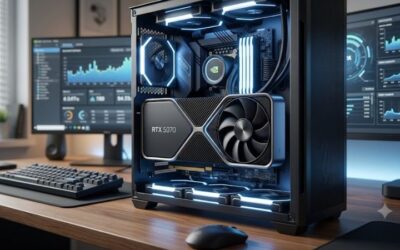
Nvidia’s mainstream Blackwell cards have settled into a clear hierarchy, and for most people building or upgrading a gaming PC in 2026, the real decision comes down to two rungs on that ladder: the GeForce RTX 5060 Ti and the GeForce RTX 5070. They sit close enough in price that the temptation to stretch is real, but far enough apart in silicon that the gap shows up in benchmarks — especially once you push past 1080p or turn on ray tracing.
The choice matters more than usual this generation because the two cards make different trade-offs rather than simply stacking performance. The RTX 5060 Ti is available in a 16GB configuration that gives it more raw VRAM than the RTX 5070, while the 5070 counters with a wider memory bus, substantially more bandwidth, and roughly 33% more shader cores. One card is built around comfortable texture headroom and low power draw; the other is built around throughput. Below, we break down where each one wins and which specific models are worth your money.
As an Amazon Associate we earn from qualifying purchases at no extra cost to you. Product prices and availability are accurate as of the date shown and are subject to change.




⚡ Save on Your Next PC — Amazon Prime
Prime members get fast free shipping on the systems above, plus early access to Prime Day & Black Friday PC deals. New members get a 30-day free trial.
Watch: RTX 5060 Ti vs 5070: Which Wins in 2026? — Video Review
Quick Verdict
Buy the RTX 5060 Ti 16GB if you game primarily at 1080p or 1440p with DLSS enabled, want a compact, cool, low-power card, and care about future texture headroom in modded or VRAM-hungry titles — the ASUS Dual RTX 5060 Ti 16GB OC is the sensible default here. Buy the RTX 5070 if 1440p at high refresh rates is your target, you play a lot of ray-traced titles, or you expect to drive an ultrawide or occasional 4K display. Skip the 8GB variants of the 5060 Ti unless you’re on a strict budget and play mostly esports or older titles.
Key Differences
- GPU and core count: The RTX 5060 Ti uses the GB206 die with 4,608 CUDA cores; the RTX 5070 steps up to GB205 with 6,144 CUDA cores, plus proportionally more RT and Tensor cores.
- Memory capacity and bus: The 5060 Ti ships in 8GB or 16GB GDDR7 configurations on a 128-bit bus (~448 GB/s). The 5070 has 12GB GDDR7 on a 192-bit bus (~672 GB/s) — less capacity than the 16GB card, but roughly 50% more bandwidth.
- Real-world performance: Expect the 5070 to lead by roughly 20–25% at 1080p and 25–30% at 1440p in rasterised games, with the gap widening in heavy ray-tracing workloads.
- Power and PSU requirements: The 5060 Ti draws around 180W and is happy on a quality 550W supply with a single 8-pin. The 5070 sits near 250W and typically wants 650W and a 12V-2×6 connector or adapter.
- Physical size: 5060 Ti models are usually compact 2.5-slot, dual-fan designs — the ASUS SFF-Ready Prime RTX 5060 Ti 16GB OC is explicitly certified for small-form-factor cases. Most 5070 partner cards are longer and thicker.
- Feature parity: Both are full Blackwell parts with DLSS 4 Multi Frame Generation, ninth-gen NVENC with AV1, HDMI 2.1b and DisplayPort 2.1b. Neither has a software advantage over the other.
GeForce RTX 5060 Ti: Efficient, VRAM-Rich, and Easy to Fit
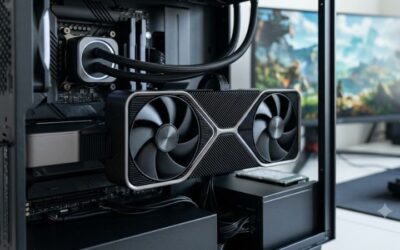
The 5060 Ti’s headline strength in 2026 is the 16GB frame buffer. Modern titles with high-resolution texture packs, ray-traced global illumination, and frame generation overhead can push past 8GB at 1440p, and when they do, the drop-off is ugly — stuttering and texture pop-in rather than a graceful frame rate decline. The ASUS Dual RTX 5060 Ti 16GB OC handles that comfortably in a quiet, 2.5-slot package with 0dB idle fans, and the White OC Edition is the same card for anyone building around a light-themed case. If space is tight, the SFF-Ready Prime version is the one to look at, with dual BIOS for switching between performance and quiet profiles.
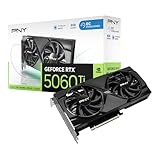
The 8GB models — the ASUS Dual RTX 5060 Ti 8GB OC, the PNY RTX 5060 Ti 8GB OC Dual-Fan, and the triple-fan PNY Epic-X RGB OC — are identical in GPU terms and perform the same right up until VRAM becomes the bottleneck. They’re perfectly good 1080p cards for competitive shooters and esports, where frame rates run high and texture budgets are modest. But for the modest price difference, the 16GB version is the smarter long-term buy for single-player gaming.
GeForce RTX 5070: More Raw Power for 1440p and Beyond
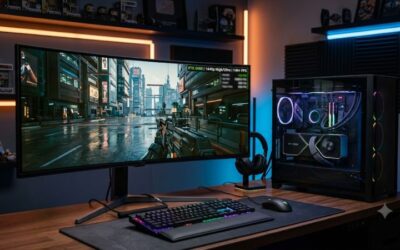
The RTX 5070 is simply a bigger GPU. More shaders, more RT cores, and a 192-bit bus that feeds them properly. That extra bandwidth is why the 5070 pulls further ahead as resolution climbs: at 1080p the two cards are closer than the spec sheet suggests, but at 1440p with settings maxed the 5070 turns marginal 50-something FPS results into a comfortable 70+. In path-traced titles, the advantage is larger still, because ray tracing leans hard on both RT throughput and memory bandwidth.
The compromise is 12GB of VRAM. That’s enough for essentially every current game at 1440p, but it offers less breathing room than the 16GB 5060 Ti for heavily modded games, 4K texture packs, or local AI workloads. You’ll also need to budget for a stronger PSU and more case airflow. For most people playing at 1440p on a 144Hz or faster monitor, that’s a trade worth making.
Which Should You Buy?
- For 1440p high-refresh gaming: Pick the RTX 5070 — the extra bandwidth and cores are exactly what that resolution asks for.
- For 1080p and light 1440p on a budget: Pick the ASUS Dual RTX 5060 Ti 16GB OC and put the savings toward a better CPU or SSD.
- For small-form-factor builds: Pick the ASUS SFF-Ready Prime RTX 5060 Ti 16GB OC, which is designed to fit and cool properly in compact cases.
- For esports and competitive shooters: Pick an 8GB 5060 Ti such as the PNY Epic-X RGB OC Triple-Fan — you’ll hit high frame rates without paying for VRAM you won’t use.
- For ray tracing, ultrawide, or occasional 4K: Pick the RTX 5070, and enable DLSS 4 to keep frame times consistent.