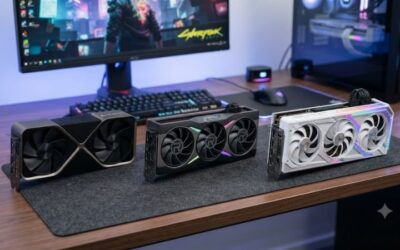
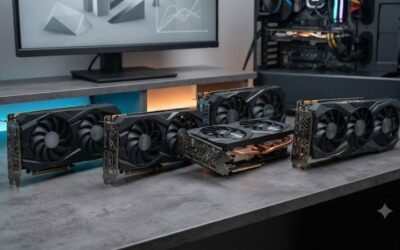
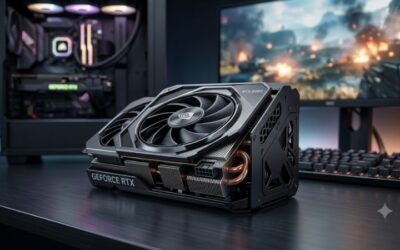
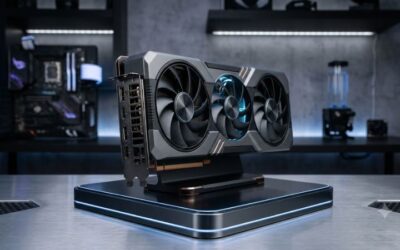
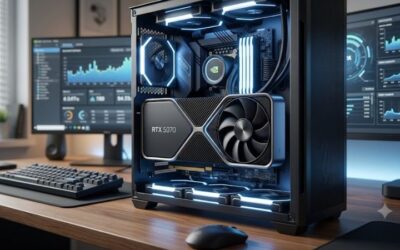
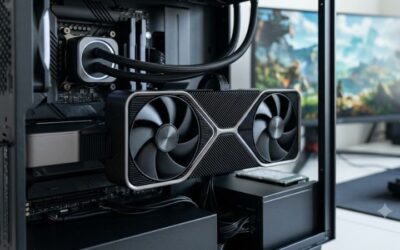
- Top Pick: ASUS Dual NVIDIA GeForce RTX 5060 8GB GDDR7 OC Edition (PCIe 5.0, 8GB GDDR7, DLSS 4, HDMI 2.1b, DisplayPort 2.1b, 2.5-Slot Design, Axial-tech Fan Design, 0dB Technology), 3 Year Warranty
- Best Value: GIGABYTE GeForce RTX 5060 WINDFORCE OC 8G Graphics Card, Cooling System, 8GB 128-bit GDDR7, PCIe 5.0, Manufactured by NVIDIA, DisplayPort & HDMI – Video Output Interface, GV-N5060WF2OC-8GD Video Card
- Premium Choice: ASUS Dual NVIDIA GeForce RTX 5060 Ti 16GB GDDR7 OC Edition Graphics Card, (PCIe 5.0, DLSS 4, HDMI 2.1b, DisplayPort 2.1b, 2.5-Slot, Axial-tech Fan, 0dB Technology), 3 Year Warranty
Shopping for a graphics card under $500 has never been more confusing. The gap between marketing claims and real-world frame rates is wider than ever, VRAM capacity has become a genuine dividing line between cards that age well and cards that don’t, and two competing upscaling ecosystems mean the “faster” card on paper isn’t always the better buy for the games you actually play. Add in fluctuating street prices and a used market full of ex-mining hardware, and it’s easy to overspend on the wrong thing.
This guide cuts through that noise. We’ve focused on current-generation cards that realistically sit at or below the $500 mark in 2026, covering NVIDIA’s RTX 5060 and 5060 Ti alongside AMD’s RX 9060 XT. Below you’ll find how to prioritise specs at this budget, honest reviews of the standout models, and answers to the questions we get asked most. Note that we’ve also included one halo pick — the RTX 5080 — for readers who find themselves with room to stretch, though it sits well outside the sub-$500 bracket.
As an Amazon Associate we earn from qualifying purchases at no extra cost to you. Product prices and availability are accurate as of the date shown and are subject to change.




⚡ Save on Your Next PC — Amazon Prime
Prime members get fast free shipping on the systems above, plus early access to Prime Day & Black Friday PC deals. New members get a 30-day free trial.
Watch: Best Graphics Card Under $500 — Video Review
How to Choose Graphics Card Under $500
- VRAM capacity: 8GB is workable at 1080p, but 16GB is the safer long-term choice in 2026. Modern titles with high-resolution texture packs and ray tracing routinely exceed 8GB at 1440p, causing stutter that no amount of raw GPU power can fix. If your budget allows, prioritise the 16GB variants.
- Target resolution and refresh rate: Buy for the monitor you own, not the one you might buy. A 1080p 144Hz panel is well served by an RTX 5060 or RX 9060 XT; a 1440p display benefits meaningfully from the 5060 Ti 16GB or a 16GB Radeon.
- Upscaling ecosystem: NVIDIA’s DLSS 4 remains the stronger image-reconstruction technology and has broader game support, while AMD’s FSR has closed much of the gap. If you play a lot of older or indie titles, this matters less than raw rasterisation performance.
- Cooler design and case clearance: Measure before you buy. Compact two-fan cards like the ASUS Dual series fit small builds comfortably, while triple-fan designs run quieter and cooler but demand more space and better case airflow.
- Power supply headroom: These cards are relatively efficient, but a quality 550-650W unit with the correct connectors is essential. Skimping on the PSU to afford a better GPU is the most common — and most costly — mistake at this budget.
The Best Picks Reviewed
ASUS Dual RTX 5060 8GB OC Edition
ASUS pairs a factory overclock with a genuinely quiet 2.5-slot Axial-tech cooler and 0dB idle mode, making this one of the most liveable 1080p cards on the market. The 8GB frame buffer is the obvious limitation, but for high-refresh esports and mainstream single-player gaming at 1080p, it delivers excellent value with a three-year warranty behind it.
GIGABYTE RTX 5060 WINDFORCE OC 8G
The WINDFORCE OC is the pragmatist’s pick — a no-frills dual-fan RTX 5060 that typically undercuts its rivals while matching them closely on performance. Thermals are solid and acoustics are respectable under load, making it the card to buy if you want RTX 5060 performance and DLSS 4 support for the least money possible.
ASUS Dual RTX 5060 Ti 16GB OC Edition
This is the sweet spot of the entire guide. The jump to 16GB of GDDR7 transforms the card’s 1440p credentials, eliminating the texture-streaming stutter that plagues 8GB models, while the same excellent Dual cooler keeps noise and temperatures in check. If you can stretch to it within the $500 cap, it’s the card we’d recommend to most buyers.
XFX Swift RX 9060 XT 16GB
XFX’s triple-fan Swift is AMD’s strongest answer in this bracket, offering 16GB of GDDR6 and RDNA 4’s improved ray tracing at a price that frequently undercuts comparable NVIDIA cards. Rasterisation performance is genuinely competitive at 1440p, and the larger cooler runs cool and quiet — just confirm you have the case clearance first.
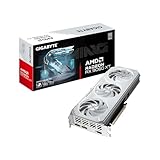
GIGABYTE RX 9060 XT Gaming OC ICE 16G
The ICE edition brings a white colourway, a compact two-slot footprint and GIGABYTE’s Hawk fans with server-grade thermal gel, which is a genuinely useful combination for smaller or aesthetics-focused builds. Performance mirrors other RX 9060 XT 16GB cards, so choose this one if slot space or build theme is a deciding factor.
Frequently Asked Questions
Is 8GB of VRAM still enough in 2026?
At 1080p with sensible settings, yes — but it’s increasingly a compromise. Several recent titles require dropping texture quality on 8GB cards even at 1080p, and at 1440p the limitation becomes obvious. If you plan to keep the card for three or more years, the 16GB options are the wiser investment.
Should I choose NVIDIA or AMD at this price?
NVIDIA holds the advantage in upscaling quality, ray tracing and productivity workloads, while AMD typically offers more VRAM per dollar and strong raw rasterisation. For pure gaming value at 1440p, the RX 9060 XT 16GB is compelling; for the broadest feature set, the RTX 5060 Ti 16GB wins.
What power supply do these cards need?
A quality 550W unit is sufficient for the RTX 5060 and RX 9060 XT, with 650W recommended for the 5060 Ti to allow headroom. Always prioritise a reputable brand with the correct native connectors over a higher wattage from an unknown manufacturer.
Will any of these cards handle 4K gaming?
Not comfortably in demanding modern titles. With aggressive upscaling you can achieve playable 4K frame rates in less demanding or older games, but genuine 4K gaming realistically starts several tiers above this budget — which is where a card like the RTX 5080 comes in.
Final Thoughts
For most buyers, the ASUS Dual RTX 5060 Ti 16GB OC is the card to beat under $500 — it combines a future-proof frame buffer, DLSS 4 support and an excellent cooler in one package. If you’d rather maximise raw performance per dollar, the XFX Swift RX 9060 XT 16GB is an outstanding alternative with the same generous 16GB of memory, while the GIGABYTE RTX 5060 WINDFORCE OC remains the smart choice for strictly 1080p builds on a tighter budget.