🛒 Best Price Today on Amazon
Prime members get fast, free shipping on everything above, plus member-only deals. New members get a 30-day free trial — cancel anytime.
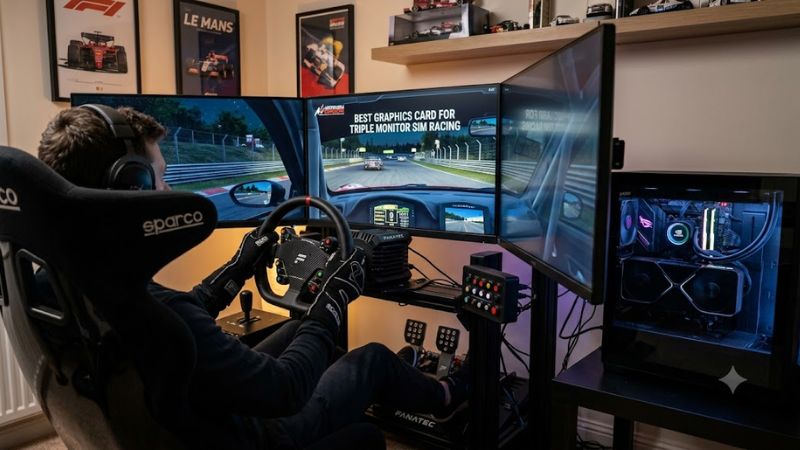
Three-screen sim racing is mainly a question of total pixels, target refresh rate, and the GPU workload of each simulator. The best graphics card for triple monitor sim racing depends on whether you use 1080p, 1440p, or 4K panels, plus your CPU, power supply, and preferred racing titles.
How to Choose a Triple-Monitor Sim Racing GPU
The best graphics card for triple monitor sim racing should match the combined resolution rather than the resolution of one panel. Triple 1440p renders 7,680 × 1,440 pixels, while triple 4K reaches 11,520 × 2,160, so GPU requirements rise sharply. CPU performance also matters in iRacing and other simulation-heavy titles.
Match the GPU to Resolution
For triple 1080p, an RTX 5070 Ti-class GPU provides substantially more graphics capacity than an entry-level card and carries 16GB of GDDR7. For triple 1440p, the RTX 5080 offers 16GB GDDR7 and a higher CUDA-core count. Triple 4K places a much heavier load on the GPU.
The RTX 5090 is the higher-capacity option when three 4K displays are the target. NVIDIA lists 32GB of GDDR7, a 512-bit memory interface, and support for four independent displays. Its 575W total graphics power also means the rest of the PC must be built around a substantially larger power budget.
Consider the Racing Simulator
Different simulators can produce very different GPU loads, so one FPS figure should not be treated as universal. A 2026 triple-screen guide reports iRacing results at 3×1440p using high settings and full-grid starts, with the RTX 5070 Ti around 95–125 FPS and RTX 5080 around 120–144 FPS. These are community-based performance bands, not controlled PC Gaming Universe testing.
ACC can require more graphics headroom than iRacing in demanding scenes. A separate 2026 source lists triple-1440p target ranges of 100–144 FPS for ACC and notes that rain and night conditions can substantially reduce performance. Treat such figures as planning references because CPU, track, weather, and settings all change the result.
Check CPU and Platform Balance
A powerful GPU does not automatically produce higher frame rates when the simulator is CPU-limited. Recent iRacing owner reports show a Ryzen 7 9800X3D with an RTX 5070 Ti reaching around 120 FPS on triple 1440p in some configurations, while another report describes dips during full-grid scenarios. These reports demonstrate why CPU and race conditions belong in the buying decision.
For a new high-end build, platform compatibility matters as much as GPU choice. The RTX 50-series cards use PCIe 5.0 support, while the RX 9070 XT also uses PCIe 5.0 x16. A complete system still needs a compatible motherboard, adequate DDR5 memory for the selected platform, sufficient PSU capacity, and a case that accepts the specific card model.
Verify Power and Display Connections
Triple monitors need three usable display outputs, but connector layouts vary between individual graphics-card models. NVIDIA’s RTX 5080 Founders Edition has three DisplayPort outputs and one HDMI output and supports up to four monitors. NVIDIA specifies 850W system power for that reference design.
The RX 9070 XT reference specification lists 304W typical board power and a 750W minimum PSU recommendation, with DisplayPort 2.1a and HDMI 2.1b support. Board-partner cards can use different dimensions and connectors, so check the exact model before purchase rather than relying only on the GPU family specification.
Top Picks for Triple Monitor Sim Racing
The table below separates the four current-generation choices by workload rather than treating every triple-monitor setup as identical. The best graphics card for triple monitor sim racing can therefore change with resolution and simulator. Specifications come from NVIDIA and AMD; performance figures are attributed to independent or community sources rather than PC Gaming Universe testing.
| Product | Best For | Key Spec | Compatibility | Watch Out For |
| NVIDIA GeForce RTX 5080 | Best Overall | 16GB GDDR7, 10,752 CUDA cores | PCIe 5.0, 850W reference system recommendation, up to 4 displays | 16GB VRAM |
| AMD Radeon RX 9070 XT | Best Value | 16GB GDDR6, 256-bit | PCIe 5.0 x16, 750W minimum PSU | Check exact card outputs and dimensions |
| NVIDIA GeForce RTX 5090 | Best for Triple 4K | 32GB GDDR7, 21,760 CUDA cores | PCIe 5.0, 1000W reference system recommendation, up to 4 displays | 575W GPU power |
| NVIDIA GeForce RTX 5070 Ti | Best for Triple 1080p/1440p | 16GB GDDR7, 8,960 CUDA cores | PCIe 5.0, up to 4-display support | Less GPU headroom for triple 4K |
Best Overall: GeForce RTX 5080
The RTX 5080 is the best graphics card for triple monitor sim racing when the target is triple 1440p with a high-refresh setup and a strong modern CPU. NVIDIA specifies 10,752 CUDA cores, 16GB GDDR7, a 256-bit memory interface, and 360W total graphics power. The reference design also supports up to four monitors.
Independent community data places the RTX 5080 around 120–144 FPS in iRacing at triple 1440p during full-grid race starts with high settings, although the source explicitly describes these as performance bands. The weakness is its 16GB memory capacity, while buyers who only use triple 1080p can spend less on GPU capacity they may not need.
Best Value: Radeon RX 9070 XT
The RX 9070 XT is a strong option for buyers prioritizing rasterized sim-racing performance and 16GB of VRAM without moving to NVIDIA’s highest power tiers. AMD lists 4,096 stream processors, 16GB GDDR6 on a 256-bit interface, up to 640GB/s bandwidth, and 304W typical board power.
A 2026 independent sim-racing source reports triple-1440p iRacing performance around 120–144 FPS and ACC around 80–95 FPS at high settings without ray tracing. Those figures come from that site’s own testing rather than PC Gaming Universe, so they should be treated as source-specific results. Buyers also need to verify the connector layout of the exact board-partner model.
Best for Triple 4K: GeForce RTX 5090
For triple 4K, the RTX 5090 provides the largest memory and compute envelope among these four choices. NVIDIA lists 21,760 CUDA cores, 32GB GDDR7, a 512-bit memory interface, 575W total graphics power, and a 1000W recommended system power figure for its reference configuration. It also supports four independent displays under specified configurations.
That capacity comes with a substantial platform requirement. NVIDIA’s 1000W recommendation is based on a system using a Ryzen 9 9950X, and the reference card requires either four PCIe 8-pin cables through the supplied adapter or a 600W PCIe Gen 5 cable. Buyers should also verify case clearance and the exact board-partner dimensions before installation.
Best for Triple 1080p/1440p: GeForce RTX 5070 Ti
The RTX 5070 Ti is the more sensible fit when the rig uses triple 1080p or triple 1440p and does not require the graphics capacity of the RTX 5080 or 5090. NVIDIA specifies 8,960 CUDA cores, 16GB GDDR7, and a 256-bit memory interface. It also supports DLSS 4 and PCIe 5.0.
Recent iRacing owner reports show a Ryzen 7 9800X3D and RTX 5070 Ti producing roughly 100–120 FPS in triple 1440p scenarios, with race-start conditions affecting the result. This is user-reported rather than a standardized benchmark, so it should not be compared directly with laboratory-style results from another setup.
FAQ: Triple Monitor Sim Racing GPUs
The best graphics card for triple monitor sim racing depends primarily on the combined resolution, refresh target, simulator, and CPU. Triple 1080p is substantially easier than triple 1440p, while triple 4K requires much more GPU capacity. Current-generation choices also differ in VRAM, power requirements, display connectivity, and upscaling features.
What GPU Do I Need for Triple 1440p Sim Racing?
For triple 1440p, the RTX 5070 Ti can fit a high-performance iRacing build, while the RTX 5080 provides additional GPU capacity for higher settings and demanding titles. A 2026 community benchmark guide reports 95–125 FPS for the 5070 Ti and 120–144 FPS for the 5080 at triple 1440p, high settings, and full-grid iRacing starts.
The RX 9070 XT is another 16GB option for this resolution. AMD specifies 16GB GDDR6 and 304W board power, while owner reports describe triple-1440p use with iRacing and ACC. Because simulator performance varies by track, weather, cars, and CPU load, these reports should guide expectations rather than act as guaranteed frame rates.
Is 16GB VRAM Enough for Triple Monitors?
16GB VRAM is a reasonable capacity for many triple-monitor sim-racing configurations, but it is not a universal requirement or guarantee for every title and setting. The RTX 5070 Ti, RTX 5080, and RX 9070 XT each provide 16GB, while the RTX 5090 doubles that to 32GB.
The practical memory requirement depends on resolution, textures, rendering features, and the game. Triple 4K creates far more pixel workload than triple 1080p, so the 5090’s 32GB gives additional capacity for particularly demanding configurations. VRAM alone, however, does not determine FPS because GPU compute and CPU workload also matter.
Can One GPU Run Three Gaming Monitors?
Yes, one modern GPU can drive three gaming monitors when its outputs and the chosen display configuration are supported. NVIDIA lists up to four monitors for the RTX 5080 and RTX 5090, while AMD’s RX 9070 XT supports multiple display outputs through DisplayPort 2.1a and HDMI 2.1b.
Before buying, check the exact graphics-card model rather than only the GPU name. Board partners can change the number and arrangement of DisplayPort and HDMI connectors, and physical dimensions can also differ. For three identical gaming monitors, having three suitable outputs directly on the card simplifies the display setup.
Is the RTX 5090 Necessary for Triple 4K?
The RTX 5090 is not automatically necessary for every triple-4K setup, but its 32GB GDDR7 memory and 575W graphics power place it in the highest-capacity class among these options. NVIDIA specifies support for four independent 4K displays at up to 165Hz under the listed configuration.
Actual game performance still depends on the simulator and CPU. A 2026 triple-screen PC guide lists RTX 5090 systems for triple 4K and targets 60–120 FPS across iRacing and ACC, while noting that title and conditions change the result. Treat those figures as that builder’s targets, not standardized benchmark results.
Final Thoughts
The best graphics card for triple monitor sim racing depends on the screens you already own and the frame-rate target you want. RTX 5070 Ti suits triple 1080p and some 1440p builds, RX 9070 XT adds a 16GB alternative, RTX 5080 fits demanding triple 1440p, and RTX 5090 targets the heaviest triple-4K configurations.