🛒 Best Price Today on Amazon
Prime members get fast, free shipping on everything above, plus member-only deals. New members get a 30-day free trial — cancel anytime.
Choosing the best motherboard for content creators means matching CPU socket, memory, storage lanes and high-speed I/O to the workload. Video editors may value USB4 and 10GbE, while 3D users can need flexible PCIe layouts, so the right choice depends on the platform, storage plan and peripherals.
How to Choose a Motherboard for Content Creators
For a creator system, start with four criteria: CPU platform, expansion, storage and connectivity. AM5 boards suit Ryzen 9000, 8000 and 7000 processors, while Intel’s current Z890 options use LGA1851. DDR5 is standard across these choices, and ATX cases are required for all four boards discussed here.
Platform compatibility
The best motherboard for content creators must match the processor before storage or connectivity enters the discussion. ASUS ProArt X870E-Creator WiFi and ASRock X870 Taichi Creator use AM5, while ProArt Z890-Creator WiFi uses LGA1851 for Intel Core Ultra Series 2. All use DDR5 rather than DDR4.
For power and chassis planning, these are ATX boards using a standard 24-pin motherboard connection with CPU power connectors, while the MSI board also provides an additional PCIe power connector for its expansion design. An ATX-compatible case and an appropriate PSU are therefore part of the platform check.
PCIe expansion
Creators using capture cards, GPUs or high-speed adapters should inspect PCIe lane allocation rather than count slots alone. ProArt X870E-Creator and X870 Taichi Creator each provide two PCIe 5.0 x16 slots that can operate in x8/x8 configurations, giving them useful flexibility for multi-card systems.
That flexibility matters more when a workflow combines a graphics card with another accelerator or high-bandwidth card. The MSI X870E Gaming Plus instead centers on one PCIe 5.0 x16 slot plus chipset-connected expansion, making it a simpler fit for a single-GPU workstation rather than a heavily expanded build.
Storage capacity
Modern editing libraries can quickly require several NVMe drives, so M.2 count and lane sharing deserve attention. ProArt X870E-Creator provides four M.2 slots, including two PCIe 5.0 x4 connections, while ProArt Z890-Creator provides five M.2 slots with one PCIe 5.0 x4 slot and four PCIe 4.0 slots.
The X870 Taichi Creator also provides four M.2 slots, including two PCIe 5.0 x4 connections, plus four SATA ports. Its second Gen5 M.2 slot shares resources with rear USB4, so storage planning should account for that relationship before installation rather than assuming every connector operates independently.
High-speed connectivity
USB4, Thunderbolt 5 and fast Ethernet can directly affect creator workflows involving external SSDs, docks, NAS systems and displays. ProArt X870E-Creator combines dual USB4 with 10GbE, 2.5GbE and Wi-Fi 7, while ProArt Z890-Creator adds dual Thunderbolt 5 alongside 10GbE and 2.5GbE networking.
The best motherboard for content creators therefore depends partly on the peripherals already owned. A Thunderbolt-heavy Intel setup may favor the Z890 board, while an AMD workstation with NAS storage can make better use of the X870E board’s dual networking and USB4 arrangement.
Top Picks
These four choices cover different creator requirements rather than one universal configuration. The table focuses on manufacturer specifications and current platform compatibility; no detailed research or independently generated performance ranking is used. Current-generation support is based on manufacturer documentation available on September 28, 2026.
| Product | Best For | Key Spec | Compatibility | Watch Out For |
| ASUS ProArt X870E-Creator WiFi | Best Overall | Dual USB4, 10GbE + 2.5GbE | AM5, DDR5, ATX | Four M.2 slots; USB4 rather than Thunderbolt 5 |
| MSI X870E Gaming Plus WiFi | Best Value | USB4, 5GbE, Wi-Fi 7 | AM5, DDR5, ATX | Three M.2 slots and simpler PCIe layout |
| ASUS ProArt Z890-Creator WiFi | Best For Intel Creators | Dual Thunderbolt 5, 10GbE | LGA1851, DDR5, ATX | M.2_5 disables PCIe 4.0 x16 slot |
| ASRock X870 Taichi Creator | Best For Multi-Card Workflows | Dual PCIe 5.0 x16, 10GbE + 5GbE | AM5, DDR5, ATX | M.2 and USB4 resource sharing |
ASUS ProArt X870E-Creator WiFi
The best motherboard for content creators on an AMD platform is represented here by ASUS ProArt X870E-Creator WiFi because its connectivity is closely aligned with creator workloads. It supports Ryzen 9000, 8000 and 7000 processors, four DDR5 DIMMs, four M.2 drives and two PCIe 5.0 x16 slots with x8/x8 operation.
Its real limitation is that it offers four M.2 slots rather than five and uses USB4 instead of Thunderbolt 5. Buyers who specifically need Thunderbolt 5 peripherals should consider the Intel ProArt alternative instead. An ATX case and AM5-compatible CPU and cooler are required, with DDR5 memory.
MSI X870E Gaming Plus WiFi
The MSI X870E Gaming Plus WiFi is the value-oriented choice for creators who want modern connectivity without moving into the more specialized creator boards. It supports Ryzen 9000, 8000 and 7000 processors, four DDR5 DIMMs, one PCIe 5.0 x16 slot, USB4, 5GbE and Wi-Fi 7.
Its main weakness is expansion capacity: there are three M.2 slots and the secondary PCIe slots come from the chipset rather than a second CPU-connected Gen5 x16 path. It makes less sense for a workstation needing multiple high-bandwidth cards or a very large NVMe array, but its ATX and AM5 requirements keep mainstream system planning straightforward.
ASUS ProArt Z890-Creator WiFi
For Intel systems, ProArt Z890-Creator WiFi pairs LGA1851 with Intel Core Ultra Series 2 processors and four DDR5 DIMM slots. Its creator-focused connectivity includes dual Thunderbolt 5, one additional USB4/Thunderbolt port, 10GbE, 2.5GbE and Wi-Fi 7, making it particularly suited to fast external devices and network storage.
The important limitation is resource sharing: using the fifth M.2 slot disables the PCIe 4.0 x16 chipset slot. Thunderbolt 5 features also require Windows 11, while the board itself specifies Windows 11 22H2 or later. An LGA1851 CPU, DDR5 memory and ATX-compatible case are required.
ASRock X870 Taichi Creator
The ASRock X870 Taichi Creator is aimed at creators who need unusually strong expansion and networking on AM5. It supports Ryzen 9000, 8000 and 7000 processors, four DDR5 DIMMs up to 256GB, two PCIe 5.0 x16 slots, dual USB4, 10GbE, 5GbE and four M.2 slots.
Its weakness is lane and connector sharing around storage. The second M.2 slot can affect the rear USB4 ports, while some Ryzen 8000 configurations also reduce PCIe and M.2 capabilities. It is therefore a strong fit for carefully planned multi-card builds, but less attractive when every storage and I/O connection must remain independent.
FAQ
The right creator motherboard is determined mainly by the CPU platform, storage requirements, PCIe expansion and external I/O rather than by a single performance figure. These four questions cover the compatibility issues most likely to affect a purchase.
Is AMD or Intel better for creator motherboards?
Neither platform is universally preferable because the choice starts with the processor and required I/O. AMD options here use AM5 and DDR5, while the ASUS ProArt Z890-Creator uses LGA1851 and DDR5 for Intel Core Ultra Series 2.
The best motherboard for content creators on AMD gives access to Ryzen 9000, 8000 and 7000 processors, while the Intel option adds Thunderbolt 5. Choose the platform that matches the CPU, applications and peripherals you intend to keep for the system’s service life.
How much RAM should a creator motherboard support?
A creator motherboard should support the amount of DDR5 memory required by the workload, and the boards here provide four DIMM slots. ProArt X870E-Creator, ProArt Z890-Creator and X870 Taichi Creator all use four DDR5 slots, while the latter two specify support for capacities up to 256GB.
The motherboard does not determine the ideal memory capacity by itself. Large projects, virtual machines and complex 3D scenes can justify more memory than ordinary editing, while the CPU memory controller and motherboard memory support list should be checked before buying a high-capacity kit.
Do content creators need 10GbE or USB4?
10GbE and USB4 are useful when a workflow regularly moves large files between fast local storage, external SSDs and NAS devices. ProArt X870E-Creator combines 10GbE, 2.5GbE and dual USB4, while X870 Taichi Creator provides 10GbE, 5GbE and dual USB4.
They are not mandatory for every creator PC. A system using only internal SSDs and local project files can place greater value on M.2 capacity and PCIe expansion, while a shared studio environment may gain more from high-speed networking and external storage connectivity.
Is an ATX motherboard necessary for a creator PC?
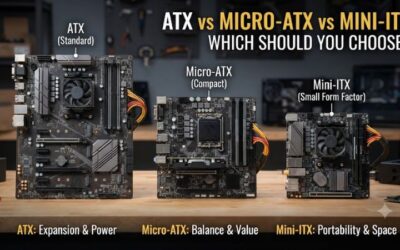
An ATX board is not technically mandatory for content creation, but all four models in this roundup use the ATX form factor. That means the case must provide ATX motherboard mounting, while CPU, RAM, GPU, storage and PSU compatibility must be checked separately for the complete build.
For a creator workstation, ATX also leaves more physical room for expansion cards and storage connections than many compact boards. The best motherboard for content creators should therefore be selected alongside the case and expansion plan, not as an isolated component.
Final Thoughts
The best motherboard for content creators depends on the platform and workflow: ProArt X870E-Creator targets AMD users needing USB4 and fast networking, ProArt Z890-Creator suits Intel and Thunderbolt 5, while MSI and ASRock cover simpler and more expansion-heavy AM5 builds. Verify CPU, DDR5, M.2 and PCIe sharing before purchase.