🛒 Best Price Today on Amazon
Prime members get fast, free shipping on everything above, plus member-only deals. New members get a 30-day free trial — cancel anytime.
For a new Intel build, the best z890 motherboard for gaming depends more on CPU support, DDR5 configuration, expansion needs, and connectivity than motherboard-level FPS differences. Z890 uses LGA1851 and DDR5, so older LGA1700 CPUs and DDR4 kits are not compatible.
How to Choose a Z890 Gaming Motherboard
A good Z890 board should match the CPU, memory kit, case, graphics card, storage layout, and power supply rather than simply having the largest VRM. For the best z890 motherboard for gaming, prioritize LGA1851 compatibility, DDR5 support, PCIe 5.0, useful networking, and enough M.2 capacity. All four picks below use ATX dimensions and target Windows 11 systems.
CPU and Platform Compatibility
The best z890 motherboard for gaming must use Intel’s LGA1851 socket and support Core Ultra processors from Series 2. Z890 boards do not accept older LGA1700 CPUs, while DDR4 is also excluded because these boards use DDR5. Intel lists current Core Ultra processors, including the 285K and newer Plus models, under the Z890 platform.
For a K-series processor, Z890 also provides the chipset platform intended for CPU overclocking, but a capable power supply and adequate CPU cooling remain necessary. The motherboard does not include a cooler or PSU. Existing LGA1700 mounting hardware can be mechanically compatible with LGA1851, although cooler compatibility should still be checked with its manufacturer.
DDR5 and Memory Layout
Memory support matters because advertised DDR5 overclocking speeds depend on the processor, DIMM configuration, BIOS, and memory kit. The ASRock Taichi Lite supports four DDR5 DIMMs and up to DDR5-9600+ overclocked, while MSI’s Tomahawk WiFi II lists up to 9200+ MT/s under specified configurations.
For a gaming build, two DIMMs are generally easier to configure at high memory speeds than four populated slots. A compatible DDR5 kit should be checked against the motherboard’s memory support list before purchase. CUDIMM support is also available on several current Z890 models, but the supported speed still depends on the complete CPU and memory configuration.
PCIe and Storage Expansion
A modern graphics card should occupy the primary CPU-connected PCIe 5.0 x16 slot, while Gen5 NVMe support can provide a separate path for a compatible SSD. The MSI Tomahawk WiFi II has one PCIe 5.0 x16 slot and four M.2 sockets, including one PCIe 5.0 x4 socket.
Storage-heavy builds need closer inspection because adding an M.2 device can sometimes change PCIe slot behavior. ASUS, for example, specifies that enabling particular M.2 slots on the ROG Maximus Z890 Hero changes the primary PCIe slot to x8. That matters for builders planning multiple Gen5 SSDs alongside a high-end GPU.
Networking, Case, and PSU Fit
Networking should match the rest of the system rather than the motherboard’s marketing tier. The Taichi Lite provides 5GbE plus 2.5GbE and Wi-Fi 7, while the Gigabyte Z890 Aorus Master provides 10GbE and Wi-Fi 7. Both are ATX boards, so an ATX-compatible case is required.
Power connectors also deserve a check before ordering. The Taichi Lite uses a 24-pin ATX connection plus two 8-pin CPU power connectors, while the ASUS Hero uses a 24-pin main connector and dual 8-pin CPU connectors. The PSU therefore needs suitable EPS connectors in addition to the GPU power connections.
Top Picks for Z890 Gaming Builds
The current Z890 market has relatively small motherboard-to-motherboard gaming differences when the same CPU, memory, GPU, and settings are used. Tom’s Hardware ran the Taichi Lite at 1920×1080 Ultra in F1 24 and Cyberpunk 2077, recording 147 FPS in F1 24; the Cyberpunk result was around the test average.
| Product | Best For | Key Spec | Compatibility | Watch Out For |
| ASRock Z890 Taichi Lite | Best Overall | 20+1+2+1+1 110A VCore, 6 M.2 | LGA1851, DDR5, ATX | Some M.2 heatsinks lack tool-free removal |
| MSI MAG Z890 Tomahawk WiFi II | Best Value | 16+1+1+1 90A SPS, 4 M.2 | LGA1851, DDR5, ATX | One Thunderbolt 4 port |
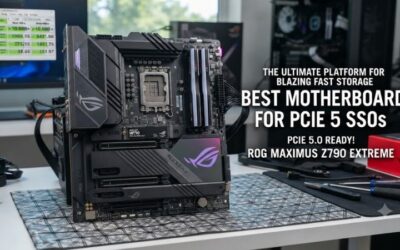
| ASUS ROG Maximus Z890 Hero | Best For Premium Builds | 22+1+2+2 power stages, 6 M.2 | LGA1851, DDR5, ATX | High-end feature set costs more |
| Gigabyte Z890 Aorus Master | Best For 10GbE | 18×110A VCore, 5 M.2 | LGA1851, DDR5, ATX | Premium pricing and last-gen audio codec |
Best Overall: ASRock Z890 Taichi Lite
The best z890 motherboard for gaming for a premium ATX build is the ASRock Z890 Taichi Lite because it combines strong power delivery, six M.2 positions, dual wired networking, Wi-Fi 7, and two Thunderbolt 4/USB4 ports. It supports four DDR5 DIMMs up to 9600+ MT/s overclocked and uses LGA1851.
Who should buy it? Builders using a Core Ultra K-series CPU who want substantial storage and networking without moving to an extreme-priced board. Its real weakness is that some M.2 heatsinks are less convenient than the tool-free designs found elsewhere, and its six-slot layout requires attention to lane sharing. Buyers seeking a simpler storage layout may prefer another model.
Best Value: MSI MAG Z890 Tomahawk WiFi II
The best z890 motherboard for gaming at a value-oriented price tier is the MSI MAG Z890 Tomahawk WiFi II, with four DDR5 slots, one PCIe 5.0 x16 slot, four M.2 sockets, 5GbE, Wi-Fi 7, and one rear Thunderbolt 4 port. MSI lists support for Core Ultra Series 2 processors, DDR5-9200+ overclocking, and Windows 11.
Who should buy it? Gamers who want current connectivity without paying for flagship extras. Tom’s Hardware describes the WiFi II as a competent budget Z890 board, but its weakness is reduced connectivity compared with the original Tomahawk, particularly one Thunderbolt 4 port and reduced Wi-Fi 7 bandwidth. Buyers needing several high-speed external links should consider another pick.
Best For Premium Features: ASUS ROG Maximus Z890 Hero
The best z890 motherboard for gaming for a premium feature-heavy build is the ASUS ROG Maximus Z890 Hero. It supports up to 256GB of DDR5, offers six M.2 slots, dual 8-pin CPU power connectors, 5GbE plus 2.5GbE networking, Wi-Fi 7, and a PCIe 5.0 x16 slot. It is an ATX board measuring 30.5 × 24.4 cm.
Who should buy it? Enthusiasts who will actually use its extensive storage, networking, diagnostics, and overclocking features. Its weakness is lane sharing: enabling certain M.2 slots causes the primary PCIe 5.0 graphics slot to operate at x8. Users installing one GPU and several SSDs should check the manual’s lane allocation before building.
Best For 10GbE: Gigabyte Z890 Aorus Master
The best z890 motherboard for gaming for users prioritizing fast wired networking is the Gigabyte Z890 Aorus Master. It combines 10GbE, Wi-Fi 7, five M.2 sockets, four DDR5 DIMM slots, and support for DDR5 speeds up to 9500 MT/s overclocked. Its primary graphics slot is PCIe 5.0 x16, with bandwidth sharing possible when the specified M.2 connection is populated.
Who should buy it? Gamers with a 10GbE network, large local transfers, or a storage-heavy workstation alongside gaming. Its weakness is that its Realtek ALC1220 audio codec is a previous-generation solution, while the board also occupies a premium price tier. Builders using ordinary 1GbE or 2.5GbE networking may not need those additional features.
FAQ
These four questions cover the compatibility points that matter most when selecting a Z890 board for a new gaming PC. The platform uses LGA1851 and DDR5, while individual boards differ in M.2 count, PCIe lane allocation, networking, USB connectivity, and memory support. Check the manufacturer’s CPU and memory lists before ordering.
Does Z890 support DDR4?
No, Z890 gaming motherboards use DDR5 memory rather than DDR4. Intel’s Core Ultra Series 2 desktop platform uses LGA1851 and DDR5, and the motherboard specifications for the four models above list DDR5 DIMM slots. Existing DDR4 modules therefore cannot be transferred to a Z890 build.
For a new system, choose the memory capacity and speed as a complete kit rather than mixing older modules. The advertised maximum speed is an overclocking specification, not a guaranteed operating speed for every CPU and DIMM combination, so the motherboard QVL and processor memory capability should be checked before buying a high-speed kit.
Is Z890 compatible with Intel Core Ultra processors?
Yes, Z890 is designed for Intel Core Ultra desktop processors using the LGA1851 socket. Intel’s compatibility listing includes the Core Ultra 9 285K and newer Series 2 processors, while Intel specifically states that the platform is not backward compatible with LGA1700 motherboards.
This means a Z890 upgrade normally requires a new motherboard and DDR5 memory if the existing system uses an older Intel platform. CPU coolers are different: Intel says LGA1700 mounting holes remain mechanically compatible with LGA1851, although individual cooler support should still be confirmed with the cooler manufacturer.
Does a more expensive Z890 motherboard increase gaming FPS?
Usually, motherboard price alone does not create a large gaming FPS difference when the CPU, GPU, memory, software, and settings remain comparable. Tom’s Hardware’s Z890 Taichi Lite gaming suite used 1920×1080 Ultra settings and found only small differences among boards in the gaming-focused comparisons.
Motherboard features matter more when they affect memory configuration, CPU power limits, storage expansion, networking, or connectivity. TechSpot’s 50-board Z890 roundup also found tightly grouped platform performance, with a 5% spread in Cinebench 2024 after excluding an outlier, reinforcing why features and compatibility deserve attention.
Can a Z890 motherboard use a PCIe 5.0 graphics card and Gen5 SSD?
Yes, Z890 boards can provide PCIe 5.0 support for both graphics and NVMe storage, but the exact lane allocation differs by model. The MSI Tomahawk WiFi II provides a PCIe 5.0 x16 graphics slot plus one PCIe 5.0 x4 M.2 slot, while the ASUS Hero provides multiple Gen5 M.2 positions with documented lane-sharing conditions.
Before installing multiple Gen5 devices, check the motherboard manual for shared lanes and disabled slots. A single gaming GPU generally has the simplest configuration, while several NVMe drives can change the primary slot’s operating mode on some premium boards. This is particularly important for builds combining a high-end GPU with multiple Gen5 SSDs.
Final Thoughts
The best z890 motherboard for gaming is determined by the complete build rather than FPS claims alone. ASRock’s Taichi Lite emphasizes expansion, MSI’s Tomahawk WiFi II targets value, ASUS’s Hero adds premium features, and Gigabyte’s Aorus Master focuses on 10GbE. Match the board to your CPU, DDR5 kit, case, PSU, GPU, and storage plan.