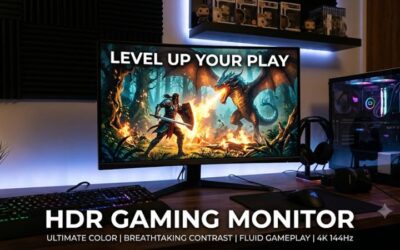
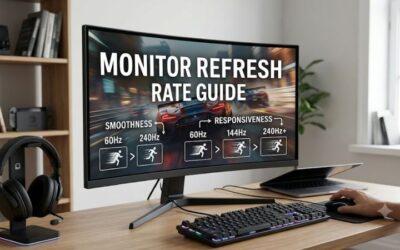
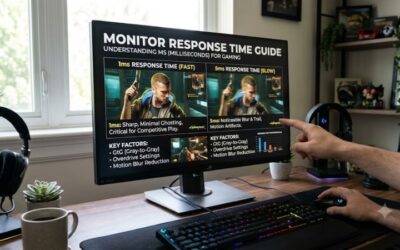
- Top Pick: Samsung 27" Odyssey OLED G6 (G61SH) QD-OLED, QHD (1440P) Gaming Monitor
- Best Value: LG 27GX704A-B 27-inch Ultragear QHD (2650×1440) OLED Gaming Monitor 240Hz, 0.03ms, NVIDIA G-Sync Compatible, AMD FreeSync Premium Pro, VESA Display HDR TrueBlack400, HDMI 2.1, DisplayPort, Black
- Premium Choice: ASUS ROG Strix 26.5” 1440P QD-OLED Gaming Monitor (XG27ACDNG) -QHD (2560×1440), 360Hz, 0.03ms, Custom Heatsink, OLED Care+, G-SYNC Compatible, 99% DCI-P3, DisplayWidget, AI Gaming, 3yr Warranty
Choosing between an OLED and an IPS gaming monitor used to be a straightforward trade-off: OLED gave you perfect blacks and instant pixel response, IPS gave you brightness, longevity and a much friendlier price. In 2026 that gap has narrowed sharply. Third-generation QD-OLED and WOLED panels are brighter, better protected against burn-in and increasingly available at 27 inches for the kind of money that used to buy a mid-range IPS display. Meanwhile, Fast IPS has pushed to 300Hz+ with 1ms GtG response and genuinely usable HDR on the higher-end models.
That makes the decision less about which technology is objectively “better” and more about how you actually play. A competitive shooter player who games eight hours a day in a bright room has very different priorities to someone playing story-driven single-player titles in a darkened bedroom. Below we break down the real-world differences, then match specific 2026 panels to specific use cases so you can buy once and buy correctly.
As an Amazon Associate we earn from qualifying purchases at no extra cost to you. Product prices and availability are accurate as of the date shown and are subject to change.



⚡ Save on Your Next PC — Amazon Prime
Prime members get fast free shipping on the systems above, plus early access to Prime Day & Black Friday PC deals. New members get a 30-day free trial.
Watch: OLED vs IPS Gaming Monitor: 2026 Comparison — Video Review
Quick Verdict
OLED is the better choice for image quality enthusiasts, HDR gaming and anyone who plays single-player titles in a controlled-light room — panels like the Samsung Odyssey OLED G6, ASUS ROG Strix XG27ACDNG and Alienware AW3425DW deliver motion clarity and contrast that no IPS panel can match. IPS remains the smarter buy if you need maximum sustained brightness, plan to leave static desktop elements on screen for hours daily, want the lowest possible cost per inch, or simply want a monitor you never have to think about.
Key Differences
- Contrast and black levels: OLED pixels switch off completely for true blacks and effectively infinite contrast; IPS relies on a backlight and suffers “IPS glow” and grey blacks in dark scenes, even with local dimming.
- Response time and motion clarity: OLED panels quote 0.03ms GtG, which means essentially zero smearing behind moving objects. Fast IPS at 1ms GtG is excellent but still shows mild dark-transition blur in fast pans.
- Brightness: IPS wins on full-screen sustained brightness, which matters in sunlit rooms. OLED peaks far higher in small highlight windows, which is why HDR content looks more dramatic on it.
- Burn-in risk: OLED carries a small but real risk from static HUDs, taskbars and streaming overlays. Modern pixel-shift, logo dimming and panel refresh routines mitigate it heavily, and warranties now typically cover it. IPS has no burn-in risk at all.
- Text rendering: IPS uses a standard RGB stripe subpixel layout, so text is crisp for productivity. QD-OLED’s triangular layout can produce slight colour fringing on thin fonts, though 2026 panels and Windows tuning have improved this.
- Price: IPS still undercuts OLED at every size and refresh tier, and the gap grows as you scale up to ultrawide.
OLED Gaming Monitors
The case for OLED in 2026 is stronger than ever. At 27 inches and 1440p, options like the LG UltraGear 27GX704A (240Hz WOLED with HDMI 2.1 and DisplayHDR TrueBlack 400) and the AOC Q27GAZD QD-OLED hit a price point that makes them credible mainstream buys rather than luxury purchases. If you want the fastest panel available, the ASUS ROG Strix XG27ACDNG runs 1440p at 360Hz with a custom heatsink and ASUS’s OLED Care+ protection suite, while the glossy ROG XG27AQDMGR trades a little ambient-light tolerance for noticeably deeper, more saturated colour.
For immersion, ultrawide OLED is the endgame. The Alienware AW3425DW pairs a 34.2-inch 3440×1440 QD-OLED panel with a gentle 1800R curve and 240Hz refresh, and it is genuinely transformative in racing sims, RPGs and anything with a strong sense of place. Samsung’s Odyssey OLED G6 sits in the same conversation at 27 inches, offering QD-OLED contrast with Samsung’s own suite of burn-in countermeasures. Across all of these, the shared advantage is the same: near-instantaneous pixel response and per-pixel lighting.
IPS Gaming Monitors
IPS has not stood still. Current Fast IPS panels reach 1440p at 300Hz and 4K at 240Hz, hold 1ms GtG with well-tuned overdrive, and cover wide colour gamuts with excellent factory calibration. Crucially, they sustain 400–600 nits across the whole screen, so a bright office or a room with an uncovered window is a non-issue. Viewing angles are still class-leading, and colour accuracy off-axis makes them the default for shared setups and content creation.
The practical arguments are just as compelling. An IPS monitor can display the same spreadsheet, IDE or streaming dashboard for ten hours a day for five years with zero degradation. It costs meaningfully less, meaning you can put the savings toward a GPU that actually feeds a high refresh rate. And for competitive players running low-graphics settings in Counter-Strike, Valorant or Apex, where contrast matters far less than raw frame delivery and visibility in shadows, a high-refresh IPS is arguably the more rational tool.
Which Should You Buy?
- For single-player and HDR gaming: pick OLED — the Alienware AW3425DW for immersion, or the Samsung Odyssey OLED G6 for a desk-friendly 27-inch footprint.
- For competitive esports: pick the highest refresh rate you can drive. The ASUS ROG Strix XG27ACDNG at 360Hz is the OLED pick; a 300Hz+ Fast IPS is the cheaper equivalent.
- For mixed work and play: pick IPS if static UI elements dominate your day, or a WOLED like the LG 27GX704A if you want OLED with slightly better text handling than QD-OLED.
- For bright rooms: pick IPS, or a matte-coated OLED — avoid glossy panels like the ROG XG27AQDMGR unless you can control reflections.
- For best value OLED: pick the AOC Q27GAZD, which delivers QD-OLED contrast and 240Hz without the flagship premium.
Frequently Asked Questions
Is OLED burn-in still a problem in 2026?
It is a manageable risk rather than an inevitability. Pixel shifting, logo dimming, automatic panel refresh cycles and heatsinks have substantially extended panel life, and most manufacturers now include burn-in coverage in their warranties. Hide your taskbar, use a short screen timeout and vary your content, and typical users should not see issues.
Does OLED actually feel faster than IPS?
Yes, in motion clarity terms. At matched refresh rates, OLED’s 0.03ms transitions eliminate the overshoot and dark-level smearing that IPS still exhibits. The difference is most obvious when tracking moving objects and reading text while panning.
Is 1440p still the sweet spot?
For most builds, yes. 1440p at 240–360Hz is far easier to drive than 4K at similar frame rates, and at 27 inches the pixel density is high enough that the upgrade to 4K delivers diminishing returns in fast-paced games.
Do I need HDMI 2.1 or DisplayPort?
DisplayPort 1.4 with DSC handles 1440p at 240Hz+ comfortably on PC. HDMI 2.1, as found on the LG 27GX704A, matters if you also plan to connect a PlayStation 5 or Xbox Series X at 120Hz.
Final Verdict
If image quality is your priority and you can manage a little static-content discipline, OLED is the clear winner in 2026 — the contrast, motion clarity and HDR impact are simply in another class, and panels like the ASUS ROG Strix XG27ACDNG and Alienware AW3425DW show how far the technology has come. If you need all-day brightness, absolute reliability under heavy desktop use, or the best frames-per-dollar for competitive play, a high-refresh Fast IPS remains a genuinely excellent and considerably cheaper choice.