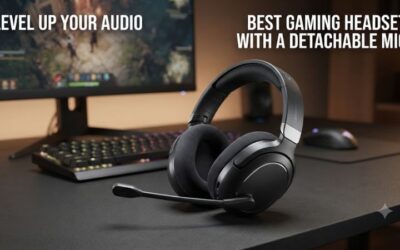
A wired headset is still the simplest way to get reliable audio on a PC. There is no battery to charge before a session, no wireless dongle competing for a USB port, and no pairing step when you switch machines. The cable carries an uncompressed signal, so what you hear is exactly what the game outputs, and a wired boom mic avoids the bandwidth compromises wireless headsets make when splitting a connection between game audio and voice.
The five headsets below cover the two connection styles PC players actually use. Analog 3.5mm models plug into a motherboard, sound card, or external DAC and work with almost anything else you own. USB models carry their own digital processing, adding spatial audio, EQ software, and sidetone controls. Picks span budget, mid-range, and premium tiers, and every one uses a detachable or flip-up microphone.
As an Amazon Associate, we earn from qualifying purchases.
Quick Answer
For most PC players, the HyperX Cloud Alpha is the wired headset to buy: its dual-chamber drivers, aluminum frame, and detachable mic cover competitive and casual play over a plain 3.5mm plug. The Corsair HS80 RGB USB adds Dolby Audio 7.1 and a broadcast-grade mic over USB, while the ASTRO A40 TR is the premium open-back pick.
Table of Contents
- HyperX Cloud Alpha
- SteelSeries Arctis Nova 1
- Razer BlackShark V2
- Corsair HS80 RGB USB
- ASTRO A40 TR Wired Headset
- How to Choose
- Who Should Skip
- FAQ
- Final Verdict
HyperX Cloud Alpha

The Cloud Alpha fits the widest range of PC setups. Its 50mm drivers sit in a dual-chamber housing that gives the bass its own space, keeping low-end effects from bleeding into the midrange where footsteps and dialogue live. The result is a clean, full sound that works for shooters, RPGs, and music with no software in the chain — it is purely analog, so it sounds the same on a gaming PC, a laptop, or a controller.
Build quality is the other reason it anchors this list. The frame is aluminum rather than plastic, the cushions use memory foam under leatherette, and both the cable and the noise-cancelling microphone detach, so common wear items can be replaced instead of retiring the whole headset. The included PC extension cable splits the plug into separate headphone and microphone jacks for desktop front panels.
Specs
- Drivers: 50mm dynamic with dual-chamber design, neodymium magnets
- Frequency response: 13 Hz to 27 kHz
- Impedance: 65 ohms
- Sensitivity: 98 dB SPL per mW at 1 kHz
- Connection: 3.5mm, detachable 1.3 m cable plus 2 m PC extension cable
- Microphone: detachable electret condenser, noise cancelling, 50 Hz to 18 kHz
- Frame: aluminum with memory foam headband and ear cushions
- Weight: 298 g (336 g with microphone and cable)
- Compatibility: PC, PS5, PS4, Xbox Series X|S, Xbox One, Nintendo Switch, mobile
- Tier: Mid-range
SteelSeries Arctis Nova 1

The Arctis Nova 1 is the budget pick for PC players who want a light headset for a full evening of games. At 236 g it is the lightest model here, and the ComfortMax system — rotating earcups, adjustable headband, and AirWeave memory foam cushions — spreads clamp force evenly instead of squeezing. The 40mm drivers support 360-degree spatial audio through SteelSeries Sonar on PC, adding a parametric EQ and game presets over the analog connection.
The detachable ClearCast Gen 2 microphone uses bidirectional noise cancelling to reject keyboard clatter and room noise, and it removes completely for listening-only use. On-headset controls handle volume and mute without alt-tabbing. Because the connection is a standard 3.5mm plug, the same headset moves to a console controller, Switch, or phone with no adapters beyond the included splitter.
Specs
- Drivers: 40mm dynamic
- Frequency response: 20 Hz to 22 kHz
- Impedance: 36 ohms
- Sensitivity: 93 dB SPL at 1 kHz / 1 mW
- Connection: 3.5mm, 1.5 m cable plus dual 3.5mm PC extension
- Microphone: detachable ClearCast Gen 2, bidirectional noise cancelling
- Software: SteelSeries Sonar with spatial audio and EQ on PC
- Controls: on-earcup volume wheel and mute button
- Weight: 236 g
- Compatibility: PC, PS5, PS4, Xbox Series X|S, Xbox One, Nintendo Switch, mobile
- Tier: Budget
Razer BlackShark V2

The BlackShark V2 is built around competitive play on PC. Its TriForce Titanium 50mm drivers split the diaphragm into three sections tuned separately for highs, mids, and lows, keeping positional cues distinct when a scene gets busy. Through the included USB sound card it unlocks THX Spatial Audio on Windows, including THX Game Profiles tuned for popular competitive titles. Over the 3.5mm plug it remains a plain stereo headset for any other device.
Voice clarity is a priority here: the detachable HyperClear cardioid microphone focuses on the front of the boom and rejects sound from the sides and back, and USB adds mic controls in Razer Synapse. At 262 g with FlowKnit memory foam cushions, it stays comfortable through long sessions, and the closed-back earcups add passive isolation for shared rooms.
Specs
- Drivers: Razer TriForce Titanium 50mm
- Frequency response: 12 Hz to 28 kHz
- Impedance: 32 ohms
- Sensitivity: 100 dB SPL per mW at 1 kHz
- Connection: 3.5mm plus included USB sound card (1.8 m cable)
- Microphone: detachable HyperClear cardioid condenser
- Spatial audio: THX Spatial Audio with game profiles over USB on PC
- Ear cushions: FlowKnit memory foam, closed-back design
- Weight: 262 g
- Compatibility: PC, PS5, PS4, Nintendo Switch, Xbox One, mobile (3.5mm)
- Tier: Mid-range
Corsair HS80 RGB USB

The HS80 RGB USB is the pick for PC players who want everything handled over one USB connection. It carries custom-tuned 50mm neodymium drivers with a frequency response extending to 40 kHz, fed by a high-resolution 24-bit, 96 kHz USB signal. Dolby Audio 7.1 surround is built in, and Corsair iCUE adds EQ profiles, sidetone adjustment, and RGB control for the earcup logos.
Its microphone is the standout: Corsair rates the omnidirectional boom as broadcast-grade, and it flips up to mute, suiting players who stream or spend the day in voice calls. A floating headband strap and cloth-wrapped memory foam earpads keep the 373 g frame comfortable, though the headset is PC-only — USB does not carry to consoles, and there is no 3.5mm fallback.
Specs
- Drivers: custom-tuned 50mm neodymium
- Frequency response: 20 Hz to 40 kHz
- Impedance: 32 ohms
- Sensitivity: 116 dB (plus or minus 3 dB)
- Connection: USB wired, 24-bit / 96 kHz audio
- Surround sound: Dolby Audio 7.1
- Microphone: omnidirectional boom, flip-up to mute
- Software: Corsair iCUE for EQ, sidetone, and RGB control
- Weight: 373 g
- Compatibility: PC and Mac only
- Tier: Mid-range
ASTRO A40 TR Wired Headset

The A40 TR is the premium option, and the only open-back design here. The open earcups trade isolation for a wider, more natural soundstage, suiting players in a quiet room who play story-driven games as often as competitive ones. It is tuned with ASTRO Audio V2 and built as a modular platform: speaker tags, ear cushions, and headband pad swap out, and ASTRO Mod Kits can convert it to a closed-back, noise-isolating setup.
The swappable boom microphone mounts on either side, flips to mute, and detaches for the in-line mic on the included cable. Pairing it with a MixAmp Pro TR (sold separately) adds game-to-voice balancing and Dolby Audio on PC, but the headset alone runs fine from any 3.5mm output. Construction is metal and matte polymer throughout.
Specs
- Drivers: 40mm dynamic
- Frequency response: 20 Hz to 20 kHz
- Impedance: 48 ohms
- Design: open-back, over-ear, Mod Kit ready
- Connection: 3.5mm 4-pole, 1.5 m cable with in-line mic plus 1.5 m PC splitter
- Microphone: swappable unidirectional boom, flip to mute, detachable
- Ear cushions: cloth with synthetic leather backing, replaceable
- Weight: 369 g
- Compatibility: PC, Mac, PS5, PS4, Xbox Series X|S, Xbox One, Nintendo Switch, mobile
- Tier: Premium
How to Choose
Start with the connection. A 3.5mm headset such as the Cloud Alpha, Arctis Nova 1, or A40 TR is the flexible choice: it works with motherboard audio, a sound card, an external DAC and amp stack, and every controller you own. A USB headset such as the HS80 RGB USB, or the BlackShark V2 via its USB sound card, processes audio itself, so EQ, spatial audio, and mic settings live in software and follow the headset between PCs — but only where the software runs, usually Windows.
Next, decide on cup design. Closed-back headsets isolate you from room noise and keep game audio from leaking out; the open-back A40 TR gives up that isolation for a broader soundstage. Driver size matters less than tuning: the dual-chamber Cloud Alpha and the TriForce drivers in the BlackShark V2 both aim to keep bass from masking detail.
Then check the microphone and fit. Detachable booms (Cloud Alpha, Nova 1, BlackShark V2) are easy to replace and remove; flip-to-mute booms (HS80, A40 TR) are faster mid-game. For long sessions, weight and cushion material decide comfort more than clamp force — the 236 g Nova 1 and cloth-cushioned HS80 suit players who find leatherette hot. Finally, desktops with separate headphone and microphone jacks need the splitter cables the analog picks here include.
Who Should Skip
Skip wired headsets entirely if you play from a couch, stream to a TV across the room, or cannot stand a cable crossing your desk — wireless removes the tether at the cost of charging and a dongle. Skip the USB-only HS80 RGB USB if you also play on console, since it has no analog fallback. Skip the open-back A40 TR if your room is noisy or others sit nearby, because it neither blocks outside sound nor keeps yours in. And if your PC’s onboard audio is noisy or quiet, budget for a USB model or external DAC rather than blaming an analog headset for the source.
FAQ
Do wired headsets have lower latency than wireless ones?
Yes. A wired connection carries audio with no encoding or buffering delay, so the signal path is effectively instant. Modern wireless headsets are close enough that most players cannot tell in casual play, but wired removes the variable entirely, along with dropouts and battery management.
Can I use a 3.5mm headset with a PC that has one combined jack?
Yes. Laptops and compact PCs use a single combined headset jack that accepts the 4-pole plug directly. On a desktop with separate green and pink jacks, use the splitter cable included with headsets such as the Cloud Alpha and Arctis Nova 1.
Is a USB headset better than a 3.5mm headset for PC gaming?
Neither is automatically better. USB headsets include their own DAC and software, so they sound consistent on any PC and add spatial audio and mic EQ. A 3.5mm headset depends on your PC’s audio hardware — excellent with a good sound card or DAC — and works with far more devices.
Do these headsets work for voice chat in Discord and TeamSpeak?
Yes. Every headset here has a boom microphone designed for voice chat, and the Cloud Alpha is certified by TeamSpeak and Discord. Detachable and flip-to-mute designs let you silence or remove the mic quickly, and USB models add software controls like sidetone.
Final Verdict
For one wired headset that does everything well on PC, buy the HyperX Cloud Alpha: durable, comfortable, and clean-sounding on any machine, no software required. The Arctis Nova 1 covers the budget tier with the lightest frame here and a strong detachable mic. Choose the BlackShark V2 for THX spatial audio, the HS80 RGB USB for its microphone and Dolby Audio, and the A40 TR for an open-back soundstage and modular premium build.
Product and ASIN Reference
| Product | ASIN |
|---|---|
| HyperX Cloud Alpha | B074NBSF9N |
| SteelSeries Arctis Nova 1 (Black) | B0B8Q4CR52 |
| Razer BlackShark V2 | B086PKMZ1Q |
| Corsair HS80 RGB USB (Carbon) | B09YHQWHKV |
| ASTRO A40 TR Wired Headset | B07PYL7WZY |