🛒 Best Price Today on Amazon
Prime members get fast, free shipping on everything above, plus member-only deals. New members get a 30-day free trial — cancel anytime.
A best gaming headset with a detachable mic gives PC players a useful split between gaming and everyday listening: attach the boom for voice chat, then remove it when you want a cleaner headphone profile. The strongest current options differ mainly in wireless latency, microphone quality, comfort, sound signature, and platform support.
How to Choose a Gaming Headset With a Detachable Mic
The right detachable-mic headset depends on four practical factors: microphone connection, platform compatibility, connection type, and listening environment. Audeze Maxwell 2 covers premium wireless use, Logitech G PRO X 2 LIGHTSPEED targets flexible wireless PC gaming, Razer BlackShark V3 Pro focuses on competitive play, while Corsair VIRTUOSO PRO suits wired open-back setups.
Check the Microphone Connection
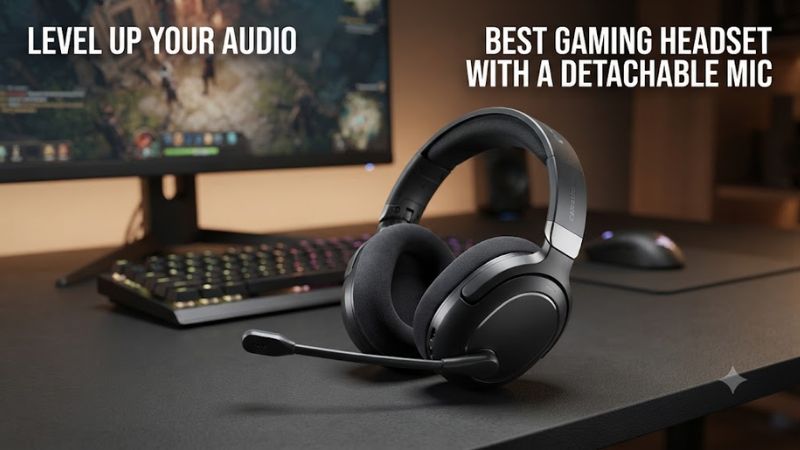
A removable boom should stay secure during normal use while remaining easy to take out when voice chat is finished. The Audeze Maxwell 2 uses a detachable hypercardioid boom, while the Razer BlackShark V3 Pro uses a detachable 12 mm HyperClear microphone. Both designs leave the headset usable without the boom attached.
For voice-heavy gaming, independent measurements also matter more than the microphone’s marketing description. RTINGS reports strong microphone performance for the Maxwell 2 and BlackShark V3 Pro, while its Logitech review describes good environmental-noise separation but less natural microphone recording. That makes the Logitech a more specific compromise rather than a universal microphone choice.
Match the Headset to Your Platform
Compatibility can change between variants, so check the exact model before buying. Maxwell 2 is sold in PlayStation and Xbox versions, while Razer offers platform-specific BlackShark V3 Pro models. Logitech’s PRO X 2 LIGHTSPEED supports PC, PlayStation, Bluetooth and analog connections, making it a straightforward PC-focused option when Xbox Wireless is not required.
If one headset must move between PC and consoles, connection hardware becomes part of the buying decision. The Razer Xbox version, for example, supports Xbox, PlayStation and PC, while the PlayStation model has a different compatibility set. The Maxwell 2 also has separate console versions, so buyers should select the correct platform edition rather than assuming every version is identical.
Choose Wireless or Wired
Wireless models make sense when desk movement and cable freedom matter, but wired models avoid charging and wireless configuration altogether. The Logitech PRO X 2 LIGHTSPEED offers LIGHTSPEED wireless, Bluetooth and 3.5 mm connections, while the Corsair VIRTUOSO PRO uses a 3.5 mm interface and includes a microphone cable plus a cable without the mic.
Battery figures also vary substantially between models and connection modes. Audeze specifies over 80 hours of wireless playback for Maxwell 2, Logitech specifies up to 50 hours, and SteelSeries lists 40 hours for the Arctis Nova 3 Wireless. These are manufacturer figures under stated conditions, so they should not be treated as identical real-world measurements.
Consider Your Listening Environment
Closed-back headsets generally make more sense when outside noise or audio leakage is a concern, while open-back designs trade isolation for a more spacious presentation. Corsair’s VIRTUOSO PRO is open-back, and RTINGS notes both its immersive passive soundstage and poor noise isolation. Maxwell 2 and BlackShark V3 Pro use closed-back designs instead.
Comfort also needs to be considered separately from microphone quality. Maxwell 2 weighs 560 g according to Audeze, and RTINGS describes it as heavy, while the Logitech model is praised for comfort. Corsair lists the VIRTUOSO PRO at 338 g, making its wired open-back design materially lighter than Maxwell 2.
Top Picks for a Detachable-Mic Gaming Headset
The current lineup covers four distinct buying cases rather than one identical feature set. Maxwell 2 combines planar magnetic drivers, low-latency wireless and a detachable boom; Logitech emphasizes comfort and connection flexibility; Razer adds ANC and competitive-focused wireless features; Corsair offers a wired open-back alternative.
| Product | Best For | Key Spec | Compatibility | Watch Out For |
| Audeze Maxwell 2 | Best Overall | 90 mm planar magnetic; 80+ hr rated battery | PC/Mac, PlayStation or Xbox variant, Switch 2 | 560 g; weak isolation |
| Logitech G PRO X 2 LIGHTSPEED | Best Value | 50 mm graphene; up to 50 hr battery | PC, PlayStation, Bluetooth, 3.5 mm | Mic recording is less natural |
| Razer BlackShark V3 Pro | Best For Competitive FPS | 12 mm detachable mic; 2.4 GHz wireless | PC, PlayStation or Xbox variants | Fit can change sound |
| Corsair VIRTUOSO PRO | Best For Open-Back Gaming | 50 mm drivers; 32 ohms | PC, Mac, consoles, Switch, mobile | No wireless; substantial leakage |
Audeze Maxwell 2 — Best Overall
Audeze Maxwell 2 is the strongest fit for buyers who want premium wireless audio and a detachable microphone in one closed-back headset. Its 90 mm planar magnetic drivers, USB-C low-latency wireless, Bluetooth 5.3 and 3.5 mm analog input provide several connection choices, while the detachable boom uses a hypercardioid design.
The main reason not to buy it is physical rather than functional: the headset is heavy. Audeze lists 560 g, while RTINGS measured about 77 hours of continuous battery life and found the headset bulky with limited noise isolation. Buyers who prioritize a lightweight fit or strong passive isolation should consider another design.
Logitech G PRO X 2 LIGHTSPEED — Best Value
The Logitech G PRO X 2 LIGHTSPEED is aimed at buyers who want wireless flexibility without giving up wired connectivity. It combines 50 mm graphene drivers with LIGHTSPEED wireless, Bluetooth and 3.5 mm operation, while Logitech rates battery life at up to 50 hours. Its boom microphone is detachable and supports Blue VO!CE processing on PC.
Its main weakness is microphone character rather than connectivity. RTINGS describes the microphone as good at separating speech from background noise, but notes that recorded speech can sound somewhat boomy and less detailed. Buyers seeking the most natural voice reproduction should look toward Maxwell 2 or another microphone-focused design.
Razer BlackShark V3 Pro — Best For Competitive FPS
The Razer BlackShark V3 Pro targets competitive PC gaming with 2.4 GHz HyperSpeed Wireless Gen-2, a detachable 12 mm HyperClear microphone, hybrid ANC and THX Spatial Audio on supported Windows systems. Razer also provides platform-specific PC, PlayStation and Xbox versions, so buyers can select the hardware for their main system.
The weakness is fit consistency. RTINGS reports that sound can change substantially with head size, hair and glasses, while its independent review also found the headset’s sound profile somewhat V-shaped. Players who want a predictable fit or a more neutral presentation should account for that before choosing this model.
Corsair VIRTUOSO PRO — Best For Open-Back Gaming
Corsair VIRTUOSO PRO is the wired option for buyers who prefer an open-back presentation and a removable microphone setup. It uses 50 mm drivers, a 32-ohm impedance and a 3.5 mm interface, with compatibility across PC, Mac, Xbox, PlayStation, Nintendo Switch and mobile devices. The microphone is detachable with the supplied cable arrangement.
Its biggest limitation is the open-back construction. RTINGS finds strong passive soundstage performance and good microphone recording quality, but also poor noise isolation and substantial leakage. This model is therefore better suited to a quiet room than a shared space, and it should not be chosen by buyers who specifically need wireless operation.
FAQ: Detachable-Mic Gaming Headsets
The key questions are usually about whether the microphone can be removed, which platform version to buy, whether wireless models introduce meaningful latency, and whether an open-back headset works in a noisy room. Those answers depend on the individual design rather than the detachable-mic feature alone, so the following distinctions matter.
Is a Detachable Microphone Better for Gaming?
A detachable microphone is useful when you want to switch between gaming and ordinary headphone use without leaving a boom attached. It also makes microphone replacement simpler on designs where the boom is a separate component, although buyers should still check whether replacement microphones are sold by the manufacturer.
For PC gaming, the benefit is mainly flexibility rather than a direct audio-performance improvement. Maxwell 2, PRO X 2 LIGHTSPEED and BlackShark V3 Pro all allow the boom to be removed, while Corsair’s VIRTUOSO PRO uses a microphone-equipped cable that can be swapped for a cable without the mic.
Which Headset Has the Best Microphone?
The Audeze Maxwell 2 has the strongest independent microphone results among these four picks. RTINGS describes its detachable microphone as excellent, with natural voice reproduction and strong background-noise handling, while Audeze specifies a detachable hypercardioid boom with additional noise-reduction features.
The Razer BlackShark V3 Pro is also strong for voice chat, with RTINGS reporting very good boom-microphone performance and impressive noise separation. Logitech’s PRO X 2 LIGHTSPEED remains capable for noisy rooms, but its recorded voice is less natural, while Corsair’s microphone performs well in controlled environments but also captures more surrounding sound.
Do Wireless Gaming Headsets Have More Latency?
Modern 2.4 GHz gaming headsets can provide low-latency connections suitable for PC gaming, so wireless operation does not automatically mean noticeable gameplay delay. RTINGS reports impressively low latency for both Maxwell 2 and BlackShark V3 Pro when using their wireless dongles.
Bluetooth is a different connection mode and should not be assumed to behave like a dedicated gaming dongle. The Logitech, Razer and SteelSeries models provide separate wireless technologies for different uses, while Maxwell 2 combines low-latency USB-C wireless with Bluetooth 5.3. For gaming, the dedicated dongle is generally the connection to prioritize.
Are Open-Back Headsets Good in Noisy Rooms?
Open-back headsets are generally a poor fit for noisy rooms because their earcups allow outside sound in and game audio out. RTINGS specifically reports poor noise isolation and significant leakage for the Corsair VIRTUOSO PRO, despite its strong soundstage and microphone performance.
A closed-back detachable-mic headset is more appropriate when background noise matters. Maxwell 2 and BlackShark V3 Pro both use closed-back designs, while the Razer model additionally provides hybrid ANC. The exact isolation level still varies by fit and environment, so closed-back construction should be treated as a design advantage rather than a guarantee of silence.
Final Thoughts
The best gaming headset with a detachable mic depends on the setup rather than one universal specification. Maxwell 2 emphasizes premium wireless audio and microphone quality, Logitech favors flexible connections, Razer targets competitive gaming, and Corsair provides an open-back wired alternative. Check platform compatibility and fit before choosing.