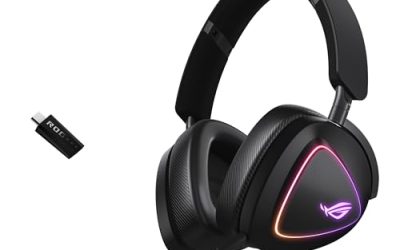
The best gaming headset with a noise cancelling microphone is the ASUS ROG Delta II, because its AI beamforming microphones and AI noise reduction strip keyboard clatter, fan hum, and room echo out of your voice before your squad hears them, while a detachable super-wideband boom covers serious chat. Every pick here attacks noise at the microphone rather than at your ears, the right fix when the problem is what your teammates hear, not what you hear.
That distinction matters. Noise cancelling earcups quiet the room for you, but they do nothing for the keyboard, dog, or fan your microphone sends down the line. The five headsets below instead use AI filtering, beamforming arrays, or bidirectional noise-cancelling capsules to isolate your voice, across premium, mid-range, and budget tiers.
As an Amazon Associate, we earn from qualifying purchases.
Table of Contents
- Quick Answer
- ASUS ROG Delta II
- Audeze Maxwell for PlayStation
- SteelSeries Arctis Nova 5
- HyperX Cloud Alpha Wireless
- SteelSeries Arctis Nova 1
- How to Choose
- Who Should Skip
- FAQ
- Final Verdict
- Product and ASIN Reference
Quick Answer
Choose the ASUS ROG Delta II for the strongest all-round package: AI beamforming microphones with AI noise reduction, a detachable super-wideband boom, tri-mode connectivity, and up to 110 hours of battery. The Audeze Maxwell leads on pure sound, the Arctis Nova 5 is the mid-range software pick, the Cloud Alpha Wireless runs for 300 hours, and the Arctis Nova 1 is the wired budget option.
ASUS ROG Delta II

The Delta II is the most complete microphone package here. ASUS builds AI beamforming microphones into the headset and pairs them with AI noise reduction, so calls without the boom still reject off-axis room noise. For ranked sessions, the detachable 10 mm super-wideband boom captures a wider voice range than standard gaming mics, and a boom status light shows mute at a glance.
The rest of the headset matches that ambition. Tri-mode connectivity covers ROG SpeedNova 2.4 GHz wireless, Bluetooth, and a wired 3.5 mm connection, and DualFlow Audio lets two sources play at once. The 50 mm titanium-plated diaphragm drivers deliver the sound, battery life is rated up to 110 hours on the 2.4 GHz link, and at 318 grams it stays comfortable across long sessions.
Specs
- Drivers: 50 mm titanium-plated diaphragm
- Wireless: ROG SpeedNova 2.4 GHz, Bluetooth, 3.5 mm wired
- Microphone: detachable 10 mm super-wideband boom, AI beamforming microphones with AI noise reduction
- Battery life: up to 110 hours on 2.4 GHz
- Weight: 318 g
- Extras: DualFlow Audio for two simultaneous sources, RGB lighting
- Compatibility: PC, PlayStation, Xbox (wired), Switch, mobile
- Tier: premium
Audeze Maxwell for PlayStation
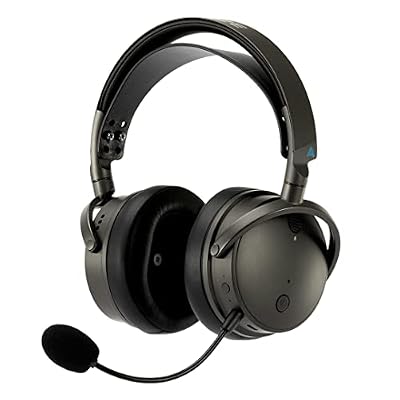
The Maxwell is the sound-quality flagship of this roundup. Its 90 mm planar magnetic drivers produce the fast, detailed response that positional audio rewards, and the PlayStation edition is tuned for Tempest 3D Audio on PS5 while also covering PC, Mac, and Switch. A spring steel headband and aluminum yokes give it a build closer to studio headphones than to a typical gaming headset.
Its detachable boom runs Audeze’s FILTER technology, an AI-assisted noise reduction system that uses a dedicated processor inside the headset to remove background noise from your voice in real time, with no software setup on console or PC. Battery life is rated at more than 80 hours, and Bluetooth multipoint keeps a phone connected beside the low-latency dongle. At 490 grams it is the heaviest headset here, the honest trade for the driver size and battery. Order the PlayStation edition for PS5 use, since the Xbox edition is a separate listing.
Specs
- Drivers: 90 mm planar magnetic
- Wireless: low-latency 2.4 GHz via USB dongle, Bluetooth multipoint
- Microphone: detachable boom with FILTER AI noise reduction, built-in secondary mic
- Battery life: more than 80 hours
- Weight: 490 g
- Extras: Tempest 3D Audio support on PS5, USB wired mode
- Compatibility: PlayStation, PC, Mac, Switch, mobile
- Tier: premium
SteelSeries Arctis Nova 5

The Nova 5 is the mid-range pick for PC players who live in voice chat. Its retractable ClearCast Gen 2.X microphone is bidirectional, so it naturally rejects sound arriving from the sides and rear, and SteelSeries layers AI noise cancelling on top through the Sonar app on PC. The mic slides fully into the earcup when you do not need it.
Around that mic sits a versatile wireless headset. The 40 mm neodymium magnetic drivers are tuned for gaming, the companion app carries more than one hundred game-specific audio presets, and Quick-Switch toggles between the 2.4 GHz dongle and Bluetooth with a button press. Battery life is rated at 60 hours, and a fifteen-minute charge returns several hours of play. Console players should note the AI mic filtering is a PC software feature; the bidirectional capsule still rejects noise on its own everywhere else.
Specs
- Drivers: 40 mm neodymium magnetic
- Wireless: 2.4 GHz via USB-C dongle, Bluetooth with Quick-Switch
- Microphone: retractable ClearCast Gen 2.X, AI noise cancelling via Sonar on PC
- Battery life: 60 hours
- Weight: 266 g
- Extras: more than 100 game audio presets in the companion app, fast charging
- Compatibility: PC, PlayStation, Switch, mobile
- Tier: mid-range
HyperX Cloud Alpha Wireless

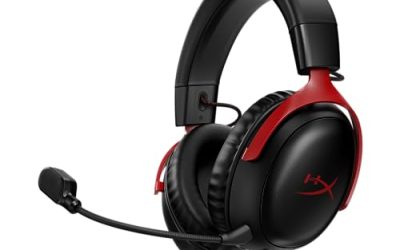
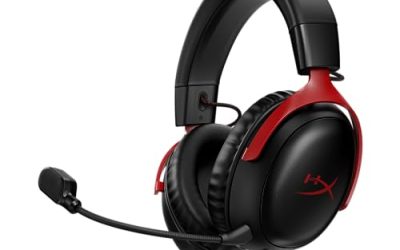
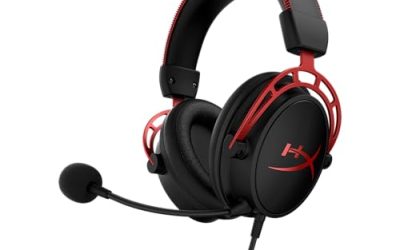
The Cloud Alpha Wireless is the endurance pick, famous for a battery rated up to 300 hours, which means weeks of play between charges. Its detachable microphone is a bidirectional noise-cancelling design in HyperX’s published specification, so the capsule favors your voice over sounds arriving from behind it, and an LED on the mic shows mute status.
Sound comes from HyperX’s 50 mm Dual Chamber Drivers, which tune mids and highs separately from the bass for clearer positional cues, with DTS Headphone:X spatial audio on PC. The frame is aluminum with memory foam ear cushions, and the 2.4 GHz USB dongle connects to PC and PlayStation. There is no Bluetooth and no AI software layer, so this is the pick for buyers who want the noise rejected by the hardware itself and almost never want to think about charging.
Specs
- Drivers: 50 mm HyperX Dual Chamber
- Wireless: 2.4 GHz via USB dongle
- Microphone: detachable bidirectional noise-cancelling, LED mute indicator
- Battery life: up to 300 hours
- Weight: 335 g
- Extras: DTS Headphone:X spatial audio, aluminum frame, memory foam cushions
- Compatibility: PC, PlayStation
- Tier: mid-range
SteelSeries Arctis Nova 1
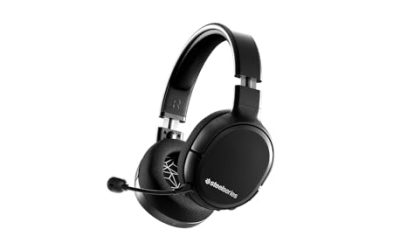
The Nova 1 brings the same microphone philosophy down to a wired budget tier. Its ClearCast Gen 2 microphone is a bidirectional noise-cancelling capsule, and on PC the Sonar app adds AI noise cancelling that strips keyboard clicks and room noise from your voice, a rare feature at this level. The mic retracts into the earcup for a clean profile between sessions.
Because it connects over a 3.5 mm cable, the Nova 1 works with almost everything: PC, PlayStation, Xbox controllers, Switch, and mobile, with no battery to manage. The 40 mm drivers support 360 degree spatial audio formats, the ComfortMAX system uses a four-point adjustable fit with AirWeave memory foam cushions, and at 236 grams it is the lightest headset here. For a shared desk, a dorm room, or a family PC, it is the simplest way to keep your chat clean.
Specs
- Drivers: 40 mm
- Wireless: none, 3.5 mm wired
- Microphone: retractable ClearCast Gen 2, AI noise cancelling via Sonar on PC
- Battery life: not applicable, wired
- Weight: 236 g
- Extras: ComfortMAX four-point fit, AirWeave memory foam cushions, on-ear controls
- Compatibility: PC, PlayStation, Xbox, Switch, mobile
- Tier: budget
How to Choose
Start by deciding where the noise has to die. AI filtering, found in the Delta II, the Maxwell, and the SteelSeries pair through Sonar, actively removes sounds like keyboard switches and fans from your voice. A bidirectional capsule, as on the Cloud Alpha Wireless, passively favors sound from the front of the mic and needs no software, but cannot erase a loud room as completely.
Next, check how the filtering is delivered. Hardware and headset-level processing, like Audeze’s FILTER chip and ASUS’s beamforming array, works on every platform including consoles. Software filtering through an app such as Sonar only runs on PC, so console-first players should weight the capsule design and any on-headset processing more heavily.
Then match the connection to your setup. Tri-mode headsets like the Delta II cover PC, console, and phone with one purchase, while the Cloud Alpha Wireless trades Bluetooth away for its huge battery. A retractable mic keeps a shared desk tidy; a detachable boom plus a built-in backup mic is the safer pattern if you take calls away from your desk. Finally, treat weight as a chat feature too: a headset you can wear for four hours keeps the mic positioned correctly far better than one you keep adjusting.
Who Should Skip
Skip this category if your room is already quiet and your current mic sounds clean; a noise cancelling microphone solves a problem you do not have, and the same budget buys better drivers elsewhere. Also skip it if what actually bothers you is hearing the room yourself. That is an ear-side problem, solved by headsets with active noise cancelling earcups or well-sealed closed-back designs, not by anything in this roundup.
Streamers who record locally should skip headset mics altogether and put the money toward a dedicated USB or XLR microphone, which will outperform every boom here. Console-only players should skip the SteelSeries picks if the AI mic filtering is the main attraction, because that layer runs through the PC app; the ASUS and Audeze headsets process noise on the headset itself. And if you mostly play single-player games with chat off, a detachable boom you never attach is money spent on a feature you will not use.
FAQ
Does a noise cancelling microphone block noise for me or for my teammates?
For your teammates. The microphone filters what it sends, so your voice chat carries less keyboard, fan, and room noise. It does not quiet the room in your ears; for that you need earcup active noise cancellation or a sealed design.
Is AI mic filtering better than a plain noise-cancelling capsule?
Usually, in louder rooms. A bidirectional capsule only favors sound from the front, while AI filtering actively identifies and removes steady noises like fans and key clicks. The trade-off is that the strongest AI tools here run through PC software or add cost at the premium tier.
Will these headsets work on PlayStation and Xbox?
Mostly, with caveats. The Maxwell for PlayStation, the Nova 5, and the Cloud Alpha Wireless connect to PlayStation over their dongles, and the wired Nova 1 plugs into any controller. The Delta II covers Xbox wired. Mic AI features that live in a PC app do not carry over to consoles.
Can I use the headset without the boom mic attached?
On the detachable models, yes. The Maxwell keeps a built-in secondary microphone for calls with the boom removed, and the Delta II falls back to its beamforming microphones. Retractable designs like the Nova 5 and Nova 1 simply slide the mic away, so it is always available when chat starts.
Final Verdict
For most PC gamers playing in a noisy room, the ASUS ROG Delta II is the buy: its beamforming microphones and AI noise reduction clean up your voice on any platform, and the detachable boom, tri-mode links, and 110-hour battery leave nothing obvious missing. The Maxwell is the premium sound pick with hardware-level FILTER processing, the Nova 5 serves PC players who want app-driven mic filtering at a mid-range tier, the Cloud Alpha Wireless pairs a hardware noise-cancelling mic with a 300-hour battery, and the Nova 1 proves the wired budget tier can keep chat just as clean.
Product and ASIN Reference
| Product | ASIN |
|---|---|
| ASUS ROG Delta II Wireless Gaming Headset (Black) | B0DGZY13L6 |
| Audeze Maxwell Wireless Gaming Headset for PlayStation | B0BP6BC17P |
| SteelSeries Arctis Nova 5 Wireless Gaming Headset | B0D2YBQQ1P |
| HyperX Cloud Alpha Wireless Gaming Headset | B09TRW57WB |
| SteelSeries Arctis Nova 1 Gaming Headset (Black) | B0B8Q4CR52 |