Action RPGs ask more of a monitor than most genres. A Souls-like parry window is a handful of frames, a boss arena in Elden Ring or Black Myth: Wukong swings from torchlit darkness to blinding spell effects in a second, and an unstable frame rate is the norm in the biggest open zones. The right display keeps input lag near zero, smooths out frame drops with variable refresh rate, and holds shadow detail in HDR instead of crushing caves into a black smear. This guide rounds up five monitors for action RPG play, from a 27-inch 4K OLED for high-end PCs to a Rapid IPS model for console performance modes.
As an Amazon Associate, we earn from qualifying purchases.
Quick Answer
For most action RPG players, the ASUS ROG Swift OLED PG27UCDM is the standout: a 26.5-inch 4K QD-OLED with a 240Hz refresh rate, 0.03ms response and full-bandwidth DisplayPort 2.1a for uncompromised PC play. On a tighter budget, the MSI MAG 274UPF delivers 4K, 144Hz and HDMI 2.1 for console performance modes, while ultrawide fans should look at the Samsung Odyssey OLED G8 G85SD.
Table of Contents
- What Action RPGs Need From a Monitor
- The 5 Best Gaming Monitors for Action RPGs
- How to Choose
- Who Should Skip These Monitors
- FAQ
- Final Verdict
What Action RPGs Need From a Monitor
Three things decide whether an action RPG feels right on a display. The first is responsiveness: dodge rolls, parries and perfect blocks are timed against enemy animations, so low input lag and fast pixel response matter more here than in a turn-based game — a smeary panel makes a fast boss feel unfair. The second is variable refresh rate: action RPGs rarely hold a locked frame rate in open areas, and VRR (FreeSync or G-Sync) removes the tearing and judder that appear when the frame rate dips mid-fight. The third is HDR contrast: these games live in dark places, and per-pixel light control keeps detail in the shadows while torches and magic still pop.
Console players should note one limit: the PS5 and Xbox Series X cap output at 120Hz, so HDMI 2.1 is the connection that matters on console.
The 5 Best Gaming Monitors for Action RPGs
1. ASUS ROG Swift OLED PG27UCDM — Best Overall

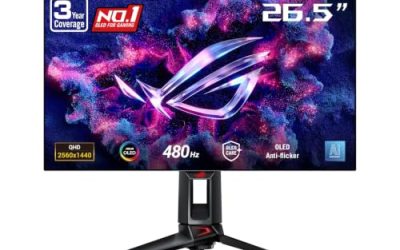
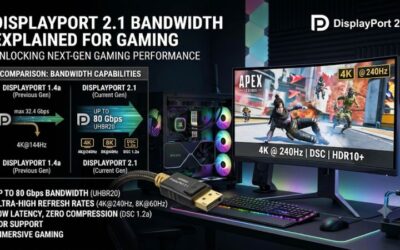
The PG27UCDM packs a fourth-generation QD-OLED panel into a 26.5-inch frame, giving it the highest pixel density on this list: 4K at this size renders texture detail, distant enemies and small HUD text with unusual sharpness. The 240Hz refresh rate and 0.03ms response keep boss movement clean, and DisplayPort 2.1a with full UHBR20 bandwidth carries 4K at 240Hz without compression — something DisplayPort 1.4 monitors cannot do. Near-instant response at any refresh rate also keeps VRR smooth when the frame rate wanders.
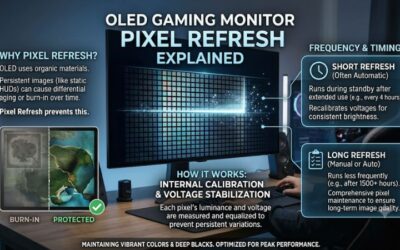
HDR is a strength, with per-pixel blacks for dungeons and a 1,000-nit peak for spell effects. ASUS adds OLED Care Pro, including a Neo Proximity Sensor that dims the screen when you step away, and the warranty runs three years with burn-in coverage.
Specs:
- Panel: 26.5-inch QD-OLED, anti-reflection
- Resolution: 3840 x 2160 (4K)
- Refresh rate: 240Hz
- Response time: 0.03ms (GtG)
- Color: 99 percent DCI-P3, true 10-bit
- HDR: DisplayHDR True Black 400, 1,000-nit peak
- Adaptive sync: G-Sync Compatible, FreeSync Premium Pro
- Ports: DisplayPort 2.1a UHBR20, HDMI 2.1, USB-C (90W)
- Extras: OLED Care Pro, Neo Proximity Sensor, 3-year warranty
2. MSI MPG 321CURX QD-OLED — Best 32-Inch Curved Pick
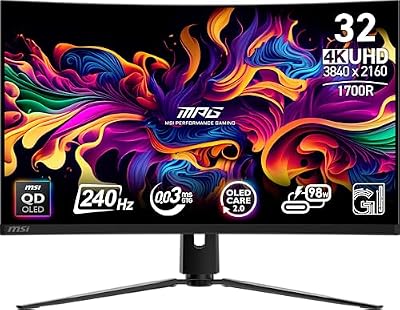
If 27 inches feels small for long sessions in big open worlds, the MPG 321CURX stretches the same 4K QD-OLED formula to 31.5 inches and wraps it in a gentle 1700R curve. Specs otherwise mirror the class leaders — 240Hz, 0.03ms response, DisplayHDR True Black 400 — so parry timing and shadow detail match the ASUS above. The larger screen helps when reading the environment in games like Monster Hunter Wilds, where a monster’s tells start at the edge of the arena.
Connectivity is console-friendly, with HDMI 2.1 for 4K at 120Hz from a PS5 or Xbox Series X, plus USB-C with 98W power delivery. One honest note: at 32 inches, 4K pixel density is lower than on the 27-inch pick, so text is slightly less crisp up close — a fair trade for immersion.
Specs:
- Panel: 31.5-inch QD-OLED, 1700R curved
- Resolution: 3840 x 2160 (4K)
- Refresh rate: 240Hz
- Response time: 0.03ms (GtG)
- Color: 99 percent DCI-P3
- HDR: DisplayHDR True Black 400
- Adaptive sync: Adaptive-Sync, G-Sync Compatible
- Ports: HDMI 2.1, DisplayPort 1.4a, USB-C (98W)
- Extras: OLED Care 2.0, KVM switch
3. ASUS ROG Strix OLED XG27AQDMG — Best 1440p Pick

Not every rig can drive 4K at high frame rates, and for mid-range GPUs 1440p is the smarter target: it is far easier to hold 120 frames per second and up in games like Lies of P. The XG27AQDMG uses a glossy WOLED panel — unusual among OLED monitors, most of which are matte — and the glossy finish gives colors and blacks extra depth in a light-controlled room. The 240Hz refresh rate and 0.03ms response match the 4K picks, so combat feels just as immediate.
The trade-offs are clear. Resolution tops out at 2560 x 1440, and the HDMI ports are 2.0 rather than 2.1, capping consoles at 1440p and 120Hz — enough for performance modes, but no 4K console output. The glossy screen also reflects more than a matte one in a bright room.
Specs:
- Panel: 26.5-inch WOLED, glossy
- Resolution: 2560 x 1440 (QHD)
- Refresh rate: 240Hz
- Response time: 0.03ms (GtG)
- Color: 99 percent DCI-P3
- HDR: HDR10, up to 1,000-nit peak
- Adaptive sync: G-Sync Compatible, FreeSync Premium
- Ports: DisplayPort 1.4, HDMI 2.0, USB hub
- Extras: Custom heatsink, OLED Anti-Flicker, 3-year warranty
4. Samsung Odyssey OLED G8 G85SD — Best Ultrawide

Action RPGs are cinematic games, and a 34-inch ultrawide is the most cinematic way to play them on PC. The G85SD pairs a QD-OLED panel with 3440 x 1440 resolution, an 1800R curve and a 175Hz refresh rate. The wider view shows more of a boss arena at once, which helps against large enemies attacking from the edge of a 16:9 frame. Per-pixel OLED contrast handles the genre’s dark art direction as it should, and FreeSync Premium Pro plus G-Sync compatibility keep VRR working on either GPU brand.
Two caveats. Ultrawide support varies by title — most modern action RPGs support 21:9, but a few lock to 16:9 with black bars, and cutscenes are often 16:9 even when gameplay is not. Consoles output 16:9 only, so this is a PC-first pick.
Specs:
- Panel: 34-inch QD-OLED, 1800R curved
- Resolution: 3440 x 1440 (Ultra WQHD, 21:9)
- Refresh rate: 175Hz
- Response time: 0.03ms (GtG)
- Color: 99 percent DCI-P3
- HDR: HDR10+ Gaming
- Adaptive sync: FreeSync Premium Pro, G-Sync Compatible
- Ports: HDMI 2.1 (x2), DisplayPort, USB hub
- Extras: Smart TV platform, Gaming Hub, 3-year warranty
5. MSI MAG 274UPF — Best Value for Console and PC

The MAG 274UPF is the one non-OLED pick, and it earns its place by covering the essentials at a mid-range tier: a 27-inch 4K Rapid IPS panel, 144Hz refresh rate, 1ms response, and two HDMI 2.1 ports that accept a 4K 120Hz signal from either console. FreeSync Premium with G-Sync compatibility smooths out frame-rate dips, and there is no burn-in to manage with static HUDs.
What you give up is contrast. An IPS panel cannot switch pixels fully off, so DisplayHDR 400 here is a spec-sheet entry rather than a visual event, and dark dungeons look gray next to any OLED on this list. If you play in a bright room or split time with desktop work, that trade is often worth it; if HDR atmosphere is the point, save for an OLED.
Specs:
- Panel: 27-inch Rapid IPS, flat
- Resolution: 3840 x 2160 (4K)
- Refresh rate: 144Hz
- Response time: 1ms (GtG)
- Color: Wide color gamut
- HDR: VESA DisplayHDR 400
- Adaptive sync: FreeSync Premium, G-Sync Compatible
- Ports: HDMI 2.1 (x2), DisplayPort 1.4a, USB-C
- Extras: Full ergonomic stand, KVM switch, console mode
How to Choose
Start with your platform. On PS5 or Xbox Series X, HDMI 2.1 and a 120Hz-or-higher panel are the whole game — every pick here except the XG27AQDMG takes a full 4K 120Hz console signal, and the Strix takes 1440p at 120Hz. On PC, match the panel to your GPU: 4K at 240Hz needs a flagship card, while 1440p at 240Hz suits mid-range builds.
Prioritize VRR and response over raw hertz. Action RPGs fluctuate, so a wide adaptive-sync range matters more than a headline refresh number. OLED’s near-instant response also holds up at 60Hz in a way LCD response does not, keeping OLED picks consistent in quality and performance modes alike.
Think about HDR honestly. If you play story-driven action RPGs for atmosphere, OLED contrast is the biggest upgrade on this page. If your room is bright or you do not want panel-care routines, the IPS pick is the pragmatic choice.
Check the size against your desk. A 32-inch or ultrawide panel needs viewing distance; a 27-inch panel suits a standard desk and keeps the whole HUD in view during fights.
Who Should Skip These Monitors
Skip this list if you play mostly competitive shooters or MOBAs — those genres reward smaller 24.5-inch esports panels with even higher refresh rates, covered in sibling guides on this site. Skip the ultrawide if you play mainly on console, since consoles cannot fill a 21:9 screen. Skip the OLEDs if your setup doubles as an all-day work monitor with static windows. And if your GPU is several generations old, even the 1440p pick will outrun it in new releases — upgrade the graphics card first.
FAQ
Do action RPGs need a 240Hz monitor?
No. Most action RPGs on console run at 30, 60 or 120 frames per second, and many PC players cap demanding titles near 120 as well. A 240Hz panel still helps on PC — OLED response stays near-instant across the VRR range — but a good 144Hz or 175Hz monitor covers the genre comfortably.
Is OLED burn-in a real risk with RPG HUDs?
It is a manageable one. Health bars and minimaps are static elements, and over thousands of hours they can leave marks on any OLED. Every OLED pick here includes care features such as pixel refresh, logo dimming or a proximity sensor, and the ASUS and Samsung models carry three-year warranties.
What is the best monitor size for action RPGs?
For most desks, 27 inches at 4K or 1440p is the sweet spot: the full HUD stays in view during boss fights and pixel density stays high. A 32-inch panel suits players who sit farther back, and a 34-inch ultrawide suits PC players who value atmosphere over console compatibility.
Can the PS5 and Xbox Series X use these monitors fully?
Partly. Both consoles cap output at 120Hz, so they cannot use the full 240Hz of the top picks, and they output 16:9 only, which rules out filling the ultrawide. With HDMI 2.1 they do get 4K at 120Hz, VRR and HDR from the PG27UCDM, MPG 321CURX, G85SD and MAG 274UPF — everything their performance modes need.
Final Verdict
The ASUS ROG Swift OLED PG27UCDM is the complete package for action RPGs on a high-end PC: dense 4K detail, 240Hz speed, true HDR contrast and DisplayPort 2.1a headroom. The MSI MPG 321CURX brings the same experience to a larger curved screen, the ASUS XG27AQDMG is the smart buy for 1440p rigs, and the Samsung G85SD is the ultrawide for maximum atmosphere. If burn-in worries or budget point you away from OLED, the MSI MAG 274UPF covers the essentials without fuss.
Product and ASIN Reference
| Product | ASIN |
|---|---|
| ASUS ROG Swift OLED PG27UCDM | B0DM6SHQTN |
| MSI MPG 321CURX QD-OLED | B0DPXZ6X7Q |
| ASUS ROG Strix OLED XG27AQDMG | B0CZWM44QP |
| Samsung Odyssey OLED G8 G85SD | B0DB9L4KJZ |
| MSI MAG 274UPF | B0CJKPM3PB |