Open world games ask different things of a monitor than competitive shooters do. Exploration titles live on sweeping vistas, dynamic weather, day and night cycles and dense detail at every distance, so screen size, resolution, HDR contrast and color range matter more than extreme refresh rates. Sessions run long, which makes a comfortable curve, an adjustable stand and good dark-scene performance worth as much as any headline specification.
This roundup picks five monitors built for that style of play: a 57-inch dual 4K super ultrawide flagship, a 49-inch OLED super ultrawide, a 39-inch OLED ultrawide, a 43-inch 4K Mini-LED panel that doubles as a smart TV, and a 32-inch 4K OLED for smaller desks. Every pick runs at 144Hz or higher with adaptive sync, so traversal stays smooth in busy cities.
As an Amazon Associate, we earn from qualifying purchases.
Quick Answer
Open world games reward immersion: big screens, high resolution, strong HDR and wide color. Samsung’s Odyssey Neo G9 57-inch fills your field of view with dual 4K detail, the Odyssey OLED G9 G93SC trades width for OLED blacks, and the LG 39GS95QE-B wraps a 39-inch OLED around you. The Neo G7 43-inch is the mid-range big-screen pick, and the MSI MAG 321UPX brings 4K OLED to a smaller desk.
Table of Contents
- Samsung Odyssey Neo G9 57-Inch (G95NC)
- Samsung Odyssey OLED G9 G93SC
- LG UltraGear 39GS95QE-B
- Samsung Odyssey Neo G7 43-Inch
- MSI MAG 321UPX QD-OLED
- How to Choose
- Who Should Skip
- FAQ
- Final Verdict
Samsung Odyssey Neo G9 57-Inch (G95NC)

The Samsung Odyssey Neo G9 57-inch is the flagship pick and the most immersive monitor in this roundup. Its 57-inch Quantum Mini-LED panel runs a dual UHD resolution of 7680 x 2160, effectively two 4K screens fused into one 32:9 canvas with no bezel down the middle. For open world games that means a horizon that wraps into your peripheral vision, with distant terrain rendered at full 4K sharpness on each half.
The 1000R curve matches the shape of human peripheral vision, and Quantum Matrix local dimming with DisplayHDR 1000 gives sunsets, torchlit caves and neon cities real punch. A 240Hz refresh rate and DisplayPort 2.1 input are fitted, although driving the full resolution at high refresh takes a powerful graphics card; most players will lean on upscaling. This premium-tier display needs the GPU and the desk space to match.
Specs
- Screen size: 57 inches, VA Quantum Mini-LED panel, 1000R curve
- Resolution: 7680 x 2160 dual UHD (32:9)
- Refresh rate: 240Hz
- Response time: 1ms gray-to-gray
- Adaptive sync: AMD FreeSync Premium Pro
- HDR and color: DisplayHDR 1000, Quantum Matrix local dimming
- Ports: DisplayPort 2.1, HDMI 2.1, USB hub
- Extras: CoreSync rear lighting, height and tilt adjustable stand
Samsung Odyssey OLED G9 G93SC

The Samsung Odyssey OLED G9 G93SC swaps Mini-LED for a 49-inch QD-OLED panel, and for open world games the trade is about contrast. Per-pixel lighting means night skies, shadowed forests and underground ruins go truly black instead of dark gray, while neon signage and magic effects glow against them. The 5120 x 1440 dual QHD resolution across a 32:9 aspect ratio still gives a wide, cinematic field of view.
The 1800R curve is gentler than the Neo G9’s, which some players find more natural for mixed use. Motion is excellent at 240Hz with a 0.03ms response time, and the G93SC skips the smart TV platform of its G95SC sibling, so it behaves purely as a monitor. The honest cautions are OLED ones: static HUD elements shown for hundreds of hours carry a burn-in risk, and full-screen brightness is lower than the Mini-LED flagship.
Specs
- Screen size: 49 inches, QD-OLED panel, 1800R curve
- Resolution: 5120 x 1440 dual QHD (32:9)
- Refresh rate: 240Hz
- Response time: 0.03ms gray-to-gray
- Adaptive sync: AMD FreeSync Premium Pro, NVIDIA G-Sync Compatible
- HDR and color: DisplayHDR True Black 400
- Ports: HDMI 2.1, DisplayPort, USB hub
- Extras: height and tilt adjustable stand, Core Lighting rear LEDs
LG UltraGear 39GS95QE-B

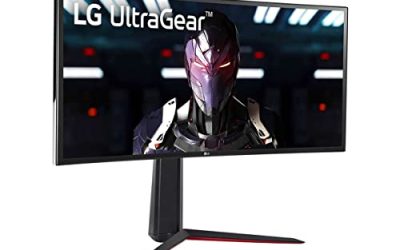
The LG UltraGear 39GS95QE-B is the ultrawide sweet spot in this roundup. Its 39-inch WOLED panel keeps the 3440 x 1440 resolution of a 34-inch ultrawide but stretches it over a larger screen with an aggressive 800R curve, so the world fills more of your vision and the display edges stay at a more even distance from your eyes. For exploration games, that wrap is the main event.
Performance is flagship grade: 240Hz, a 0.03ms response time, DisplayHDR True Black 400 and both FreeSync Premium Pro and G-Sync Compatible support. HDMI 2.1 ports also make it a strong console display. The trade-off is pixel density of roughly 96 pixels per inch, so fine text is less crisp than on a 4K screen; in games the effect is minor, but it matters if you also work at the same desk.
Specs
- Screen size: 39 inches, WOLED panel, 800R curve
- Resolution: 3440 x 1440 (21:9)
- Refresh rate: 240Hz
- Response time: 0.03ms gray-to-gray
- Adaptive sync: AMD FreeSync Premium Pro, NVIDIA G-Sync Compatible
- HDR and color: DisplayHDR True Black 400, DCI-P3 98.5 percent
- Ports: 2 x HDMI 2.1, DisplayPort, USB hub
- Extras: tilt, height and swivel adjustable stand
Samsung Odyssey Neo G7 43-Inch

The Samsung Odyssey Neo G7 43-inch is the mid-range big-screen pick, built like a small TV that happens to be an excellent gaming monitor. The flat 43-inch Quantum Mini-LED panel runs full 4K at 144Hz, so open world landscapes stay sharp whether you sit at a desk or lean back with a controller. Quantum Matrix local dimming and DisplayHDR 600 give it HDR contrast that most 4K monitors in its tier cannot match.
Its smart TV platform and Gaming Hub stream cloud games and video apps without a PC attached, and built-in speakers mean one less peripheral on the desk. The honest trade-offs: a flat panel this large shows some viewing-angle shift at the far edges when you sit close, and 144Hz is plenty for exploration games but not aimed at esports. For players who want one big 4K screen for PC, console and streaming, it covers all three.
Specs
- Screen size: 43 inches, VA Quantum Mini-LED panel, flat
- Resolution: 3840 x 2160 4K UHD (16:9)
- Refresh rate: 144Hz
- Response time: 1ms
- Adaptive sync: AMD FreeSync Premium Pro
- HDR and color: DisplayHDR 600, Quantum Matrix local dimming
- Ports: HDMI 2.1, DisplayPort, USB hub
- Extras: smart TV platform with Gaming Hub, built-in speakers, remote included
MSI MAG 321UPX QD-OLED

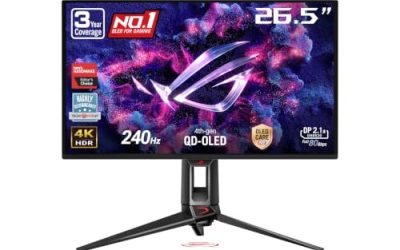
The MSI MAG 321UPX QD-OLED is the pick for players who want 4K OLED immersion on a normal-sized desk. Its 31.5-inch flat QD-OLED panel pairs 3840 x 2160 resolution with perfect per-pixel contrast, so open world detail stays crisp in the center of the screen, and dark scenes keep the depth that LCD panels wash out. Text and HUD elements are sharper here than on any ultrawide in this roundup.
It is also the fastest 16:9 pick: 240Hz with a 0.03ms response time and HDMI 2.1 console support, so it doubles as an esports-capable display when you switch genres. MSI’s OLED Care 2.0 features help manage burn-in risk from static game interfaces, and the stand adjusts for height, tilt, swivel and pivot. It gives up the wrap-around width of the ultrawides, which is the price of fitting a standard desk.
Specs
- Screen size: 31.5 inches, QD-OLED panel, flat
- Resolution: 3840 x 2160 4K UHD (16:9)
- Refresh rate: 240Hz
- Response time: 0.03ms gray-to-gray
- Adaptive sync: AMD FreeSync Premium, Adaptive-Sync
- HDR and color: DisplayHDR True Black 400, DCI-P3 99 percent
- Ports: 2 x HDMI 2.1, DisplayPort 1.4a, USB-C with 15W power delivery
- Extras: OLED Care 2.0, height, tilt, swivel and pivot adjustable stand
How to Choose
Start with aspect ratio. Super ultrawide 32:9 panels like the two Odyssey G9 models deliver the strongest sense of place in open world games, but check that your favorite titles support the resolution properly; some games pillarbox cutscenes or stretch the interface. A 21:9 ultrawide such as the LG 39GS95QE-B has the widest game support of the wide formats. A 16:9 4K screen is the safe universal choice and the sharpest for text.
Next, match the panel to your room and play style. OLED gives the best dark-scene contrast for night exploration and story-driven games, with a small burn-in risk from static HUD elements over very long play. Mini-LED gets much brighter, which suits sunlit rooms and HDR highlights, and carries no burn-in concern. Then check your graphics card: dual 4K and 5120 x 1440 are demanding resolutions, and upscaling features do heavy lifting in these titles. Finally, measure your desk. The 57-inch and 49-inch panels are close to 1.2 meters wide and need a deep desk or a heavy-duty monitor arm.
Who Should Skip
Skip the super ultrawides if your favorite open world games lack proper ultrawide support, or if your graphics card already struggles at 1440p; a wider, denser screen will only lower frame rates further. Skip the OLED picks if you play one title with a bright static HUD for thousands of hours and never vary your content, or if your room is very bright and you play mostly in daylight. Skip the 43-inch Neo G7 if you sit close at a shallow desk. Competitive players who only dip into open world games occasionally should keep their esports monitor and skip this category entirely.
FAQ
Do all open world games support 32:9 and 21:9 resolutions?
Most modern PC releases support 21:9 well, and many support 32:9, but support is never guaranteed. Some titles limit cutscenes to 16:9, and a few lock the field of view. Check your main games before choosing a super ultrawide, and expect to use community fixes occasionally on older releases.
Is OLED burn-in a real risk with game HUDs?
The risk is real but manageable. Modern QD-OLED and WOLED panels include pixel refresh cycles, panel shift and logo dimming, and monitors like the MSI MAG 321UPX add dedicated care features. Varying your content, hiding static interface elements when the game allows it, and letting the panel run its refresh cycles keeps the risk low for typical mixed use.
What graphics card do I need for the 57-inch Neo G9?
Its 7680 x 2160 resolution packs far more pixels than a single 4K screen, so even flagship cards rely on DLSS or FSR upscaling in demanding games. A high-end card is the realistic minimum, and full 240Hz at native resolution needs a DisplayPort 2.1 connection that only some current cards provide.
Is 144Hz enough for open world games?
Yes. Open world titles are usually GPU-bound at high resolutions and rarely sustain frame rates near 144, let alone 240. A 144Hz panel with adaptive sync, like the Neo G7 43-inch, covers the range these games actually run in. Higher refresh rates still help if you split time with faster-paced genres on the same screen.
Final Verdict
For maximum immersion and a flagship budget, the Samsung Odyssey Neo G9 57-inch stands alone: dual 4K width, bright Mini-LED HDR and no burn-in worries. If perfect blacks matter more than sheer width, the Odyssey OLED G9 G93SC is the premium alternative, while the LG UltraGear 39GS95QE-B is the best-balanced ultrawide for most desks. The Neo G7 43-inch is the mid-range pick that doubles as a smart TV, and the MSI MAG 321UPX QD-OLED brings 4K OLED quality to a standard desk. Choose by desk size and graphics card strength first; every monitor here makes an open world look better than a basic gaming display.
Product and ASIN Reference
| Product | ASIN |
|---|---|
| Samsung Odyssey Neo G9 57-Inch (G95NC) | B0CDQM55C9 |
| Samsung Odyssey OLED G9 G93SC | B0CDQMQQS2 |
| LG UltraGear 39GS95QE-B | B0CV1VL18C |
| Samsung Odyssey Neo G7 43-Inch | B0BW1VM62Y |
| MSI MAG 321UPX QD-OLED | B0CWPWRFGX |