🛒 Best Price Today on Amazon
Prime members get fast, free shipping on everything above, plus member-only deals. New members get a 30-day free trial — cancel anytime.
For most 1440p buyers, the RX 7800 XT is the better value, while the RTX 4070 Ti Super is the stronger choice for ray tracing, 4K, DLSS, creative software, and lower-risk long-term performance.
Quick answer: Our top pick in 2026 is the GPU architecture — our #1 rated choice. See the full ranked comparison, alternatives and buying advice below.
RTX 4070 Ti Super vs RX 7800 XT: Quick Verdict
The two GPUs share 16GB of VRAM and a 256-bit memory bus, but they target different priorities. The RX 7800 XT usually costs substantially less and delivers excellent traditional rasterized performance at 1440p. The RTX 4070 Ti Super is faster overall, particularly at 4K and with ray tracing enabled, and Nvidia’s DLSS ecosystem can make a larger difference than the raw specifications suggest.
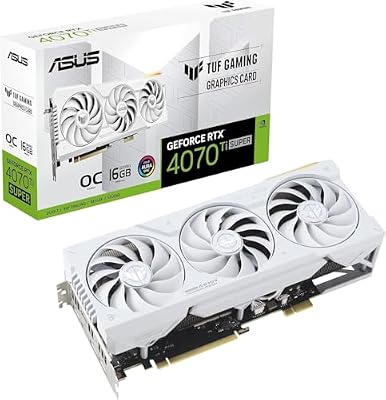
ASUS TUF Gaming GeForce RTX™ 4070 Ti Super BTF White OC Edition Gaming Graphics Card (PCIe 4.0, 16GB GDDR6X, Exclusive to BTF ATX Motherboards
Included for 'RTX 4070 Ti Super vs RX 7800 XT: Which GPU to Buy?' because the listing specifies 16GB GDDR6X and Exclusive to BTF ATX Motherboards, details this guide uses to compare options.
View on Amazon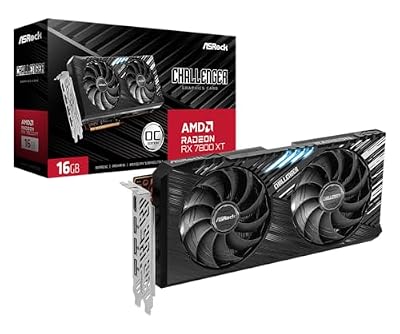
ASRock Radeon RX 7800 XT Challenger 16GB OC Graphics Card, RDNA 3, 2475MHz Boost, 16GB GDDR6 256-bit, PCIe 4.0, Dual Fans, 0dB Silent, LED Indicator
Included for 'RTX 4070 Ti Super vs RX 7800 XT: Which GPU to Buy?' because the listing specifies RDNA 3 and 2475MHz Boost, details this guide uses to compare options.
View on Amazon| Specification | GeForce RTX 4070 Ti Super | Radeon RX 7800 XT |
|---|---|---|
| GPU architecture | Ada Lovelace | RDNA 3 |
| VRAM | 16GB GDDR6X | 16GB GDDR6 |
| Memory bus | 256-bit | 256-bit |
| Memory bandwidth | 672GB/s | 624GB/s |
| Typical board power | 285W | 263W |
| Upscaling and frame generation | DLSS Super Resolution and Frame Generation | FSR and frame-generation support in compatible games |
| Video encoding | AV1 encode and decode | AV1 encode and decode |
| Display support | DisplayPort 1.4a and HDMI 2.1a | DisplayPort 2.1 and HDMI 2.1 |
Price and Value in 2026
Market pricing varies by cooler design, retailer discounts, and remaining stock, but the RX 7800 XT commonly sits around $450–$600. The RTX 4070 Ti Super is more often found around $700–$850. That gap can exceed $200, which is too large to ignore if you mainly play conventional rasterized games at 1440p.
At equal prices, the RTX 4070 Ti Super is the obvious performance choice. At typical market prices, the RX 7800 XT can deliver more frames per dollar, while the Nvidia card justifies its premium through ray tracing, DLSS, CUDA-related software support, and stronger 4K headroom.
1440p Gaming: Which Card Wins?
Both GPUs are well suited to 1440p, including high-refresh gaming. In games without ray tracing, published reviews commonly place the RTX 4070 Ti Super ahead by roughly 15–25%, although the difference changes with the game, processor, settings, and driver or patch version. The RX 7800 XT remains fast enough for high or ultra settings in most current 1440p releases.
For a 1440p monitor running at 144Hz or 165Hz, the RX 7800 XT is often the sensible purchase when the goal is maximum value. Competitive games such as Counter-Strike 2, Valorant, Fortnite, and similar titles may become CPU-limited before either GPU reaches its full potential, so spending more on the graphics card may not improve the experience proportionally.
The RTX 4070 Ti Super becomes more attractive at 1440p when you use demanding effects such as full ray-traced lighting, high-quality reflections, or path tracing. It also offers more room for demanding future games without immediately relying on aggressive image-quality compromises.
Practical 1440p settings
- RX 7800 XT: Start with native resolution, high settings, and ray tracing off. If a game dips below the monitor’s refresh target, use FSR Quality before lowering textures; the card’s 16GB VRAM can usually handle high-resolution texture packs.
- RTX 4070 Ti Super: Use DLSS Quality for demanding games and enable Frame Generation only after the native or upscaled base frame rate is reasonably smooth. For a 60Hz or 75Hz display, native or Quality-mode rendering often looks better than chasing very high generated-frame counts.
4K Gaming: The Extra GPU Power Matters
At 4K, the RTX 4070 Ti Super’s additional shader performance and memory bandwidth become more useful. In rasterized games, published results typically show it ahead of the RX 7800 XT by approximately 20–35%, with wider gaps in particularly demanding titles. Neither card is a guaranteed ultra-settings, 4K ray-tracing solution for every new release, but the Nvidia model is the more comfortable option.
The RX 7800 XT can still be a capable 4K card if you choose high rather than ultra settings and use FSR Quality or Balanced when necessary. Its 16GB VRAM is valuable here: reducing texture quality should not be your first adjustment unless a specific game has unusually heavy memory use.
For 4K, the RTX 4070 Ti Super’s DLSS support can be decisive. DLSS Quality renders internally below 4K and reconstructs the image, often preserving more detail than simply lowering a conventional resolution scale. Frame Generation can increase displayed smoothness, but it does not replace the responsiveness provided by a strong base frame rate.
Ray Tracing and Upscaling
Ray tracing is the clearest technical advantage for the RTX 4070 Ti Super. Its dedicated RT hardware and Nvidia’s broader software support generally provide higher performance in ray-traced games than the RX 7800 XT. The difference is especially important in titles with heavy global illumination or path tracing.
DLSS is also available in more games than competing vendor-specific reconstruction technologies, although support changes over time and many games offer multiple options. FSR remains useful and is not limited to Radeon hardware, but image quality and frame-generation behavior vary considerably by implementation.
If you primarily play games such as Cyberpunk 2077, Alan Wake 2, Portal with RTX, or other ray-tracing-heavy releases, choose the RTX 4070 Ti Super unless the RX 7800 XT is dramatically cheaper and you are comfortable disabling or reducing those effects.
VRAM, Memory, and Longevity
Both cards have 16GB of VRAM, so neither has a capacity advantage. That is a meaningful strength for both GPUs at 1440p and a reasonable foundation for 4K. Heavy texture packs, mods, ray tracing buffers, and future games can still exceed 16GB in unusual cases, but lowering textures is normally a more effective fix than replacing the GPU immediately.
The RTX 4070 Ti Super uses faster GDDR6X memory and has 672GB/s of theoretical bandwidth, compared with 624GB/s for the RX 7800 XT. These figures do not translate directly into a fixed percentage of extra FPS because cache design, shader workloads, and game engines also matter.
Power, Cooling, and System Compatibility
The official board-power figures are close: 285W for the RTX 4070 Ti Super and 263W for the RX 7800 XT. Actual gaming consumption varies by model and workload, but neither is a low-power graphics card.
A quality 650W power supply is often adequate for a typical system using either card, while a 750W unit provides more margin for a high-end processor, factory-overclocked model, multiple drives, or future upgrades. Check the exact card’s connector requirements: RTX 4070 Ti Super models commonly use a 12VHPWR or newer 12V-2×6 connection, sometimes with an adapter, whereas RX 7800 XT cards generally use two conventional 8-pin PCIe connectors.
For a quick power-budget estimate, assume a 120W gaming CPU, 285W GPU, 60W for the motherboard, memory, storage, and fans, and a 20% reserve:
(120 + 285 + 60) × 1.20 = 558W.
That calculation explains why a good 650W supply can work for a standard RTX 4070 Ti Super system, while a 750W supply is preferable when the CPU or graphics card is more power-hungry. Power-supply quality and the correct cable connection matter more than choosing the smallest possible wattage.
Decision Matrix
| Your situation | Better choice | Reason |
|---|---|---|
| 1440p gaming with ray tracing disabled | RX 7800 XT | Usually much better value and still excellent performance |
| 4K gaming with high settings | RTX 4070 Ti Super | More performance headroom and stronger upscaling support |
| Ray tracing or path tracing is important | RTX 4070 Ti Super | Better RT performance and DLSS support |
| Price-sensitive upgrade from an older mid-range GPU | RX 7800 XT | More of the budget goes toward raw gaming performance |
| Streaming, CUDA applications, or creator software | RTX 4070 Ti Super | Broader Nvidia software and encoder support in many workflows |
| Long-term 1440p ownership with 16GB required | Either | Both provide the same VRAM capacity; features and price decide |
Which GPU Should You Buy?
Buy the RX 7800 XT if your priority is affordable 1440p performance, you mainly play rasterized games, and the card is at least $200 cheaper than the RTX 4070 Ti Super. It is also a strong match for a 1440p 144Hz monitor and a mid-range gaming system.
Buy the RTX 4070 Ti Super if you want the faster overall GPU, regularly play at 4K, care about ray tracing, use DLSS-supported games, or need Nvidia’s software and encoding advantages. Its higher purchase price is easier to justify when you will keep the card for several years or use a 4K display.
The short version of the RTX 4070 Ti Super vs RX 7800 XT decision is simple: choose Radeon for value-first 1440p gaming, and choose GeForce for ray tracing, 4K headroom, and feature breadth. Check the current price difference before buying; a discount can quickly change which card offers the better deal.
Ready to decide? Our #1 pick for 2026 is the GPU architecture.
Live price & availability on Amazon.