🛒 Best Price Today on Amazon
Prime members get fast, free shipping on everything above, plus member-only deals. New members get a 30-day free trial — cancel anytime.
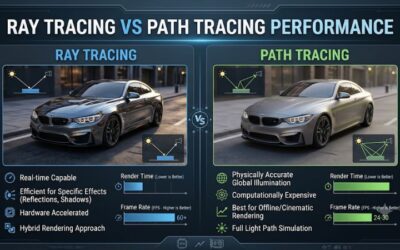
Hardware and software ray tracing both simulate how light interacts with objects, but they use different methods to represent and process a scene. hardware ray tracing vs software ray tracing matters when choosing GPU settings, especially in Unreal Engine 5 games where reflections, lighting quality, hardware compatibility, and frame rates can differ considerably.
Hardware Ray Tracing vs Software Ray Tracing: Key Differences
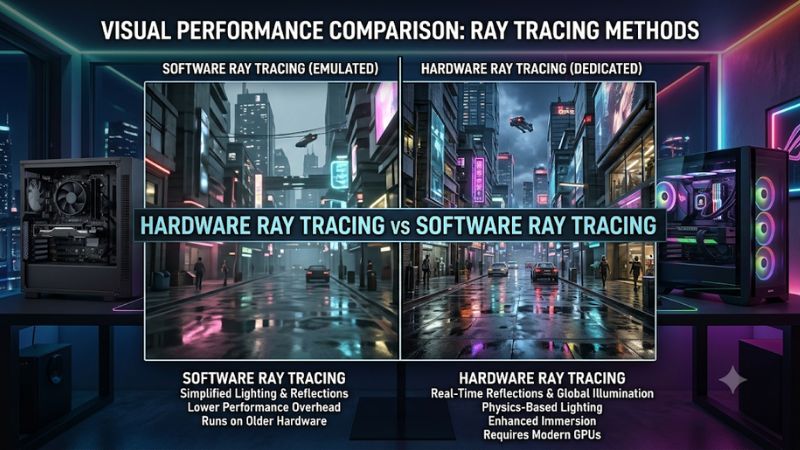
The main difference is how a game traces rays through its environment. Hardware ray tracing uses dedicated GPU acceleration to process ray intersections, while software ray tracing relies on alternative representations of scene geometry and general-purpose processing. However, the exact distinction depends on the graphics engine, so the two approaches should not be treated as identical across every game.
1. How Hardware Ray Tracing Works
Hardware ray tracing uses specialized GPU components to accelerate calculations involved in tracing rays through a 3D scene. NVIDIA calls its dedicated components RT Cores, while AMD and Intel also provide hardware acceleration for supported ray-tracing workloads on their graphics architectures.
These components accelerate operations such as bounding volume hierarchy (BVH) traversal and ray-triangle intersection. Instead of relying entirely on general shader resources, the GPU can dedicate specialized hardware to important parts of the ray-tracing process. This makes complex reflections, shadows, and lighting effects more practical in real-time games.
2. How Software Ray Tracing Works
Software ray tracing performs ray-tracing calculations without depending on dedicated ray-tracing cores. Depending on the implementation, calculations can run on conventional GPU shader cores or use simplified scene representations, such as signed distance fields. This allows ray-traced effects to work across a broader range of graphics hardware.
Unreal Engine 5 provides a useful example through Lumen. Its software ray-tracing mode uses Mesh Distance Fields to approximate scene geometry. This approach is less demanding in certain scenes, but it cannot represent every geometric detail as accurately as tracing the actual triangles.
NVIDIA Blog+1
3. Why the Two Methods Produce Different Results
Hardware acceleration can improve geometric accuracy because the renderer can trace rays against actual triangles rather than relying exclusively on simplified representations. This matters for detailed reflections, animated characters, and objects with complex shapes. The difference becomes particularly visible on mirrors and highly reflective surfaces.
Software methods can produce convincing lighting without requiring dedicated ray-tracing hardware. However, approximations may introduce missing details, inaccurate reflections, or limitations around certain materials and geometry. These differences depend on the engine’s implementation rather than simply whether a GPU supports ray tracing.
Epic Developer Community+1
4. Which Method Is Better for Gaming Performance?
Hardware ray tracing is not automatically faster in every situation. Dedicated acceleration can reduce the cost of intersection calculations, but scene updates, shader complexity, denoising, and the number of rays still affect performance. High-quality hit lighting, for example, can significantly increase GPU workload even when hardware acceleration is available.
Software ray tracing can sometimes deliver better performance in particular scenes. AMD GPUOpen’s Unreal Engine optimization guidance recommends software Lumen for many scenarios, reporting a substantial performance difference in its own Radeon RX 7900 XTX measurements. That finding applies to its specific engine workloads, not every game or GPU.
Epic Developer Community+1
Hardware Ray Tracing vs Software Ray Tracing: Performance and Compatibility
Choosing between these approaches requires more than comparing visual quality. The graphics engine, GPU architecture, game implementation, and rendering settings all influence the outcome. Unreal Engine’s Lumen documentation illustrates why: software tracing can be more efficient in scenes with many overlapping instances, while hardware tracing supports more accurate geometry and higher-quality mirror reflections.
1. Image Quality and Visual Detail
Hardware ray tracing generally has an advantage when a game needs accurate reflections of detailed geometry. Because it can intersect rays with actual triangles, it can represent objects and animated characters that simplified distance-field representations may not capture correctly. This is particularly useful in scenes containing mirrors, reflective surfaces, and complicated character models.
Software ray tracing remains useful for global illumination and reflections where approximate geometry is sufficient. Lumen combines screen traces with other tracing methods to improve visual consistency. Consequently, comparing screenshots without controlling screen traces and lighting settings can produce misleading conclusions.
Epic Developer Community+1
2. GPU Requirements and Compatibility
Hardware ray tracing requires a supported graphics card, compatible drivers, and a rendering API or engine implementation that exposes the necessary capabilities. NVIDIA GeForce RTX, AMD Radeon RX, and Intel Arc graphics families include hardware ray-tracing support, although their performance and feature support vary by generation and model.
Software ray tracing can operate on a wider range of hardware because it does not inherently require dedicated RT acceleration. Nevertheless, that does not mean every older GPU can run every ray-traced game. The game engine, graphics API, available memory, shader performance, and minimum system requirements still determine compatibility.
3. Direct Performance and Resource Trade-Offs
The difference between hardware and software approaches is not a universal FPS multiplier. Hardware acceleration can reduce the computational cost of tracing against complex geometry, but it does not remove the workload associated with lighting, material evaluation, scene updates, and denoising.
Software tracing can be competitive when an engine uses efficient distance fields and the scene contains geometry that benefits from approximation. AMD GPUOpen specifically highlights this trade-off in its Unreal Engine guidance. Therefore, GPU owners should compare actual in-game performance instead of assuming that hardware tracing always wins.
Epic Developer Community+2
4. Which Games Benefit Most?
Games featuring reflective environments, detailed character models, and complex lighting can benefit significantly from hardware ray tracing. Full ray-traced effects may improve reflections, shadows, and global illumination, although the visual improvement depends on how extensively developers implement them.
Software ray tracing is useful in games built around Lumen, especially when developers prioritize broad hardware compatibility and performance. The best choice depends on the scene. A large environment with many overlapping objects may favor software tracing, while a mirror-heavy interior may benefit more from hardware acceleration.
Epic Developer Community+1
Hardware vs Software Ray Tracing Comparison Table
| Comparison Factor | Hardware Ray Tracing | Software Ray Tracing |
| Processing method | Dedicated GPU acceleration | General GPU processing or software geometry representations |
| Geometry | Can trace actual triangles | May use simplified representations |
| Reflections | Supports detailed geometric reflections | May have geometric and reflection limitations |
| Global illumination | Supports detailed ray-based lighting | Can approximate indirect lighting |
| GPU requirements | Requires supported hardware | Does not inherently require dedicated RT cores |
| Compatibility | Depends on hardware and API support | Generally supports a broader hardware range |
| Performance | Often advantageous for complex ray workloads | Can be faster in suitable scenes |
| Best application | Detailed reflections and complex geometry | Efficient lighting and broader compatibility |
Important: These are general implementation differences, not guaranteed results for every game. Unreal Engine Lumen, for example, combines multiple tracing methods rather than relying on one universal rendering technique.
Frequently Asked Questions
1. Is Hardware Ray Tracing Always Better Than Software Ray Tracing?
No, hardware ray tracing is not always the better choice. It can produce more accurate reflections and handle complex geometry, but its performance depends on the GPU, game engine, and scene complexity. Software tracing can be more efficient in specific environments, particularly when simplified geometry provides sufficient visual quality.
2. Can You Use Software Ray Tracing Without an RTX GPU?
Yes, software ray tracing does not inherently require an NVIDIA RTX graphics card. Some engines support software-based tracing through conventional GPU resources or simplified geometry representations. However, individual games may still impose graphics API, driver, GPU, and operating-system requirements that exclude older hardware.
3. Does Hardware Ray Tracing Reduce FPS?
Yes, enabling hardware ray-traced effects can reduce FPS because the GPU must perform additional lighting, reflection, and intersection calculations. Dedicated acceleration helps manage this workload but does not make it free. Lowering ray-tracing quality, reducing resolution, or using supported upscaling technology can help maintain playable frame rates.
4. Should You Enable Hardware Ray Tracing in Unreal Engine 5?
Enable it when your GPU supports the feature and the game or project benefits from more accurate geometry and reflections. For Lumen, compare hardware and software modes using the same scene and graphics settings. If the visual improvement is small but performance drops noticeably, software tracing may be the more practical option.
Final Thoughts
The choice in hardware ray tracing vs software ray tracing comes down to visual accuracy, GPU resources, and game-engine implementation. Hardware acceleration is valuable for detailed reflections, while software methods can offer better efficiency in suitable scenes. Compare both options in your favorite games before deciding which settings deserve your GPU resources.