🛒 Best Price Today on Amazon
Prime members get fast, free shipping on everything above, plus member-only deals. New members get a 30-day free trial — cancel anytime.
The Radeon RX 5700 XT review: price, specs and is it worth it question now centers on used-market value rather than launch MSRP. The 8GB RDNA card remains capable at 1080p and 1440p, but condition, power requirements, ray tracing support, and the price of newer GPUs can change the buying decision in 2026.
How to Choose a Radeon RX 5700 XT Alternative
The first criterion is price: the RX 5700 XT makes sense only when its used cost is clearly below newer cards such as the RX 9060 XT 16GB. The second is resolution, because its strongest fit remains 1440p raster gaming. The third is feature support, especially ray tracing. The fourth is power and case compatibility.
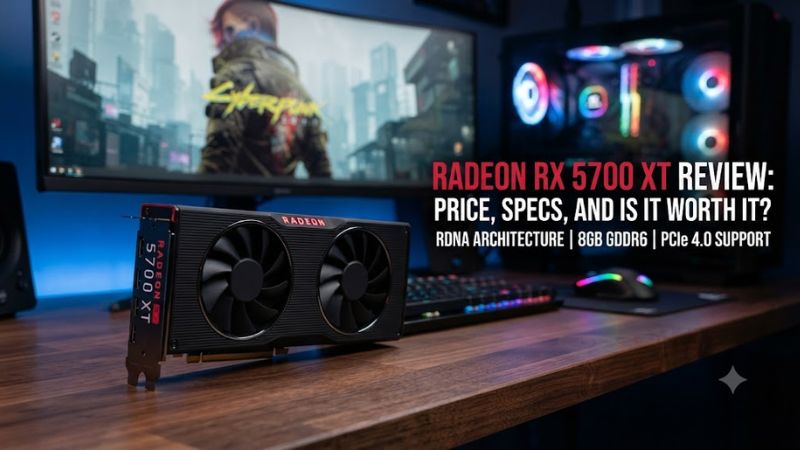
For the Radeon RX 5700 XT review: price, specs and is it worth it decision, platform fit is straightforward. AMD specifies PCIe connectivity, an 8-pin plus 6-pin power arrangement, and a 600W minimum PSU recommendation. Board-partner cards can differ in dimensions, cooling, and connector placement, so the exact model matters when fitting an older case.
Price Matters More Than the Old MSRP
The RX 5700 XT launched at $399, but that figure is no longer a useful buying target because AMD discontinued the card years ago. Recent US marketplace listings show used examples around 120–220, with condition, warranty, cooler design, and seller reputation creating substantial variation between individual cards.
A sensible Radeon RX 5700 XT review: price, specs and is it worth it verdict therefore starts around the lower part of that used range. A clean card near $130 can be attractive for a budget upgrade, while a $200-plus purchase deserves comparison with newer GPUs offering more VRAM, newer media features, and stronger ray tracing hardware.
Resolution Should Match the GPU
The RX 5700 XT is primarily a 1080p and 1440p card. Tom’s Hardware reported a 9.9% average performance advantage over the GeForce RTX 2060 Super at 2560×1440 across its benchmark suite, while 4K requires more compromises in demanding games and is not the main reason to choose this GPU.
For a Radeon RX 5700 XT review: price, specs and is it worth it purchase, a 1440p monitor makes more sense than a 4K target. The 8GB frame buffer can still serve conventional raster workloads, but newer games with heavy textures and demanding effects can make the capacity less comfortable than a modern 12GB or 16GB alternative.
Features Separate Old and New GPUs
The RX 5700 XT uses first-generation RDNA and has no dedicated ray accelerators. That does not prevent conventional gaming, but it means modern ray-traced workloads rely on the GPU’s general shader resources instead of dedicated hardware. Newer Radeon generations also add newer acceleration and upscaling capabilities.
That feature gap matters when considering Radeon RX 5700 XT review: price, specs and is it worth it in 2026. If your library is mostly competitive games and older AAA titles using raster rendering, the card can still make sense. If ray tracing is central to your games, a newer GPU is easier to justify even at a higher purchase price.
Power and Case Fit Still Matter
AMD rates the reference RX 5700 XT at 225W typical board power and recommends a 600W PSU. The reference specification calls for one 8-pin and one 6-pin connector. Partner cards can use different cooling assemblies and dimensions, so checking the specific model is important rather than assuming every 5700 XT has identical physical requirements.
A Radeon RX 5700 XT review: price, specs and is it worth it should also account for an older PSU. A system with a quality 600W unit and suitable PCIe leads is a straightforward match, while an aging or undersized power supply can make a cheap used GPU a poor upgrade. DDR4 and DDR5 system platforms can both accommodate the card.
Top Picks
The RX 5700 XT remains the historical value pick when purchased cheaply, but newer cards are stronger choices when prices move too close together. The table separates the older used option from current alternatives and focuses on the buyer’s reason for choosing each model rather than treating six-year-old hardware as a new-generation product.
| Product | Best For | Key Spec | Compatibility | Watch Out For |
| Radeon RX 5700 XT | Best Value Used | 8GB GDDR6, 225W | PCIe x16, 6-pin + 8-pin, 600W PSU | No dedicated ray tracing hardware |
| Radeon RX 9060 XT 16GB | Best Overall | 16GB GDDR6, RDNA 4 | PCIe desktop platform, 8-pin | 16GB model costs more than used 5700 XT |
| Intel Arc B580 | Best Budget Alternative | 12GB GDDR6, 190W | PCIe 4.0 x8, 8-pin | Game and driver behavior varies by title |
| Radeon RX 9070 | Best 1440p Upgrade | 16GB GDDR6, 220W | PCIe desktop platform | Much higher purchase price |
Radeon RX 5700 XT — Best Value Used
The RX 5700 XT is the value pick for buyers who find a healthy used card at a genuinely low price. Its core specification includes 40 compute units, 2,560 stream processors, 8GB of GDDR6, a 256-bit memory interface, 448GB/s bandwidth, and 225W typical board power. AMD lists a 600W minimum PSU recommendation.
The weakness is age rather than basic raster capability. The Radeon RX 5700 XT review: price, specs and is it worth it answer becomes negative when a seller asks modern-GPU money for an aging card. Buyers should also avoid it if they specifically need hardware ray tracing, newer media features, or a substantial warranty, because those priorities favor newer products.
Radeon RX 9060 XT 16GB — Best Overall
The RX 9060 XT 16GB is the strongest modern comparison for a buyer who wants a mainstream Radeon rather than an aging used card. AMD lists 16GB of GDDR6 and a 1×8-pin connector, while independent 1440p results place it around RX 7700 XT performance in conventional gaming with a newer feature set.
The main weakness is cost: it is not competing with a $130 used RX 5700 XT on raw purchase price. However, the 16GB capacity gives it more room for modern texture loads, and its newer architecture brings ray accelerators and current-generation software support. It is the safer long-term choice for a new build.
Intel Arc B580 — Best Budget Alternative
The Arc B580 is a useful non-Radeon comparison because it targets the same broad budget-gaming audience while offering 12GB of GDDR6 and a 192-bit interface. Its original US price was $249.99, and independent 1440p results showed roughly 60 fps in the review suite, giving budget builders another route to modern 1440p gaming.
Its weakness is consistency between games and platforms. Some titles respond very well to Intel’s current drivers, while others can show larger performance gaps. The B580 also uses PCIe 4.0 x8, making motherboard compatibility worth checking on older systems. Buyers seeking the simplest Radeon ecosystem may prefer an AMD card.
Radeon RX 9070 — Best 1440p Upgrade
The RX 9070 is a substantially newer class of GPU with 16GB of GDDR6 and a 220W board-power rating. AMD launched it at $549, and TechSpot’s later 1440p comparison found it around 160% faster than the RX 5700 XT on average at Ultra settings across its seven-game suite, using the same test platform and current drivers.
That performance comes with a much higher purchase price, so it is not a direct budget replacement. It is appropriate for someone upgrading from a 5700 XT who wants a large performance jump and modern features. A buyer should not choose it merely to replace a functioning 5700 XT for light 1080p gaming.
FAQ
The most useful Radeon RX 5700 XT review: price, specs and is it worth it answer depends on whether you already own the card or are shopping secondhand. The hardware remains viable for conventional 1080p and 1440p gaming, but its lack of dedicated ray tracing hardware and older 8GB memory capacity make the purchase increasingly dependent on price.
Is the RX 5700 XT still good for 1440p gaming?
Yes, the RX 5700 XT is still suitable for 1440p gaming when expectations focus on rasterized performance and sensible settings. Tom’s Hardware found it averaged 9.9% faster than the RTX 2060 Super at 2560×1440 across its benchmark suite, establishing 1440p as one of the card’s strongest use cases.
The Radeon RX 5700 XT review: price, specs and is it worth it conclusion changes for demanding modern games using ray tracing or very heavy texture settings. In those situations, newer GPUs with dedicated ray hardware and larger memory pools can provide more headroom, making the 5700 XT better suited to buyers prioritizing traditional rendering.
How much should you pay for a used RX 5700 XT?
A used RX 5700 XT is most compelling around 120–160, while prices approaching $200 require a particularly good model, warranty, or condition to justify the purchase. Recent US marketplace examples have appeared from roughly $120 to $220, showing why one listing should not be treated as a universal market price.
The card’s original $399 MSRP is useful for historical context but should not determine today’s value. A Radeon RX 5700 XT review: price, specs and is it worth it decision should compare the actual asking price with current cards, seller protection, cooler condition, power requirements, and the remaining value of 8GB of VRAM.
Does the RX 5700 XT support ray tracing?
No, the RX 5700 XT does not have dedicated hardware ray accelerators, so it lacks the hardware ray-tracing architecture introduced in later Radeon generations. The GPU can still run games that offer ray-traced effects, but performance can fall sharply when those effects become a major part of the workload.
That limitation is more important in 2026 than it was at launch because ray tracing is now present in many major PC releases. A Radeon RX 5700 XT review: price, specs and is it worth it recommendation therefore fits raster-focused players better than buyers who specifically want modern RT features and newer upscaling capabilities.
What PSU does the RX 5700 XT need?
AMD recommends a 600W power supply for the RX 5700 XT reference design, which has a 225W typical board-power rating and uses one 8-pin plus one 6-pin auxiliary connector. The exact partner model can differ, so its manufacturer specification should be checked before installation.
The Radeon RX 5700 XT review: price, specs and is it worth it answer also depends on PSU quality rather than wattage alone. A reliable 600W unit with the required PCIe connectors is the reference requirement, while an old or questionable supply is a reason to budget for a replacement instead of focusing only on the GPU’s used price.
Final Thoughts
The Radeon RX 5700 XT review: price, specs and is it worth it verdict is still positive for a cheap used card aimed at 1080p or 1440p raster gaming, but it is no longer a general-purpose recommendation. Around 120–160 can make sense; higher prices should push buyers toward newer 12GB or 16GB GPUs with modern features.