🛒 Best Price Today on Amazon
Prime members get fast, free shipping on everything above, plus member-only deals. New members get a 30-day free trial — cancel anytime.
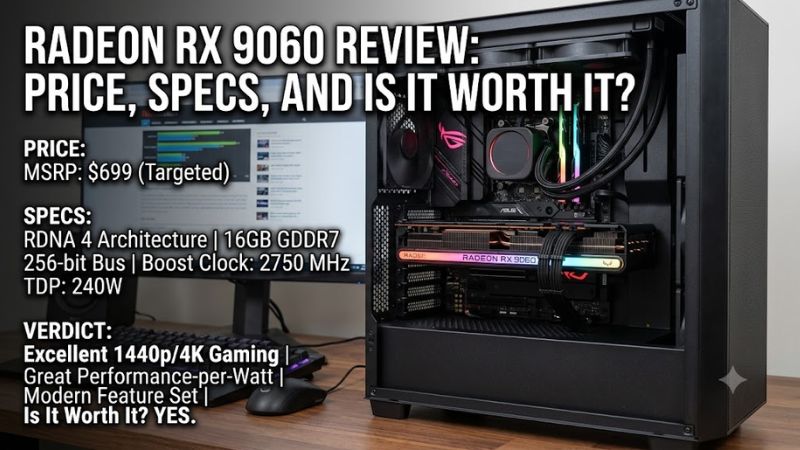
The radeon rx 9060 review: price, specs and is it worth it question comes down to value, availability, and the limits of 8GB graphics memory. AMD’s Radeon RX 9060 targets mainstream desktop gaming, but it is primarily an OEM component rather than a conventional retail graphics card. That makes the price of the complete PC especially important.
How to Choose a Mainstream Gaming Graphics Card
The Radeon RX 9060 makes sense for budget-conscious players targeting 1080p, particularly when buying a prebuilt desktop at a competitive price. Its reduced power requirements are attractive, but 8GB of VRAM and uncertain standalone availability complicate comparisons with retail GPUs. Buyers should compare complete-system prices, gaming performance, memory capacity, and upgrade flexibility before committing.
Gaming Resolution and Performance
The RX 9060 is primarily a 1080p graphics card, although selected games can run well at 1440p with adjusted settings. TechSpot’s November 2025 review compared it with several competing GPUs across seven games, finding performance broadly similar to the GeForce RTX 5060. Individual results varied with the game, graphics preset, and resolution.
For competitive games, this level of performance can suit high-refresh-rate displays when settings are chosen carefully. Demanding single-player titles require more attention to texture quality, ray tracing, and upscaling. The RX 9060 should not be treated as a universal ultra-settings solution, especially when a game needs more video memory than the card provides.
Graphics Memory and Future Games
The RX 9060 includes 8GB of GDDR6 memory on a 128-bit interface, with memory bandwidth reaching 288GB/s. AMD also specifies 32MB of Infinity Cache. These specifications suit mainstream gaming, but the capacity can become a limitation in newer titles with detailed textures, demanding ray tracing, or large asset pools.
Buyers should distinguish memory capacity from overall GPU speed. An 8GB card can deliver good frame rates in games that fit within its memory budget, yet experience stuttering or require lower settings in other titles. Players planning to keep a graphics card for several years should compare 16GB alternatives before choosing a system built around this GPU.
Platform and Power Compatibility
AMD specifies a PCIe 5.0 x16 interface, a typical board power of 132W, one 8-pin auxiliary power connector, and a recommended minimum 450W power supply. These requirements make the RX 9060 relatively modest in power demand compared with more powerful gaming GPUs, although the complete system determines the final PSU requirement.
The card supports Windows 10 64-bit, Windows 11 64-bit, and Linux x86-64. A compatible PCIe graphics slot is necessary, but an older motherboard is not automatically disqualified. Check the specific prebuilt PC’s power supply, physical card dimensions, connector placement, and case clearance because OEM configurations can differ from standard retail designs.
Total System Price and Upgrade Options
The RX 9060 has no established official retail graphics-card MSRP in the reviewed sources. TechSpot estimated an equivalent value of around $260 from its comparison with an RX 9060 XT 8GB system, but this was an estimate rather than an AMD list price. Actual prebuilt pricing depends on the other components and regional availability.
Compare systems with similar processors, memory, storage, and warranty coverage instead of comparing headline prices alone. A cheaper desktop may include a weaker CPU, limited memory, or a basic power supply that restricts future upgrades. If the RX 9060 system costs nearly as much as a comparable machine with a faster retail GPU, the discount may not justify the compromises.
Top Picks: RX 9060 and Its Alternatives
The RX 9060 is most compelling when included in an attractively priced prebuilt desktop, rather than purchased as a standalone upgrade. Its closest alternatives offer different combinations of speed, memory capacity, and availability. The comparison below uses published specifications and review findings, not a direct PC Gaming Universe test. Retail prices fluctuate, so the table avoids presenting estimates as guaranteed purchase prices.
| Product | Best For | Key Spec | Compatibility | Watch Out For |
| Radeon RX 9060 | Best Overall for a discounted prebuilt | 8GB GDDR6; 132W board power | PCIe 5.0 x16; 8-pin power | OEM-focused availability |
| Radeon RX 9060 XT 16GB | Best Value for longer-term gaming | 16GB GDDR6; 32 compute units | PCIe desktop graphics slot; check model-specific PSU needs | Higher purchase price |
| NVIDIA GeForce RTX 5060 | Best For NVIDIA features | 8GB GDDR7; DLSS support | PCIe desktop graphics slot; check card-specific power and clearance | 8GB capacity can constrain demanding games |
| Radeon RX 9070 | Best For 1440p and heavier workloads | 16GB GDDR6; 256-bit interface | PCIe desktop graphics slot; check PSU and dimensions | Higher power demand and system cost |
Best Overall: Radeon RX 9060
The RX 9060 is the most sensible choice here when a prebuilt system offers it at a meaningful discount. Its 28 compute units, boost clock up to 2,990MHz, and 288GB/s memory bandwidth provide a credible foundation for mainstream gaming. The modest 132W board power also gives system builders more flexibility than higher-power alternatives.
The drawback is availability: AMD positions this model for desktop systems, and TechSpot reported buying a complete PC to examine the card. Buyers who want a straightforward replacement GPU should not assume they can purchase an equivalent retail board. Choose this option when the complete desktop is competitively priced and its other components meet your needs.
Best Value Alternative: Radeon RX 9060 XT 16GB
The RX 9060 XT 16GB is worth comparing if you want a conventional retail graphics card and greater memory headroom. AMD lists 16GB of GDDR6 and 32 compute units for this version, with a reference starting price of $349 at announcement. Its higher memory capacity is particularly useful for demanding textures and games that exceed an 8GB card’s practical limits.
Its weakness is that it costs more than the RX 9060 should cost in a properly discounted system, and partner-card prices can vary. The 9060 XT also comes in an 8GB version, so check the exact memory configuration before buying. Players who mainly run lightweight esports titles may not benefit enough from the extra capacity to justify a large price difference.
Best For NVIDIA Features: GeForce RTX 5060
The GeForce RTX 5060 is a relevant alternative for players who prefer NVIDIA’s software ecosystem, including DLSS features and supported ray-tracing options. It uses 8GB of GDDR7 memory, so its newer memory type does not remove the capacity limitation shared with the RX 9060. Its appeal depends on the games you play and the prices of complete systems or individual cards.
TechSpot’s seven-game comparison found that the RX 9060 performed broadly around the RTX 5060, with meaningful variation between titles and settings. Neither card wins every game, so compare benchmarks at the resolution and quality preset you actually intend to use. Choose the RTX 5060 if its supported features matter to you and the price is competitive.
Best For Higher-Resolution Gaming: Radeon RX 9070
The Radeon RX 9070 is a more substantial option for players who prioritize 1440p performance and additional graphics memory. AMD lists 16GB of GDDR6, a 256-bit memory interface, and typical board power of 220W. That extra capacity and broader hardware configuration make it a more suitable starting point for demanding games than the RX 9060.
The trade-off is a higher overall system cost and greater power requirements. AMD announced a $549 starting price for the RX 9070, but that figure is a launch reference rather than a promise of current retail pricing. It is unnecessary for someone primarily playing less demanding games at 1080p, especially if spending more would require compromising the CPU or monitor.
What the Gaming Benchmarks Actually Show
TechSpot’s review used a Ryzen 7 9800X3D, a Gigabyte X670E Master motherboard, DDR5-6000 memory, Windows 11 24H2, and a range of graphics cards. Its gaming comparisons covered 1080p and 1440p at medium and higher presets. Those details matter because CPU choice, game selection, and graphics settings can materially change comparative results.
In its seven-game geometric-mean results, the RX 9060 was approximately 13–14% slower than the RX 9060 XT, depending on resolution. It was also around 23–29% faster than the RX 7600 across the reported comparisons, with the exact margin depending on the settings. These are results from TechSpot’s specific test suite, not a promise of identical frame rates in every game.
FAQ: Radeon RX 9060 Price, Specs, and Buying Advice
Is the Radeon RX 9060 worth buying?
The RX 9060 can be worth buying when it is included in a well-priced prebuilt desktop that meets your gaming needs. Its low power demand and performance near the RTX 5060 in TechSpot’s comparison make it a credible mainstream option, but its 8GB memory capacity limits flexibility in demanding games.
Before purchasing, compare the total desktop price against systems with the RX 9060 XT 16GB or other current-generation GPUs. There is no official standalone MSRP established in the sources cited here, so a seller’s advertised price should be evaluated against the actual hardware included rather than an assumed graphics-card price.
How much does the Radeon RX 9060 cost?
The RX 9060 does not have a verified official standalone retail price in the sources used for this review. TechSpot estimated an equivalent value of approximately $260 from a prebuilt-system comparison, but that figure is not an official MSRP or a guaranteed current selling price.
For context, AMD announced starting prices of $349 for the RX 9060 XT 16GB and $549 for the RX 9070. These are announcement prices, not verified current retail quotes. Compare current local listings and complete-system specifications before deciding whether an RX 9060 desktop represents good value.
Can the Radeon RX 9060 handle 1440p gaming?
Yes, the RX 9060 can handle 1440p gaming in selected titles, particularly when graphics settings are adjusted to suit its performance and 8GB memory capacity. TechSpot’s published comparisons include 1440p results across several games, although performance varies substantially with the game and preset.
For demanding modern releases, lowering texture quality or enabling supported upscaling may help maintain playable performance. If 1440p gaming at high settings is your main goal, compare the RX 9060 XT 16GB and RX 9070 before committing to an 8GB graphics card.
What power supply does the Radeon RX 9060 require?
AMD recommends a minimum 450W power supply for the RX 9060 and specifies one 8-pin auxiliary power connector. Its typical board power is 132W, although the appropriate PSU for an entire computer also depends on the processor, other components, and the system manufacturer’s configuration.
Check the actual card and desktop specifications before upgrading. OEM systems may use proprietary power supplies, unusual connector arrangements, or compact cases that limit replacement options. The GPU’s PCIe 5.0 x16 interface also needs to be considered alongside the motherboard’s physical slot and the available space inside the chassis.
Final Thoughts
The radeon rx 9060 review: price, specs and is it worth it verdict is conditional: it suits budget-focused 1080p gaming when bundled into a competitively priced desktop. Its 8GB VRAM and OEM-oriented availability are genuine drawbacks. Compare complete-system costs against the RX 9060 XT 16GB before buying, especially if you want greater flexibility for demanding future games.