🛒 Best Price Today on Amazon
Prime members get fast, free shipping on everything above, plus member-only deals. New members get a 30-day free trial — cancel anytime.
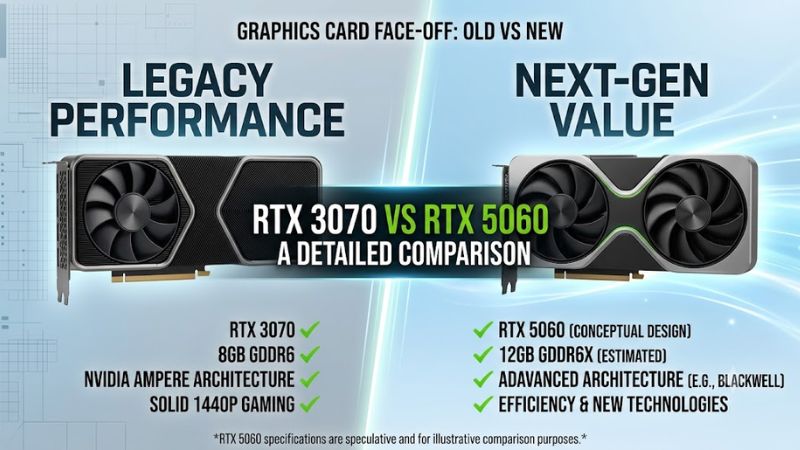
Choosing between these graphics cards means weighing traditional rendering performance against newer features and lower power consumption. The rtx 3070 vs rtx 5060 comparison matters most to gamers choosing between a used Ampere card and a newer Blackwell GPU. Resolution, game settings, local prices, and memory demands can change which card makes more sense.
How to Choose Between These Graphics Cards
The right choice depends on your current hardware, the games you play, and whether you prioritize raw rendering speed or newer software features. The RTX 3070 launched in NVIDIA’s Ampere generation, while the RTX 5060 belongs to Blackwell. Both support hardware-accelerated ray tracing, but they differ in memory bandwidth, architecture, power requirements, and supported DLSS features.
Traditional Gaming Performance
For conventional rendering, compare results from the same games, test systems, resolutions, and quality presets rather than relying on architecture names. PassMark’s aggregated G3D Mark comparison places the RTX 3070 ahead of the RTX 5060 in its reported overall score, although that synthetic result does not establish which card wins in every game.
For players targeting 1080p or 1440p, the more useful evidence is a recent game-by-game benchmark with ray tracing disabled and identical image-quality settings. CPU limitations can narrow the difference at lower resolutions, while demanding graphics settings can expose memory-capacity limits. Neither card should be judged from a single game’s result.
VRAM and Memory Bandwidth
Both desktop cards have 8GB of video memory, so moving from the RTX 3070 to the RTX 5060 does not increase nominal VRAM capacity. The RTX 3070 uses GDDR6 on a 256-bit memory interface, whereas the RTX 5060 uses GDDR7 on a 128-bit interface. Memory type and bus width alone cannot determine gaming performance.
This shared 8GB capacity is important in games with high-resolution textures, ray tracing, or large asset workloads. If a game exceeds the memory budget, frame-time spikes or texture compromises may occur even when average frame rates appear reasonable. Players who want a meaningful VRAM increase should compare other cards with more memory rather than treating either option as a capacity upgrade.
Power, Cooling, and Physical Fit
The RTX 3070 has a reference total graphics power rating of 220W, while NVIDIA specifies 145W for the RTX 5060. Lower board power can reduce heat output and ease cooling demands, although the actual temperatures and noise depend on the partner card, case airflow, fan curve, and room temperature.
Before buying either card, check the exact model’s length, thickness, power connector, and manufacturer-recommended PSU. NVIDIA lists a 550W system-power recommendation for the RTX 5060; individual RTX 3070 models and complete systems may call for different supplies. Both use a PCIe expansion slot, and a compatible older motherboard can generally host the newer card, subject to firmware and system compatibility.
Features, Drivers, and Compatibility
The RTX 5060 supports NVIDIA’s newer DLSS feature set, including DLSS 4 capabilities listed for the generation, while the RTX 3070 supports DLSS features available to its Ampere architecture. Availability varies by game and feature, so check whether your preferred titles support the specific rendering and frame-generation options you want.
Both cards support DirectX 12 Ultimate and can run on Windows gaming PCs with a suitable PCIe slot, current drivers, sufficient power, and enough case clearance. A PCIe 5.0 card is designed for PCIe compatibility, but its negotiated link depends on the motherboard and platform. Confirm the precise board and card specifications before purchasing instead of assuming every model has identical dimensions or connectors.
RTX 3070 vs RTX 5060: Performance and Value Compared
The practical difference is that the RTX 3070 remains a capable option for conventional rendering, while the RTX 5060 brings newer architectural features and lower rated power consumption. PassMark’s comparison reports a G3D Mark score of 22,066 for the RTX 3070 and 20,619 for the RTX 5060. These are aggregated synthetic scores, not game FPS results, and should not be presented as a universal gaming-performance ranking.
| Product | Best For | Key Spec | Compatibility | Watch Out For |
| NVIDIA GeForce RTX 3070 | Used-card buyers prioritizing traditional rendering | 8GB GDDR6; 220W reference power | PCIe expansion slot; check PSU and card dimensions | Higher power demand; used-card condition |
| NVIDIA GeForce RTX 5060 | Buyers wanting newer features and efficiency | 8GB GDDR7; 145W total graphics power | PCIe Gen 5 interface; check board, PSU and case | Still limited to 8GB VRAM |
RTX 3070: Better Fit for Traditional Rendering
The RTX 3070 is worth considering if you can find a reasonably priced used model and your main priority is conventional gaming performance. Its 8GB GDDR6 memory and 256-bit interface provide a different memory configuration from the RTX 5060, and aggregated PassMark results currently favor the older card. Actual results still depend on the game, settings, and system configuration.
Its main drawback is age and power demand. A used card may have experienced years of heat exposure, and its cooler, fans, or warranty status deserve attention before purchase. It is less appealing if your power supply is marginal or if you specifically want the newer Blackwell feature set. Compare the final used price against a new card with a valid warranty.
RTX 5060: Better Fit for Newer Features
The RTX 5060 suits buyers who value Blackwell-era features, GDDR7 memory, and a lower reference power rating. NVIDIA lists 3,840 CUDA cores, a 2.50GHz boost clock, 8GB of memory, and 145W total graphics power for the desktop model. These specifications describe the GPU, not guaranteed frame rates from every manufacturer’s board.
Its weakness is that the newer generation does not increase the standard memory capacity beyond 8GB. Buyers focused on demanding texture settings or games that exceed that budget should weigh this limitation carefully. The RTX 5060 is also not automatically faster in every traditional rendering workload, so compare independent results for the games you actually play before paying more for newer features.
Which Card Makes More Sense for 1080p?
For 1080p gaming, either card can be appropriate, depending on the title and target frame rate. Competitive games at reduced graphics settings may be limited by the CPU, while visually demanding single-player games can place more load on the GPU. A useful comparison therefore separates native rendering from upscaling and frame-generation results rather than combining them into one number.
If you already own an RTX 3070, replacing it with an RTX 5060 is not an obvious upgrade based on the model number alone. The newer card’s efficiency and feature support may justify a change for particular needs, but buyers should compare actual frame rates and frame-time behavior in their games. If your current performance is acceptable, saving the upgrade budget may offer better value.
Which Card Makes More Sense for 1440p?
At 1440p, the shared 8GB memory capacity deserves more attention because higher texture quality and demanding effects can increase VRAM use. Both cards may need settings adjustments in particularly demanding games. Average FPS alone does not reveal every memory-related hitch, so look for frame-time data and notes about texture settings when comparing independent reviews.
The RTX 3070’s memory interface is wider, but that fact alone does not guarantee a win at 1440p. Likewise, GDDR7 does not automatically make the RTX 5060 faster in every workload. Choose based on benchmarks that use the same resolution, comparable quality presets, and clearly stated upscaling settings. Treat ray-tracing results separately from conventional rasterization results.
FAQ
Is the RTX 3070 faster than the RTX 5060?
The RTX 3070 leads the cited PassMark G3D Mark comparison, but that does not mean it wins every game. PassMark reports 22,066 for the RTX 3070 and 20,619 for the RTX 5060 in its aggregated synthetic benchmark.
For a buying decision, prioritize game-specific results with the same resolution and quality settings. Also check whether each test uses native rendering, upscaling, or frame generation, since those configurations measure different aspects of performance.
Does the RTX 5060 have more VRAM than the RTX 3070?
No, both standard desktop models have 8GB of video memory. The RTX 3070 uses GDDR6, while the RTX 5060 uses GDDR7, so the newer card changes the memory technology without increasing nominal capacity.
For games that exceed an 8GB memory budget, either card may require lower texture settings or other graphics adjustments. Check benchmarks that report memory behavior and frame-time consistency if you play demanding modern releases.
Is the RTX 5060 more power efficient?
Yes, the RTX 5060 has a lower specified total graphics power rating than the RTX 3070’s reference rating. NVIDIA lists 145W for the RTX 5060, compared with 220W for the RTX 3070.
Actual system consumption varies with the game, CPU, and other components, and board-partner designs can differ. Check your exact model’s power connector and PSU requirements before installation, especially when replacing an older card in a compact PC.
Should you upgrade from an RTX 3070 to an RTX 5060?
Not automatically, because the RTX 5060 does not offer a larger standard VRAM capacity and the cited synthetic comparison favors the RTX 3070.
An upgrade may still make sense if lower power use, newer DLSS features, warranty coverage, or a particular game’s results justify the expense. Compare the net cost after selling your existing card with alternatives that offer a more substantial performance or memory increase.
Final Thoughts
The rtx 3070 vs rtx 5060 decision comes down to price, power use, and feature priorities rather than generation alone. The RTX 3070 remains worth considering on the used market, while the RTX 5060 offers newer features and lower rated power. Compare local prices and game-specific benchmarks before choosing.