🛒 Best Price Today on Amazon
Prime members get fast, free shipping on everything above, plus member-only deals. New members get a 30-day free trial — cancel anytime.
When comparing rtx 3060 vs rtx 5060, the right choice depends on resolution, memory demands, and the features you want from a graphics card. The RTX 5060 belongs to NVIDIA’s newer generation, while the RTX 3060 remains relevant for budget builds, particularly when its 12GB of VRAM matters more than newer rendering features.
How to Choose Between These Graphics Cards
The choice comes down to real gaming performance, available video memory, feature support, and system compatibility. In most new gaming builds, the RTX 5060 is the stronger starting point because it uses NVIDIA’s Blackwell architecture and supports newer DLSS features. The RTX 3060 can still make sense when a discounted card offers enough performance and memory for your games.
Performance at 1080p
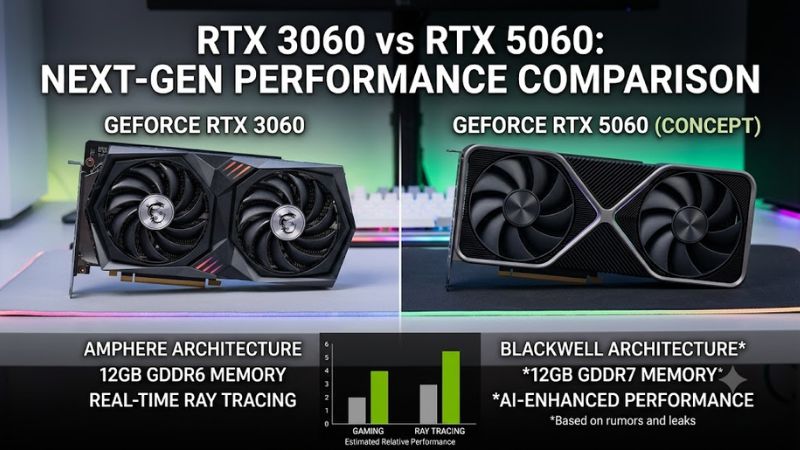
For conventional rendering, the RTX 5060 generally delivers higher frame rates than the RTX 3060. Independent comparisons show an advantage across several games, although the size of the gap varies with the title, graphics preset, CPU, and driver version. Competitive games may also become CPU-limited, reducing the difference between the cards.
In the comparison published by NanoReview, the RTX 5060 leads the RTX 3060 in the site’s listed 1080p High and Ultra game averages. These figures are useful as directional evidence, not a universal prediction for every PC. Check the individual game’s settings and benchmark methodology before applying any result to your own build. Read the benchmark comparison.
Video Memory and Newer Games
The standard RTX 5060 has 8GB of GDDR7 memory, while the RTX 3060 was sold with both 12GB and 8GB GDDR6 configurations. The 12GB RTX 3060 provides more capacity for games that use large textures, although extra VRAM does not automatically make it faster overall. GPU processing power remains important.
This is the central trade-off in the RTX 3060 vs RTX 5060 decision. A newer GPU can render frames faster yet encounter memory pressure when a game uses demanding textures or ray tracing settings. Lowering texture quality can help when VRAM is the bottleneck, but buyers who prioritize newer rendering features should still consider the RTX 5060.
DLSS and Ray Tracing
The RTX 5060 supports DLSS 4 features, including Multi Frame Generation in supported games, while the RTX 3060 supports earlier DLSS functionality. The newer card’s feature set can improve perceived smoothness and image reconstruction when a game implements the relevant technologies. Generated frames are not equivalent to the same number of traditionally rendered frames.
Both GPUs support hardware-accelerated ray tracing, but their architectures and processing capabilities differ. The RTX 5060 is generally the more attractive choice for someone building around current ray-traced games. However, image quality, latency, and actual performance depend on the game, selected options, and whether frame generation is available.
Compatibility With Your Existing PC
Both graphics cards use a PCI Express interface and can work in a compatible desktop motherboard with an appropriate graphics slot. The RTX 5060 supports PCIe Gen 5, whereas the RTX 3060 uses PCIe Gen 4. The newer card can operate in backward-compatible slots, but the platform and card configuration determine the negotiated link speed.
Check the exact model’s dimensions, power connectors, and recommended power supply before purchasing. NVIDIA lists a 550W system power recommendation for the reference RTX 5060 and a 550W recommendation for the RTX 3060, although partner cards and complete systems can differ. A suitable PSU also needs the correct connector and sufficient capacity for the CPU and other components. NVIDIA RTX 5060 specifications and NVIDIA RTX 3060 specifications.
Top Picks: RTX 3060 vs RTX 5060
These recommendations depend on the actual card price, memory configuration, and intended workload. The RTX 5060 is the more compelling option for a new 1080p gaming system, while the RTX 3060 12GB remains worth considering for a buyer who needs extra memory capacity or finds a substantial discount. Neither GPU is an automatic winner at every price.
| Product | Best For | Key Spec | Compatibility | Watch Out For |
| RTX 5060 | Best Overall | 8GB GDDR7; Blackwell | PCIe-compatible desktop with suitable PSU | 8GB VRAM |
| RTX 3060 12GB | Best Value when discounted | 12GB GDDR6; Ampere | PCIe-compatible desktop with suitable PSU | Older architecture |
| RTX 3060 8GB | Best for a very low-cost used build | 8GB GDDR6; reduced memory configuration | Check exact board and PSU requirements | Less memory bandwidth than the 12GB model |
| RTX 5060 compact partner card | Best For smaller compatible cases | 8GB GDDR7; model-specific cooler | Check card length, thickness, and connectors | Cooling and noise vary by model |
Best Overall: RTX 5060
Choose the RTX 5060 for a new gaming PC if your main target is 1080p and you want newer rendering features. Its stronger general gaming performance and support for DLSS 4 make it a sensible starting point for modern titles. Look for a model with a suitable cooler, a warranty, and a price that compares favorably with other current GPUs.
The main weakness is its 8GB memory capacity. Players who use high-resolution texture packs, demanding ray tracing settings, or memory-intensive creative applications may need to reduce settings in some workloads. Buyers who specifically need more VRAM should compare alternatives with larger memory configurations instead of assuming the newest generation always suits every task.
Best Value: RTX 3060 12GB
Consider the RTX 3060 12GB if you can buy it used or discounted for considerably less than the RTX 5060. Its larger memory capacity can help in workloads where VRAM usage is the limiting factor, and it remains suitable for many 1080p games with sensible settings. Verify the seller’s condition description and return policy before buying a used card.
Do not choose it solely because it has 12GB of memory. The older GPU has lower overall gaming performance than the RTX 5060 in many comparisons, and it lacks the newer card’s DLSS 4 Multi Frame Generation support. Buyers paying a price close to the newer model should generally favor the RTX 5060 unless their workload specifically benefits from the older card’s additional VRAM.
Best For Tight Budgets: RTX 3060 8GB
The RTX 3060 8GB can suit a low-cost upgrade when its asking price is well below the alternatives and the seller provides a reliable warranty or return option. It can run many games at 1080p, especially when settings are adjusted to match the game’s demands. Check the exact model because the 8GB version is not equivalent to the 12GB variant.
Its reduced memory configuration is a meaningful limitation, and buyers should not assume all RTX 3060 cards perform identically. Avoid paying a premium for an older 8GB card simply because it carries the RTX 3060 name. Compare its condition, actual price, power requirements, and independent performance results against newer options before making a decision.
Best For Compact Builds: RTX 5060 Partner Models
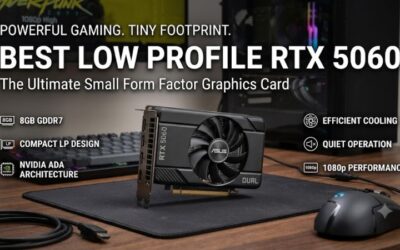
A compact RTX 5060 variant may suit a smaller desktop if its dimensions and cooling design match the case. Board partners sell different cooler sizes and factory configurations, so the GPU name alone cannot establish whether a particular card fits. Check the manufacturer’s specification sheet for card length, height, thickness, and power connector clearance.
Do not buy a compact model without checking airflow and noise reviews for that exact version. A small cooler may run warmer or use a more audible fan profile under sustained gaming loads than a larger design. If your case has generous clearance, compare full-size alternatives too, since the least expensive or smallest card is not automatically the best purchase.
FAQ
Is the RTX 5060 faster than the RTX 3060?
Yes, the RTX 5060 is generally faster in conventional gaming benchmarks, although the size of its advantage varies by game and settings. Independent comparisons show stronger average frame rates for the newer GPU at common gaming resolutions. Results can differ with CPU limitations, drivers, ray tracing, and memory usage.
For a fair comparison, use the same game version, resolution, graphics preset, and upscaling mode. Do not compare a result with DLSS or frame generation enabled against native rendering without those features and treat the figures as equivalent. Your actual experience also depends on the rest of the PC.
Is the RTX 3060 12GB better than the RTX 5060 8GB?
No, not as a general gaming choice; the RTX 5060 is typically faster, but the RTX 3060 12GB has more video memory. That extra capacity can help in particular games and creative workloads when an 8GB card runs short of VRAM. Memory capacity alone does not determine rendering performance.
If you play at 1080p with ordinary texture settings, the RTX 5060 is usually the more attractive option for a new build. If your work requires larger GPU memory allocations, compare application-specific results and prices before deciding. The RTX 3060 12GB becomes more compelling when it costs substantially less.
Can the RTX 5060 run on an older motherboard?
Yes, the RTX 5060 can work in a compatible older motherboard because PCI Express is designed for backward compatibility. The card supports PCIe Gen 5, but an older motherboard may operate it at a lower link generation. The exact slot, firmware, physical clearance, and system configuration still matter.
Before upgrading, verify the motherboard’s graphics slot, power supply connectors, and available case space. Check the card manufacturer’s documentation for its particular requirements rather than relying on the reference specification alone. Also confirm that the power supply can handle the entire PC under load.
Should you upgrade from an RTX 3060 to an RTX 5060?
Upgrade to the RTX 5060 if your current RTX 3060 cannot maintain your desired frame rate or you want newer supported graphics features. The newer card can offer a meaningful performance improvement, but the value depends on its purchase price and how much you can recover by selling your existing GPU.
If your RTX 3060 already handles your games comfortably at your preferred settings, keeping it may be the more economical choice. Compare independent benchmarks for the specific games you play, paying attention to VRAM-related limitations and frame-time consistency. An upgrade makes the most sense when it solves a real performance problem.
Final Thoughts
The rtx 3060 vs rtx 5060 decision favors the RTX 5060 for most new 1080p gaming builds because it offers stronger general performance and newer features. The RTX 3060 12GB remains a reasonable budget alternative when discounted enough to justify its age. Compare actual prices, memory needs, and power compatibility before buying.