🛒 Best Price Today on Amazon
Prime members get fast, free shipping on everything above, plus member-only deals. New members get a 30-day free trial — cancel anytime.
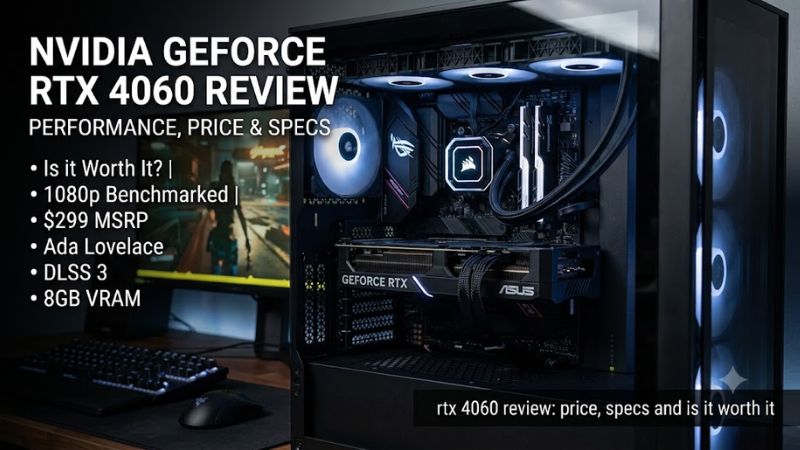
The rtx 4060 review: price, specs and is it worth it question matters most to budget-conscious PC gamers choosing a graphics card in 2026. NVIDIA’s GeForce RTX 4060 combines efficient power use, DLSS Frame Generation and capable 1080p gaming, but its 8GB memory capacity and older-generation hardware make the asking price especially important.
How to Choose a Budget Gaming Graphics Card
Choosing a graphics card means balancing performance, memory, power requirements and software support rather than comparing model numbers alone. The RTX 4060 launched at $299, but that historical price is not a reliable estimate of its current retail cost. Compare live prices for newer alternatives before deciding whether an older card still represents sensible value.
1080p Gaming Performance
The RTX 4060 is primarily a 1080p graphics card, suited to esports, established games and many demanding single-player titles with sensible graphics settings. In TechSpot’s review, its 15-game average was 91 FPS at 1080p, although individual results varied substantially. Those figures describe that review’s game selection and test configuration, not a universal frame rate for every PC.
For context, TechSpot’s benchmark findings showed the card performing around 15% ahead of the RTX 3060 on that 15-game average. The RTX 3060 Ti remained faster, however, illustrating why an upgrade from an older card does not automatically deliver a worthwhile performance improvement. Buyers should prioritize benchmarks for the games they actually play.
VRAM Capacity and Graphics Settings
The RTX 4060 includes 8GB of GDDR6 memory connected through a 128-bit memory interface. That configuration is adequate for many 1080p games, but demanding textures, ray tracing and newer releases can put pressure on the available memory. Lowering texture quality or ray-tracing settings can help when a game exceeds the card’s practical memory budget.
Gamers who expect to keep a card for several years should consider whether a newer alternative with more memory better fits their plans. VRAM capacity alone does not determine performance: GPU processing power, memory bandwidth, game optimization and upscaling support all matter. Still, 8GB is a meaningful limitation to weigh before paying a premium for an older model.
Power Consumption and PC Compatibility
NVIDIA specifies a 115W total graphics power rating for the RTX 4060, and the company lists a 550W system power recommendation. The card uses a PCIe 4.0 x8 interface and standard GDDR6 memory. A compatible PCIe slot is required, but the motherboard does not need to support DDR5 specifically because system RAM generation and graphics-card memory are separate considerations.
Before buying, check the exact partner card’s dimensions, power connector and cooling design. A compact model may suit a smaller case, while a factory-overclocked version can have different clearance or power requirements. Verify the power supply’s available connectors and quality as well as its wattage; a number printed on the PSU alone does not establish overall suitability.
Features for Gaming and Streaming
The RTX 4060 supports NVIDIA DLSS 3 Frame Generation, ray tracing, Reflex and AV1 hardware encoding. DLSS can improve performance in supported games, while AV1 encoding can help streamers and creators produce video efficiently. These capabilities are useful, but they do not make every game faster: results depend on software support, settings and the performance cost of enabling visual effects.
Frame Generation is especially relevant to single-player gaming, where higher displayed frame rates may be more valuable than minimizing input latency. Competitive players should still evaluate native performance and responsiveness. If you mainly play esports titles, a newer GPU’s raw frame rate may matter more than ray tracing or advanced image-generation features.
Top Picks: Four Graphics Cards to Compare
The RTX 4060 is no longer the only sensible option for a budget gaming build. The following comparison covers four cards with different strengths, from NVIDIA’s familiar software ecosystem to newer GPUs offering more memory. Manufacturer specifications and independent benchmark findings provide a starting point, but local prices and game-specific performance should determine the final purchase.
| Product | Best For | Key Spec | Compatibility | Watch Out For |
| NVIDIA GeForce RTX 4060 | Existing budget builds | 8GB GDDR6; 115W graphics power | PCIe 4.0 x8; check card dimensions and PSU | Limited VRAM |
| NVIDIA GeForce RTX 5060 | Newer NVIDIA build | 8GB GDDR7; 145W graphics power | PCIe-compatible slot; 550W recommended system power | Still has 8GB VRAM |
| Intel Arc B580 | Memory-focused value | 12GB GDDR6; 190W board power | PCIe 4.0 x8; reference card recommends 600W PSU | Game and system compatibility vary |
| AMD Radeon RX 9060 XT 16GB | Higher memory capacity | 16GB GDDR6; 160W board power | PCIe 5.0 x16 interface; verify board and PSU requirements | Higher initial cost |
Specifications and power recommendations: NVIDIA, Intel and AMD. The RX 9060 XT’s listed 160W is the manufacturer reference specification; partner cards may differ. Prices and availability vary by retailer.
Best Overall: NVIDIA GeForce RTX 5060
The RTX 5060 is the more logical starting point for a new NVIDIA gaming build when its price is competitive. Its Blackwell architecture, 8GB of GDDR7 memory and newer-generation feature support offer a more current platform than the RTX 4060. NVIDIA lists 145W graphics power and a 550W recommended system power supply, though individual card designs vary.
Buy it if you want NVIDIA’s current software ecosystem and features for supported games, streaming and creative applications. Its main weakness is that the 8GB capacity remains restrictive in some demanding titles. If your existing RTX 4060 already meets your performance needs, upgrading solely to obtain a newer model is difficult to justify without comparing game-specific gains and total upgrade cost.
Best Value: Intel Arc B580
Intel’s Arc B580 deserves attention when memory capacity and purchase price are priorities. Its official specification lists 12GB of GDDR6, a 192-bit memory interface and a $249 recommended customer price at launch. That memory configuration gives it more room for demanding textures than an 8GB RTX 4060, although capacity alone cannot predict which card will deliver higher frame rates in a particular game.
Consider it for a cost-conscious gaming PC, especially if independent benchmarks cover your favorite games. The reference card has a 190W total board power rating and an 8-pin power connector, with a 600W PSU recommendation. Intel Arc performance can depend on game support and system configuration, so check motherboard firmware, Resizable BAR support and recent game-specific results before purchasing.
Best for NVIDIA Feature Support: GeForce RTX 4060
The RTX 4060 remains attractive to players who want an efficient GPU with DLSS 3 Frame Generation, ray tracing support and AV1 encoding. In TechSpot’s 15-game test suite, it averaged 91 FPS at 1080p. This is a useful historical benchmark reference, but it should not be treated as a current universal score or directly compared with figures from different game lists, CPUs or settings.
Buy this card when its actual price is meaningfully below comparable newer models, particularly if you have a modest power supply or a small case that fits a compact partner card. The central weakness is its 8GB of VRAM and relatively narrow memory interface. Buyers should skip it when a newer card offers a meaningful performance improvement or more memory for a similar total cost.
Best for Higher Memory Capacity: AMD Radeon RX 9060 XT 16GB
AMD’s Radeon RX 9060 XT 16GB is worth comparing if you play newer games with high-resolution textures or want more memory headroom. AMD lists 16GB of GDDR6, 32 compute units and a $349 suggested launch price. Its RDNA 4 architecture supports FSR 4 in compatible games, giving it a different upscaling feature set from NVIDIA’s DLSS ecosystem.
Choose it if current retailer pricing and independent benchmarks support the extra cost. The 16GB version has a 160W reference total board power rating, but partner designs can differ in dimensions, connectors and power requirements. Do not assume that a higher memory capacity automatically makes it faster in every game; check rasterized performance, ray tracing, upscaling quality and the titles you play.
FAQ
Is the RTX 4060 worth buying in 2026?
The RTX 4060 is worth buying in 2026 if its current price is low enough to compete with newer cards and your main target is 1080p gaming. Its efficiency and NVIDIA features remain useful, but its original $299 MSRP is historical rather than a guarantee of today’s price. Compare live listings before committing.
Can the RTX 4060 run games at 1440p?
Yes, the RTX 4060 can run many games at 1440p, but demanding titles may require reduced graphics settings or upscaling. Its 8GB of VRAM and performance class make it better suited to 1080p overall. Check benchmarks for your specific games rather than relying on a single average FPS figure.
What power supply does the RTX 4060 need?
NVIDIA recommends a 550W system power supply for the RTX 4060, alongside a 115W graphics power rating. The exact partner card’s connector requirements must also match your PSU. A quality power supply, suitable case clearance and compatible PCIe slot matter; DDR4 versus DDR5 system memory does not determine GPU compatibility.
Is the RTX 4060 better than the RTX 5060?
The RTX 4060 is not generally the better choice for a new build when the RTX 5060 is similarly priced, because the newer model uses GDDR7 and a newer GPU architecture. However, the RTX 5060 also has 8GB of memory, so buyers should compare game-specific performance, price and memory demands rather than assuming either card suits every workload.
Final Thoughts
This rtx 4060 review points to a conditional recommendation: the card remains a capable, efficient 1080p option, but its value depends on current pricing. Compare it with the RTX 5060, Intel Arc B580 and Radeon RX 9060 XT 16GB before buying. If the older card costs too much for its performance and 8GB memory limit, choose a better-priced alternative.