🛒 Best Price Today on Amazon
Prime members get fast, free shipping on everything above, plus member-only deals. New members get a 30-day free trial — cancel anytime.
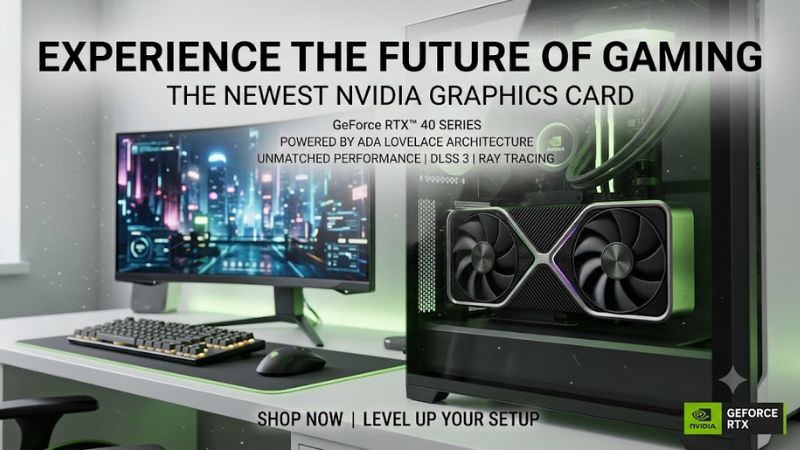
The newest nvidia graphics card lineup available as of October 13, 2026, is NVIDIA’s GeForce RTX 50 Series, based on the Blackwell architecture. The GeForce RTX 5090 remains the flagship model listed on NVIDIA’s official product page, while the RTX 5080 and lower-tier cards offer alternatives for different budgets, resolutions, and gaming requirements.
How to Choose the Newest NVIDIA Graphics Card
Choosing the right GPU depends on your monitor resolution, target frame rate, available budget, and existing PC hardware. The RTX 5090 suits demanding 4K gaming, while the RTX 5080 targets high-end systems. The RTX 5070 and RTX 5060 Ti provide more accessible options, although current retail prices and stock can change their relative value considerably.
Choose Based on Gaming Resolution
Resolution is a practical starting point when comparing the newest NVIDIA graphics card options. For demanding 4K games with ray tracing, the RTX 5090 and RTX 5080 deserve consideration. For 1440p gaming, the RTX 5070 Ti or RTX 5070 may provide a more balanced combination of performance and cost, depending on the game and graphics settings.
At 1080p, an RTX 5060 or RTX 5060 Ti may be sufficient for many gaming setups. Competitive players targeting high refresh rates should also consider CPU limitations, because a faster GPU cannot improve frame rates indefinitely when the processor becomes the bottleneck. Check independent benchmarks at your intended resolution before purchasing.
Match the GPU to Your Budget
The launch prices published by NVIDIA provide a reference point, not a promise of what retailers currently charge. The RTX 5090 launched at $1,999, the RTX 5080 at $999, and the RTX 5070 at $549. Actual US retail prices can be substantially higher when supply is limited, so compare the final price rather than relying on launch pricing alone.
Budget-conscious buyers should compare the RTX 5060, RTX 5060 Ti, and RTX 5070 against their current prices and memory configurations. An expensive GPU is not automatically the best purchase for every player. A less costly model may leave enough money for additional storage, a better monitor, or a CPU upgrade that produces a more balanced gaming PC.
Check Compatibility Before Buying
Modern desktop GeForce RTX 50 Series graphics cards use a PCIe interface and can operate in compatible PCIe x16 slots on many older motherboards. However, the motherboard slot, system firmware, card dimensions, and case layout still matter. Check the exact manufacturer’s specifications for the specific card model instead of assuming every partner card has identical dimensions or power requirements.
Power delivery also deserves attention. NVIDIA’s reference specifications list different power requirements for different GPUs, while board-partner models may vary. Verify the recommended PSU wattage, required power connector, cable arrangement, and available clearance before installation. A suitable power supply and a case with sufficient room are essential parts of a compatible upgrade.
Consider Memory and Graphics Features
Video memory affects how comfortably a GPU handles high-resolution textures, large game worlds, ray tracing, and certain creative workloads. NVIDIA lists the RTX 5090 with 32GB of GDDR7, the RTX 5080 with 16GB, and the RTX 5070 with 12GB. The RTX 5060 Ti comes in 16GB and 8GB configurations, so check the precise model before comparing prices.
The RTX 50 Series also supports NVIDIA’s newer DLSS technologies, including Multi Frame Generation features for supported games. Generated frames can improve displayed smoothness, but they are not equivalent to the same increase in natively rendered frames and do not remove the need for responsive input. Check game support and compare image quality, latency, and native performance when evaluating these features.
Top Picks: Newest NVIDIA Graphics Card Options
The following recommendations cover four desktop GPUs from NVIDIA’s current GeForce RTX 50 Series. They are selected by intended use rather than a claim that one model suits every buyer. The specifications and launch prices come from NVIDIA, while actual gaming performance should be judged using independent benchmarks with matching games, resolutions, and settings.
| Product | Best For | Key Spec | Compatibility | Watch Out For |
| GeForce RTX 5090 | Best Overall | 32GB GDDR7 | PCIe x16 slot, suitable PSU and case | Extremely expensive |
| GeForce RTX 5070 | Best Value candidate | 12GB GDDR7 | Compatible desktop PCIe slot and PSU | May struggle with demanding 4K workloads |
| GeForce RTX 5080 | Best For 4K gaming | 16GB GDDR7 | High-capacity PSU and adequate clearance | High purchase cost |
| GeForce RTX 5060 Ti | Best For mainstream gaming | 8GB or 16GB GDDR7 | Compatible PCIe slot, PSU and case | Choose memory capacity carefully |
GeForce RTX 5090: Best Overall
The GeForce RTX 5090 is the flagship option for buyers prioritizing high-end gaming performance, demanding ray-tracing workloads, and GPU-intensive creative applications. NVIDIA lists 32GB of GDDR7 memory and a $1,999 launch price. Its substantial memory capacity is useful for demanding workloads, although buyers should compare application-specific benchmarks before paying a premium.
Its main weakness is cost, alongside significant power and cooling demands. The exact PSU recommendation, connector requirements, dimensions, and cooling design depend on the selected board model. Choose this card if you have a high-end system and a suitable budget; skip it if your main goal is affordable 1080p or 1440p gaming.
GeForce RTX 5070: Best Value Candidate
The RTX 5070 is a more accessible choice for players building a modern gaming PC around 1440p resolution. NVIDIA specifies 12GB of GDDR7 memory and a $549 launch price. Its position in the lineup makes it worth comparing against similarly priced alternatives, especially when ray tracing, supported DLSS features, and the games you play influence the buying decision.
However, value depends on the current street price, not just the original price. Buyers should also consider whether 12GB of memory meets their preferred texture settings and future game requirements. Choose the RTX 5070 when its actual price and independent benchmark results suit your target frame rate; avoid assuming that every game will perform equally well.
GeForce RTX 5080: Best For 4K Gaming
The RTX 5080 targets high-end gaming systems that need more graphics performance than mainstream cards provide. NVIDIA lists 16GB of GDDR7 memory and a $999 launch price. It is worth considering for demanding 4K games, high graphics settings, ray tracing, and creative software that benefits from a powerful GPU, provided its retail price remains reasonable.
The drawback is its cost: the RTX 5080 can consume a large portion of a complete PC budget. Its 16GB memory capacity may also matter for workloads that exceed available video memory. Buyers should compare independent 4K benchmarks and the exact board’s power and size requirements before upgrading from an existing high-end card.
GeForce RTX 5060 Ti: Best For Mainstream Gaming
The RTX 5060 Ti is aimed at buyers who want a current-generation NVIDIA GPU without moving into the more expensive upper tiers. NVIDIA lists versions with 8GB or 16GB of GDDR7 memory and a $379 launch price for the model family. For mainstream gaming, the right configuration depends on resolution, graphics settings, and the price difference between the two memory options.
The 8GB version is the key trade-off to consider when playing memory-intensive games with high-resolution textures. The 16GB model offers more capacity, but that alone does not make it faster in every game. Choose based on measured performance and local pricing, and check the individual card’s dimensions and PSU requirements before ordering.
Frequently Asked Questions
What is the newest NVIDIA graphics card in 2026?
The GeForce RTX 5090 is the flagship desktop graphics card listed in NVIDIA’s official RTX 50 Series lineup as of October 13, 2026. However, a recent report suggests that production may be changing, and NVIDIA has not officially confirmed that report. Check current stock and manufacturer announcements before buying.
Is the newest NVIDIA graphics card worth buying?
The newest NVIDIA graphics card is worth buying when its performance, features, and price match your needs. The RTX 5090 targets premium systems, while the RTX 5070 and RTX 5060 Ti are more accessible options. Compare current retail prices with independent benchmarks before deciding whether an upgrade makes financial sense.
Which NVIDIA graphics card is best for 4K gaming?
The RTX 5090 and RTX 5080 are the primary high-end options to consider for demanding 4K gaming. Actual frame rates depend on the game, ray-tracing settings, CPU, driver version, and DLSS configuration. Compare independent benchmarks at 3840 × 2160 using matching settings rather than mixing results from different test conditions.
Will a new NVIDIA graphics card work with my PC?
A new desktop NVIDIA graphics card can work with many existing PCs if the motherboard, power supply, case, and system configuration are compatible. Check the specific card’s PCIe interface, recommended PSU, power connectors, physical dimensions, and display outputs. A laptop GPU is different from a desktop graphics card and cannot be installed as a conventional desktop upgrade.
Final Thoughts
The newest nvidia graphics card lineup remains the GeForce RTX 50 Series, with the RTX 5090 positioned at the top of NVIDIA’s listed desktop range. The RTX 5080, RTX 5070, and RTX 5060 Ti offer alternatives for different budgets and workloads. Compare current availability, independent benchmarks, memory capacity, and PC compatibility before choosing your next GPU.