🛒 Best Price Today on Amazon
Prime members get fast, free shipping on everything above, plus member-only deals. New members get a 30-day free trial — cancel anytime.
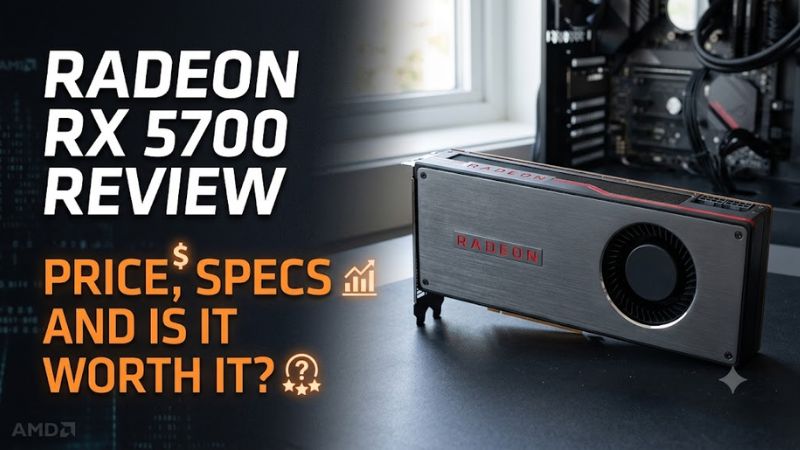
The radeon rx 5700 review: price, specs and is it worth it question matters most to budget-conscious PC gamers considering an older graphics card. AMD’s RDNA-based GPU still offers capable traditional rendering, 8GB of GDDR6 memory, and PCIe 4.0 connectivity. However, its age, limited modern graphics features, and uncertain secondhand pricing affect its value in 2026.
How to Choose a Graphics Card in 2026
Choosing a graphics card requires more than comparing average frame rates. Consider the games you play, the resolution you target, the card’s condition, and the total cost of installation. The Radeon RX 5700 launched in 2019, so its strongest case today is a suitably priced used card rather than a new purchase at an inflated price.
Consider Your Gaming Resolution
The RX 5700 is primarily suited to 1080p gaming, with 1440p remaining practical when a game’s demands and graphics settings permit. Its performance varies by title, engine, and CPU, so older benchmark results should not be treated as predictions for every modern release. Lowering texture quality can also help when 8GB of VRAM becomes a limitation.
For historical context, PC Gamer’s 2019 review reported the RX 5700 averaging approximately 11% higher frame rates than the GeForce RTX 2060 at 1440p Ultra across its benchmark suite. Those results reflect that review’s specific games and test system, not current games or every available card. Source: PC Gamer, AMD Radeon RX 5700 review. Read the original benchmark review.
Check Memory and Modern Graphics Features
The RX 5700 includes 8GB of GDDR6 memory on a 256-bit bus, providing 448GB/s of memory bandwidth. These specifications remain relevant to conventional rasterized games, but memory capacity alone cannot predict performance. Demanding textures, complex scenes, and newer rendering techniques can push the card beyond its comfortable operating range.
Another consideration is ray tracing. The RX 5700 lacks dedicated hardware for accelerating ray tracing, unlike newer graphics cards designed with that capability. It also misses newer GPU architectures’ feature sets and efficiency improvements. If your preferred games rely heavily on ray tracing or advanced upscaling and frame-generation features, a newer card may provide a more suitable experience.
Verify Power, Cooling, and Physical Fit
AMD specifies a typical board power of 180W for the reference RX 5700. The original reference design uses one eight-pin PCIe auxiliary power connector, although individual partner models can differ. Check the exact card’s manufacturer specifications before purchasing, particularly if the listing uses a photograph that may not show the actual model.
A good-quality power supply with sufficient capacity and the correct native PCIe power connection is essential. Also confirm the card’s length, slot thickness, and cooling arrangement against your case. Used cards may have worn fans, accumulated dust, or degraded thermal interface materials, making condition and return rights important parts of the buying decision.
Compare the Total Cost of Ownership
A low asking price does not automatically make an old GPU a good deal. Add any shipping costs, potential repairs, and the cost of a power supply upgrade before comparing it with a newer alternative. Warranty coverage also matters because many original retail warranties may have expired or may not transfer to a second owner.
For a used RX 5700, request clear photographs, the exact manufacturer and model number, and evidence that the card operates correctly under a sustained gaming workload. Compare its asking price with working alternatives available locally. If the difference is small, a newer GPU with current driver support and more modern features can be the more sensible long-term purchase.
Top Picks: Radeon RX 5700 and Its Alternatives
The radeon rx 5700 review: price, specs and is it worth it assessment depends on whether you want inexpensive conventional gaming or a GPU with a longer feature-support horizon. The following comparison separates the older card from newer alternatives. Current street prices and availability vary by retailer and region, so compare live listings rather than relying on historical launch prices.
| Product | Best For | Key Spec | Compatibility | Watch Out For |
| AMD Radeon RX 5700 | Best Overall for a cheap used build | 8GB GDDR6; 180W typical board power | PCIe x16 desktop slot; check auxiliary connector | Age, condition, no dedicated ray tracing hardware |
| AMD Radeon RX 6600 | Best Value alternative | 8GB GDDR6; PCIe 4.0 x8 interface | Compatible PCIe desktop slot; verify PSU and case | Reduced bandwidth on some platforms |
| Intel Arc B580 | Best For newer features and 1440p | 12GB GDDR6; PCIe 4.0 x8 interface | Compatible PCIe slot; Resizable BAR support is important | Driver and game-specific variation |
| NVIDIA GeForce RTX 5060 | Best For modern NVIDIA features | 8GB GDDR7; PCIe 5.0 x8 interface | Compatible PCIe slot; verify exact board power and connector | 8GB VRAM can constrain demanding games |
Best Overall: AMD Radeon RX 5700
The Radeon RX 5700 is most attractive to buyers assembling an inexpensive PC from used components. Its 8GB of GDDR6 memory, 256-bit bus, and established rasterization performance make it worth considering for older games and many conventional 1080p workloads. Buyers should prioritize a working, fairly priced card over an overclocked model with uncertain history.
Its weaknesses are age, limited modern graphics features, and the possibility of previous mining or heavy use. It is not the right choice for someone who wants dedicated ray tracing hardware or a fresh retail warranty. The radeon rx 5700 review: price, specs and is it worth it verdict is therefore conditional: buy only when its price makes the compromises worthwhile.
Best Value: AMD Radeon RX 6600
The RX 6600 is a useful comparison for budget builders because it uses 8GB of GDDR6 and a PCIe 4.0 x8 interface while targeting efficient 1080p gaming. Its lower board power than the RX 5700 reference specification can also make it easier to accommodate in a modest system. Actual performance depends on the game, driver, and specific board.
Choose the RX 6600 if its price is competitive and you prefer a newer architecture with lower power demands. It still has 8GB of memory, so it is not immune to demanding modern games. Buyers with an older PCIe 3.0 system should also understand that the card’s narrower interface can affect performance in some workloads, although the impact varies.
Best For Modern Features: Intel Arc B580
The Intel Arc B580 offers 12GB of GDDR6 memory and newer graphics capabilities, making it an alternative for buyers who play demanding games and want additional memory headroom. It is worth comparing against used RX 5700 listings when prices are close, especially if you care about modern rendering features rather than simply maximizing performance per dollar in older games.
Its suitability depends on the complete system and game library. Resizable BAR support is important for getting the intended performance, and individual titles can behave differently across graphics architectures. Check your motherboard, CPU platform, BIOS options, and current driver support before purchasing. Do not assume every older PC will deliver the same results as a newer test system.
Best For NVIDIA Features: GeForce RTX 5060
The RTX 5060 provides a newer NVIDIA architecture, 8GB of GDDR7 memory, and access to contemporary NVIDIA gaming technologies. It is a better fit for buyers who specifically want supported ray tracing, DLSS features, or newer software capabilities. These advantages can matter more than raw traditional rendering performance when choosing a GPU for current releases.
However, its 8GB memory capacity is still a potential limitation in demanding games at high settings. It is also not automatically the right purchase for every budget: compare the actual price, warranty, power requirements, and independent benchmarks for your games. Someone building a low-cost PC may get better overall value from a discounted previous-generation card.
Frequently Asked Questions
Is the Radeon RX 5700 still worth buying in 2026?
Yes, the RX 5700 can be worth buying in 2026 if you find a functional used card at a sufficiently low price. It remains useful for many 1080p games and selected 1440p workloads, but its 8GB VRAM capacity, lack of dedicated ray tracing hardware, and age make it less suitable for buyers seeking modern features or long-term headroom.
What is the original price of the Radeon RX 5700?
The Radeon RX 5700 launched at $349 in the United States in 2019, before taxes. That figure is historical MSRP, not a current market valuation. Secondhand prices depend on location, condition, seller protections, and availability, so use recent local listings to determine whether a particular card offers reasonable value.
What power supply does the RX 5700 need?
AMD lists typical board power at 180W for the reference RX 5700, and the reference design uses an eight-pin PCIe auxiliary connector. The exact PSU recommendation and connector arrangement can vary with the rest of the PC and the partner card, so consult the specific manufacturer’s requirements rather than assuming every RX 5700 model is identical.
Can the Radeon RX 5700 run games at 1440p?
Yes, the RX 5700 can run many games at 1440p, but performance depends on the title, settings, and desired frame rate. Historical benchmarks from Tom’s Hardware and PC Gamer provide useful comparisons, although their older game suites do not predict results in modern releases. Reducing demanding settings may help when GPU performance or VRAM capacity becomes a constraint.
Final Thoughts
The radeon rx 5700 review: price, specs and is it worth it conclusion is straightforward: this GPU remains a reasonable used-market option for budget-focused gamers who mainly play conventional 1080p titles. Its 8GB memory, 180W reference power rating, and aging feature set limit its appeal. Compare the total cost with newer alternatives before buying.