🛒 Best Price Today on Amazon
Prime members get fast, free shipping on everything above, plus member-only deals. New members get a 30-day free trial — cancel anytime.
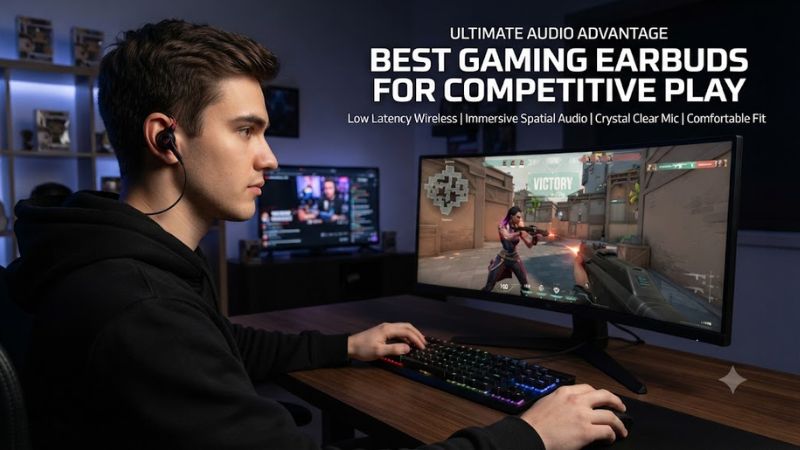
For best gaming earbuds for competitive play, prioritize sound separation, positional imaging, a secure fit, and a connection suited to your PC. Wired IEMs avoid wireless latency, while modern 2.4GHz models add convenience without relying on ordinary Bluetooth. Platform support and microphone needs also change which design makes sense.
How to Choose Gaming Earbuds for Competitive Play
The right model depends less on headline features than on how well it handles fast audio cues. For PC competitive games, start with connection type, then consider imaging and separation, physical isolation and fit, and finally microphone and software support. These criteria lead to different picks because no single design covers every use case equally well.
Choose a Low-Latency Connection
For best gaming earbuds for competitive play, connection latency matters most when visual timing and audio cues must stay closely aligned. A wired IEM sends analog audio without a wireless link, while 2.4GHz gaming systems use dedicated dongles designed for low-latency play. Standard Bluetooth is better treated as a secondary option for gaming.
The Sony INZONE E9 uses a detachable 3.5mm connection and includes a USB-C audio box for PC features, making it the straightforward wired choice. SteelSeries Arctis GameBuds and ASUS ROG Cetra True Wireless SpeedNova instead provide dedicated 2.4GHz modes, so players can avoid using conventional Bluetooth during competitive sessions.
Prioritize Separation and Imaging
Competitive audio needs enough separation for footsteps, reloads, abilities, and gunfire to remain distinguishable when several sounds overlap. Imaging then helps translate those sounds into direction. SoundGuys specifically emphasizes separation and isolation ahead of spatial width and depth when assessing competitive gaming IEMs.
The Sony INZONE E9 is the specialist option here, with Sony describing its tuning as optimized for FPS sounds and SoundGuys reporting strong competitive-shooter performance. Oriveti’s bleqk Dynabird takes a broader approach, combining positional performance with a more musical tuning for games outside competitive shooters.
Match Fit and Isolation to Your Room
A secure seal can matter as much as a driver specification because outside noise can mask quiet cues. The Sony INZONE E9 uses a sealed housing, multiple ear tips, and a flexible ear hook, while the Dynabird uses conventional IEM tips and passive isolation. A good fit is therefore part of the practical compatibility between your ears and the earbud.
For best gaming earbuds for competitive play in a noisy room, passive isolation can be particularly useful because it does not require ANC processing. Wireless models add ANC as an option: both Arctis GameBuds and ROG Cetra True Wireless SpeedNova provide active noise cancellation, giving them more flexibility when gaming away from a quiet desk.
Check PC, Console, and Mic Compatibility
Compatibility should be checked before comparing sound quality. A PC gamer can use USB, 3.5mm, or supported wireless connections, but console compatibility varies by model and version. SteelSeries lists PC, PlayStation, Xbox, and handheld support for Arctis GameBuds, while ASUS provides 2.4GHz and Bluetooth connectivity for its SpeedNova model.
Microphone requirements also separate these picks. The INZONE E9 and Dynabird do not include microphones, so they suit players who already use a desktop, USB, webcam, or separate headset microphone. Arctis GameBuds and ROG Cetra SpeedNova include microphones, making them simpler for Discord and in-game voice chat without adding another audio device.
Top Picks for Competitive Gaming
The four choices below cover different priorities rather than one universal design. Sony focuses heavily on competitive FPS audio, Oriveti provides a wired IEM alternative with broader listening appeal, SteelSeries combines 2.4GHz wireless with Bluetooth, and ASUS adds extensive wireless features. Prices are manufacturer MSRP or current manufacturer-listed pricing where available, not temporary retailer discounts.
| Product | Best For | Key Spec | Compatibility | Watch Out For |
| Sony INZONE E9 | Best Overall | 3.5mm; USB-C audio box; 1.8m cable | PC, laptop, controller | No microphone |
| Oriveti bleqk Dynabird | Best Value | 9.2mm dynamic driver; 16Ω | 3.5mm PC, laptop, controller, dongle | No microphone |
| SteelSeries Arctis GameBuds | Best Wireless | 2.4GHz + Bluetooth 5.3; up to 10h | PC, PlayStation, Xbox, handhelds | Mic noise handling can vary |
| ASUS ROG Cetra SpeedNova | Best Features | 2.4GHz + Bluetooth 5.3; 10mm drivers | PC and supported consoles/devices | $199.99 MSRP |
Sony INZONE E9 — Best Overall
The Sony INZONE E9 is the most specialized option for players whose priority is competitive FPS audio. It uses a wired 3.5mm connection, a sealed in-ear design, a flexible ear hook, and a supplied USB-C audio box with PC-oriented features. Sony lists a $149.99 MSRP, while its current US store page also shows promotional pricing.
The real weakness is versatility: there is no built-in microphone, and independent reviews describe the tuning as less appealing for general entertainment and non-FPS games. SoundGuys specifically found the E9 particularly strong for competitive shooters while noting those tradeoffs, so it is not a sensible choice if one pair must also handle voice chat without another microphone.
Oriveti bleqk Dynabird — Best Value
The Oriveti bleqk Dynabird costs $99 and uses a 9.2mm beryllium-coated dynamic driver, a 16-ohm impedance, and a detachable 0.78mm two-pin cable terminating in 3.5mm. Its compatibility is therefore broad across PCs, laptops, controllers, and external audio adapters that provide a standard analog output.
For best gaming earbuds for competitive play at a lower price, the Dynabird has an important advantage: SoundGuys found its positioning strong for competitive shooters while also describing it as more enjoyable for music and other games than the Sony E9. The main weakness is the lack of a microphone, plus less passive isolation than the E9.
SteelSeries Arctis GameBuds — Best Wireless
The SteelSeries Arctis GameBuds are the practical wireless choice when a PC player wants dedicated gaming connectivity without giving up Bluetooth. SteelSeries lists 2.4GHz wireless, Bluetooth 5.3, ANC, 100-plus game audio presets, and up to 10 hours per charge with up to 40 hours from the charging case. MSRP is $159.99.
The main weakness is microphone performance in difficult environments rather than gaming connectivity. RTINGS reports that default microphone noise handling can affect voice clarity, while SoundGuys also notes limitations including SBC-only Bluetooth and PC-only custom EQ. Players wanting the simplest wireless setup should therefore use 2.4GHz for gaming rather than ordinary Bluetooth.
ASUS ROG Cetra True Wireless SpeedNova — Best Features
The ASUS ROG Cetra True Wireless SpeedNova targets players who want a feature-rich wireless package. ASUS lists Bluetooth 5.3, 2.4GHz SpeedNova, LC3 and LC3+ for 2.4GHz, 10mm drivers, ANC, and Armoury Crate support. Its US MSRP is $199.99, putting it above the other wireless option here.
For best gaming earbuds for competitive play, its advantage is flexibility rather than a narrow FPS specialization. RTINGS describes the 2.4GHz connection as low latency and notes PC software support, while ASUS adds bone-conduction AI microphones and adaptive ANC. The drawback is cost: many competitive PC players may not need its broader feature set.
FAQ About Gaming Earbuds for Competitive Play
The main buying question is whether an earbud’s connection, imaging, isolation, and communication features fit the game and setup. Wired IEMs remain straightforward for competitive PC play, while dedicated 2.4GHz wireless models are more convenient when cable-free movement and device switching matter.
Are wired earbuds better for competitive gaming?
Yes, wired earbuds avoid the additional wireless transmission stage and are a straightforward choice when low latency is the priority. A 3.5mm IEM such as the Sony INZONE E9 or Oriveti Dynabird can connect directly to compatible PC audio hardware without requiring a wireless dongle.
That does not make every wireless model unsuitable. Arctis GameBuds and ROG Cetra SpeedNova both offer dedicated 2.4GHz gaming modes, which independent reviews and manufacturer documentation distinguish from ordinary Bluetooth connections. For desktop players who prefer wireless, those modes are the relevant comparison rather than Bluetooth music mode.
Do gaming earbuds help with footsteps?
Yes, gaming earbuds can make footsteps easier to distinguish when their tuning, separation, imaging, and isolation suit the game. SoundGuys highlights separation and isolation as especially important because directional information is less useful if louder effects mask the quieter cue.
The effect depends on the game mix and the listener, so no earbud can create positional information that is absent from the game’s audio. The Sony INZONE E9 is specifically tuned for FPS sounds, while the Dynabird provides a less specialized presentation that independent testing found suitable for competitive shooters and other games.
Can I use these earbuds on a gaming PC?
Yes, all four picks can be used with a compatible gaming PC, but their connection methods differ. The Sony INZONE E9 and Dynabird use analog connections, while Arctis GameBuds and ROG Cetra SpeedNova provide USB-based 2.4GHz wireless connections alongside Bluetooth.
PC software support also differs. Sony provides the INZONE Hub experience through the supplied USB-C audio box, SteelSeries provides its software ecosystem for GameBuds, and ASUS uses Armoury Crate for SpeedNova configuration. Players should therefore check available USB ports and the intended audio connection before buying.
Which earbuds are suitable for Discord voice chat?
Arctis GameBuds and ROG Cetra True Wireless SpeedNova are the straightforward choices here because both include built-in microphones. The Sony INZONE E9 and Oriveti Dynabird do not have microphones, so they require a separate microphone or another voice-chat input.
For best gaming earbuds for competitive play, that distinction can be more important than a small difference in audio tuning. A player with a dedicated USB microphone can choose either wired IEM without sacrificing communication, while a player who wants one compact device should focus on the wireless models with integrated microphones.
Final Thoughts
The best gaming earbuds for competitive play depend on whether you value wired simplicity, specialized FPS tuning, wireless convenience, or broader features. Sony INZONE E9 and Oriveti Dynabird emphasize wired competitive audio, while SteelSeries and ASUS add 2.4GHz wireless, microphones, and extra software features for more flexible PC setups.