🛒 Best Price Today on Amazon
Prime members get fast, free shipping on everything above, plus member-only deals. New members get a 30-day free trial — cancel anytime.
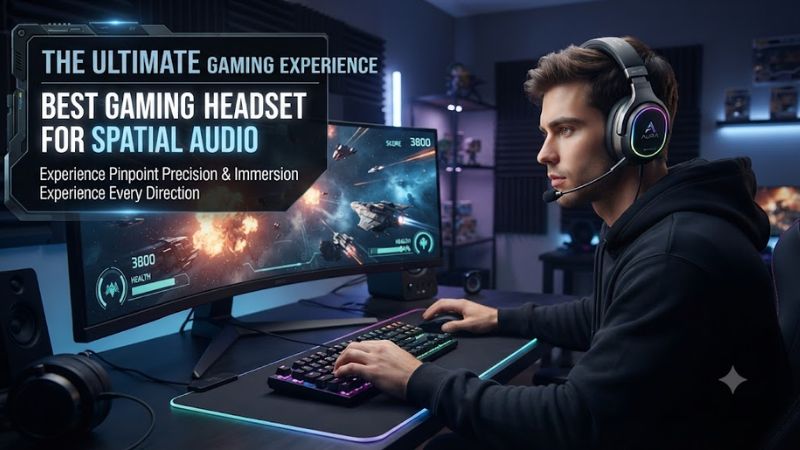
Spatial audio depends on more than a headset’s surround label. best gaming headset for spatial audio buyers should check the spatial format, connection method, software support, platform compatibility, and how well the headset preserves directional cues in actual independent measurements.
How to Choose a Gaming Headset for Spatial Audio
The right headset should match your PC software, preferred connection, comfort needs, and game types. A headset with DTS Headphone:X, THX Spatial Audio, or SteelSeries Sonar can process positional information differently, so feature names alone do not establish identical results. Independent reviews also show that stereo imaging can remain important.
Spatial audio format and software
A best gaming headset for spatial audio should provide a clearly supported spatial system rather than relying only on a generic surround label. Razer’s BlackShark V3 uses THX Spatial Audio, while HyperX’s Cloud III S Wireless includes DTS Headphone:X Spatial Audio through its software.
Software also matters because spatial processing may be enabled or adjusted outside Windows’ basic sound controls. Razer specifies THX Spatial Audio 7.1.4 for the BlackShark V3 on Windows 11 version 23H2 or later, while HyperX provides DTS processing through NGENUITY on PC.
Directional accuracy matters more than the label
A best gaming headset for spatial audio needs clear positional information when sounds move around the listener. Independent measurements and listening reports can therefore be more useful than a product page’s surround terminology, particularly for shooters where front, rear, vertical, and lateral cues need to remain distinguishable.
For competitive games, spatial processing is not automatically preferable to stereo. PCWorld’s review of the Arctis Nova 7 Gen 2 found strong localization in stereo and additional width with Sonar Spatial Audio, illustrating why buyers should compare both modes rather than assuming virtual surround is always superior.
Connection and latency
A best gaming headset for spatial audio should use a low-latency connection for PC gaming, especially when directional sounds must align closely with on-screen action. The BlackShark V3 supports 2.4GHz, Bluetooth, and USB, while the Maxwell 2 supports a USB-C wireless dongle, Bluetooth, and wired USB-C or 3.5mm connections.
Wireless convenience varies substantially between models. The BlackShark V3 advertises up to 70 hours of battery life, whereas HyperX lists up to 120 hours over 2.4GHz and up to 200 hours over Bluetooth for Cloud III S Wireless. Battery figures depend on operating mode and usage, so they should not be treated as direct measurements of spatial performance.
Compatibility should match your setup
For a best gaming headset for spatial audio, compatibility includes both the physical connection and the software needed for spatial processing. The BlackShark V3 supports PC, PlayStation, Xbox, and mobile connections, while Cloud III S Wireless supports PC, Mac, PS5, mobile devices, and Nintendo Switch but not Xbox.
PC buyers should also check operating-system requirements before choosing a headset. Razer specifically requires Windows 11 version 23H2 or newer for THX Spatial Audio 7.1.4 on the BlackShark V3, while HyperX’s DTS implementation is accessed through its PC software rather than requiring a particular graphics card or motherboard platform.
Top Picks
The table below separates four current options by the type of buyer they suit. The picks use manufacturer specifications plus independent reviews and measurements rather than PC Gaming Universe detailed research. Prices can change by retailer, so no temporary sale price is treated as a fixed specification.
| Product | Best For | Key Spec | Compatibility | Watch Out For |
| Razer BlackShark V3 | Best Overall | 50mm TriForce Titanium Gen-2; THX Spatial Audio 7.1.4 | PC, PS, Xbox, mobile | Spatial 7.1.4 needs Windows 11 23H2+ |
| HyperX Cloud III S Wireless | Best Value | 53mm angled drivers; DTS Headphone:X | PC, Mac, PS5, mobile, Switch | No Xbox support |
| SteelSeries Arctis Nova 7 Gen 2 | Best For Multiplatform Use | 40mm drivers; 50-hour-class battery | PC, consoles, mobile | Microphone quality is a weak point |
| Audeze Maxwell 2 | Best For Audio Quality | 90mm planar magnetic drivers; Dolby Atmos support | PC, PS or Xbox variants | Heavy design |
Razer BlackShark V3 — Best Overall
The best gaming headset for spatial audio for a broad PC audience is the Razer BlackShark V3 when THX processing and low-latency wireless are priorities. It combines 50mm TriForce Titanium Gen-2 drivers, three connection methods, and THX Spatial Audio 7.1.4 support on compatible Windows 11 systems.
The real weakness is that its headline spatial mode has an operating-system requirement, and low-latency operation affects battery endurance. PC Gamer also reports that the headset’s standard wireless mode has higher latency than its dedicated low-latency mode. Buyers who need Mac-first spatial processing or dislike Razer software should consider another option.
HyperX Cloud III S Wireless — Best Value
The best gaming headset for spatial audio at a value-oriented price tier is the HyperX Cloud III S Wireless, particularly for PC players who want DTS processing without moving into premium pricing. It uses angled 53mm drivers, 2.4GHz wireless, Bluetooth, and DTS Headphone:X Spatial Audio through HyperX software.
Its biggest limitation is platform coverage rather than core PC functionality. HyperX lists PC, Mac, PS5, mobile, and Switch compatibility, with no Xbox support, while independent measurements from SoundGuys found improved reproduction and better perceived positioning with DTS enabled. Xbox-focused buyers should therefore choose another variant or model.
SteelSeries Arctis Nova 7 Gen 2 — Best For Multiplatform Use
The SteelSeries Arctis Nova 7 Gen 2 suits buyers who want flexible wireless connections alongside spatial processing. SteelSeries lists 360° Spatial Audio, USB-C connectivity, and a 50-hour battery rating, while independent reviews report simultaneous 2.4GHz and Bluetooth operation and broad PC, console, and mobile compatibility.
Its real weakness is the microphone, which Tom’s Guide describes as underwhelming for the price, while the headset’s physical controls also receive criticism. It is therefore less attractive for users who prioritize microphone quality above connection flexibility, although PC users can further adjust audio and microphone settings through SteelSeries GG.
Audeze Maxwell 2 — Best For Audio Quality
The Audeze Maxwell 2 is the best gaming headset for spatial audio for buyers who put high-resolution audio ahead of weight and portability. Its 90mm planar magnetic drivers, USB-C wireless connection, Bluetooth, and wired inputs give it a substantially different hardware approach from typical dynamic-driver gaming headsets.
The important drawback is weight. Independent measurements describe the Maxwell 2 as heavy and potentially fatiguing during long sessions, while other reviews also note that it cannot simultaneously mix wireless dongle and Bluetooth audio. Buyers wanting a lightweight headset or dual-wireless mixing should look elsewhere.
FAQ
Is spatial audio better than stereo for PC gaming?
Spatial audio is not automatically better than stereo for every PC game, because positional processing depends on the game’s audio implementation, headset response, and the listener’s preferences. Independent reviews of the Nova 7 Gen 2 found strong directional localization in stereo while also finding Sonar Spatial Audio useful for a wider presentation.
For competitive shooters, start by checking how a game handles its own spatial mix before adding another processing layer. A headset such as the BlackShark V3 provides a dedicated THX mode, but its software requirement means Windows configuration is part of the buying decision.
Does Windows spatial audio work with gaming headsets?
Windows spatial audio can work with compatible gaming headsets, but the exact setup depends on the headset’s software and licensed format. Razer’s BlackShark V3 uses THX Spatial Audio through its software, while Audeze provides Dolby Atmos configuration through Dolby Access on compatible Maxwell systems.
Avoid enabling several spatial processors simultaneously unless a game or headset specifically requires that arrangement. Running overlapping virtual-surround layers can change the intended presentation, so use the headset’s documented processing path and compare it with the game’s native spatial option when available.
Does a wireless headset add noticeable audio delay?
A modern 2.4GHz wireless headset can provide low-latency gaming audio, so wireless operation does not inherently mean a noticeable delay. Independent reviews describe low-latency wireless performance for the Maxwell 2, while Razer advertises a dedicated low-latency mode for the BlackShark V3.
Bluetooth is a different consideration because gaming latency can vary by codec and device implementation. For PC gaming where timing matters, the included 2.4GHz dongle is generally the connection to prioritize when the headset provides one, leaving Bluetooth for compatible secondary devices.
Which headset is easiest to use across PC and consoles?
The SteelSeries Arctis Nova 7 Gen 2 is designed around broad connectivity, with simultaneous 2.4GHz and Bluetooth support and compatibility spanning PC, consoles, and mobile devices. The exact console experience still depends on the particular connection and platform, so buyers should verify the variant before ordering.
The HyperX Cloud III S Wireless is also flexible, but its official compatibility list excludes Xbox. The Audeze Maxwell 2 uses separate PlayStation and Xbox variants, while the Razer BlackShark V3 supports PC, PlayStation, Xbox, and mobile connections.
Final Thoughts
Choosing the best gaming headset for spatial audio comes down to processing format, positional clarity, connection latency, software, and platform compatibility. The BlackShark V3 emphasizes THX processing, Cloud III S emphasizes value, Nova 7 Gen 2 emphasizes connectivity, and Maxwell 2 emphasizes planar audio hardware.