🛒 Best Price Today on Amazon
Prime members get fast, free shipping on everything above, plus member-only deals. New members get a 30-day free trial — cancel anytime.
Best motherboard with built in wifi for gaming should start with the CPU socket, then Wi-Fi generation, memory type, expansion needs, and case size. Current AMD and Intel platforms use different sockets and DDR5, so a board with built-in wireless is only useful when the rest of the platform matches your build.
How to Choose a Motherboard With Built-In Wi-Fi
The right board depends less on a gaming label than on platform fit. For current builds, AM5 covers Ryzen 7000, 8000 and 9000 desktop CPUs, while Intel B860 boards target Core Ultra processors using LGA1851. Wi-Fi 6E is already practical for gaming, while Wi-Fi 7 matters more when your router and client devices support it.
Start With CPU Socket and Memory
Start with the socket before comparing networking features. A board such as the MSI MAG B850 Tomahawk MAX WiFi uses AM5/DDR5, while the ASUS Prime B860-Plus WiFi uses LGA1851/DDR5. Neither platform accepts the other company’s desktop CPUs, so the CPU should decide the motherboard family first. Platform-compatibility matters.
For an AMD-build, the best motherboard with built in wifi for gaming should match the Ryzen-generation/RAM-plan rather than chase the newest chipset. The MSI B850 board supports Ryzen 7000, 8000 and 9000 processors, while four DIMM slots use DDR5 and support EXPO and A-XMP memory-profiles for mainstream gaming builds.
Check Wi-Fi 6E or Wi-Fi 7
Wireless-generation is the second filter. Wi-Fi 6E uses the 6 GHz band, while Wi-Fi 7 adds newer features such as wider channels and Multi-Link Operation. A Wi-Fi-7 motherboard does not make an older-router faster, so the networking hardware at both ends of the connection still determines what you can use.
The ASUS Prime B860-Plus WiFi provides 2×2 Wi-Fi 6E and Bluetooth 5.3, matching a router that supports 6 GHz without requiring Wi-Fi 7. The MSI B850 Tomahawk MAX WiFi moves to Wi-Fi-7 and 5G LAN, but MSI lists Wi-Fi-7-support as Windows 11 only for this board when both-end support is present.
Match PCIe and M.2 Expansion
Expansion should match the way the PC will be used. The MSI B850 Tomahawk MAX WiFi has one PCIe 5.0 x16 graphics slot and multiple M.2-slots, while the ASUS B860-Plus WiFi has one PCIe 5.0 x16 slot and two M.2-slots. Extra storage can therefore be a deciding factor between otherwise similar boards for GPU-expansion.
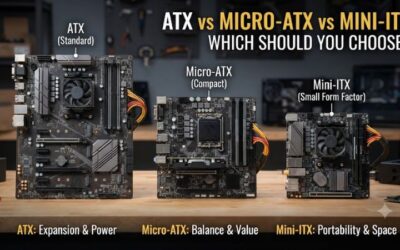
For compact systems, the ASRock B850I Lightning WiFi uses the Mini-ITX format at 17 by 17 cm, with two DDR5 DIMM slots, one PCIe 5.0 x16 slot, and two M.2 slots. It suits a small-AM5 system, but the layout leaves less expansion-room than ATX-boards for additional cards and storage.
Verify Case and RAM Compatibility
Case clearance is the fourth check because built-in Wi-Fi does not change board-dimensions. ATX-boards such as the MSI, ASUS, and Gigabyte picks need an ATX-case, while the ASRock B850I is Mini-ITX. Also confirm cooler/GPU/radiator/power-cable clearance before ordering. Always verify case-support before purchase.
Memory compatibility deserves attention. These current boards use DDR5 rather than DDR4, and advertised memory speeds can depend on the CPU, DIMM count, BIOS version, and memory kit. Check the manufacturer’s memory-support list when a high-speed-kit matters, especially with 2/4 modules before buying a high-speed kit.
Top Picks
These four boards cover mainstream AMD, mainstream Intel, compact AM5, and Wi-Fi 7-focused Intel builds. The selections use current manufacturer-specs and platform-fit rather than lab testing. Prices are omitted because retail pricing changes by region and date, while the hardware requirements below remain verifiable.
| Product | Best For | Key Spec | Compatibility | Watch Out For |
| MSI MAG B850 Tomahawk MAX WiFi | Best Overall | Wi-Fi 7; 4× M.2 | AM5; DDR5; ATX | Feature set may exceed a basic build |
| ASUS Prime B860-Plus WiFi | Best Value | Wi-Fi 6E; PCIe 5.0 M.2 | LGA1851; DDR5; ATX | 2× M.2; no Wi-Fi 7 |
| ASRock B850I Lightning WiFi | Best For compact AM5 | Wi-Fi 6E; 2× M.2 | AM5; DDR5; Mini-ITX | Limited expansion |
| Gigabyte B860 AORUS Elite WiFi7 Ice | Best For Wi-Fi 7 Intel | Wi-Fi 7; 3× M.2 | LGA1851; DDR5; ATX | B860 is not for CPU multiplier overclocking |
MSI MAG B850 Tomahawk MAX WiFi
The MSI MAG B850 Tomahawk MAX WiFi is the Best Overall choice for an AM5 gaming-PC needing strong networking and expansion. It supports Ryzen 7000/8000/9000, DDR5, Wi-Fi 7, 5G LAN, one PCIe 5.0 x16 GPU-slot, and four M.2 connections, including two PCIe 5.0 x4 positions for supported processors.
Its main weakness is that the feature set is more than a basic gaming system may need, particularly if the network is limited to Wi-Fi-6E or wired gigabit Ethernet. Do not buy it for an Intel-CPU or DDR4 build; it is an ATX AM5 board and requires a compatible AM5 processor, DDR5 memory, and an ATX case.
ASUS Prime B860-Plus WiFi
The ASUS Prime B860-Plus WiFi is the Best Value choice for an Intel Core Ultra build that needs integrated-Wi-Fi. It supports LGA1851, DDR5, Wi-Fi 6E, 2.5Gb-Ethernet, one PCIe 5.0 x16 slot, and two M.2-slots, including one PCIe 5.0 x4 connection for a fast boot drive in a mainstream gaming-system.
For best motherboard with built in wifi for gaming, note that the ASUS Prime B860-Plus WiFi has only two M.2-slots and Wi-Fi-6E. Skip it if you need Wi-Fi 7 or multiple NVMe-drives. It also requires an ATX case, DDR5 memory, and an Intel-LGA1851 processor for a typical gaming build without guesswork.
ASRock B850I Lightning WiFi
The ASRock B850I Lightning WiFi is the Best For compact-AM5 systems. Its Mini-ITX 17 by 17 cm footprint supports Ryzen 7000/8000/9000, DDR5, Wi-Fi 6E, 2.5Gb LAN, one PCIe 5.0 x16 slot, and one Gen5 plus one Gen4 M.2 slot, with BIOS Flashback for recovery in compact builds.
The trade-off is limited expansion. Two DDR5 DIMM slots and the Mini-ITX layout provide less RAM/add-in-card flexibility than ATX-boards, while Wi-Fi 6E is not Wi-Fi 7. Choose another board if you need several-drives, several PCIe cards, or an ATX-oriented build; this model is for compact-AM5 systems and case-layout limits.
Gigabyte B860 AORUS Elite WiFi7 Ice
The Gigabyte B860 AORUS Elite WiFi7 Ice is Best For Intel builders who specifically want Wi-Fi 7 without moving to a Z-series chipset. It uses LGA1851 and B860, supports DDR5, Wi-Fi 7, 2.5GbE, USB4 Type-C, one PCIe 5.0 x16 slot, and three M.2 slots for current-connectivity without moving to a higher chipset tier.
Its weakness is that B860 is aimed at mainstream Core Ultra platform use rather than CPU multiplier overclocking. Do not choose it solely for the white-design if you have no Wi-Fi-7 network, and confirm the case supports ATX. The board also requires DDR5 and an Intel Core Ultra processor using LGA1851.
FAQ
These answers cover common buyer questions after the shortlist is clear. Built-in Wi-Fi is a networking feature, not a promise of lower game latency; the router, wireless-environment, internet-connection, and server path still affect online play. Those factors can matter more than the Wi-Fi label.
Is Built-In Wi-Fi Good Enough for Gaming?
Yes, built-in Wi-Fi can be useful for gaming when Ethernet is impractical. A motherboard with integrated Wi-Fi removes the need for a separate Wi-Fi-adapter and keeps the antenna connection on the rear I/O, while Wi-Fi 6E or Wi-Fi 7 can use 6 GHz when the network supports it in your home.
For a best motherboard with built in wifi for gaming, prioritize a supported CPU socket and stable platform features before the Wi-Fi badge. Wi-Fi 7 is not required for PC gaming, and Wi-Fi 6E can be enough when the router, internet service, and local wireless environment do not justify newer hardware.
Do You Need Wi-Fi 7 for a Gaming PC?
No, Wi-Fi 7 is not required for a gaming-motherboard. Wi-Fi 6E supports the 6-GHz-band, and the ASUS Prime B860-Plus WiFi provides 2×2 Wi-Fi 6E alongside 2.5Gb Ethernet. Wi-Fi 7 matters more when the router and client devices both support its newer capabilities and channels across the same network.
For best motherboard with built in wifi for gaming, the network you already own matters. A Wi-Fi 7 board may leave features unused with an older-router, while Wi-Fi 6E can be enough when your network already uses 6 GHz and your gaming PC sits near the access point before changing the motherboard first.
Which CPU Platform Should You Choose?
AM5 and LGA1851 are the current-platforms, and the answer depends on your CPU. Ryzen 7000, 8000, and 9000 use AM5 boards such as the MSI B850 and ASRock B850I, while Intel Core Ultra Series 2 uses LGA1851 boards such as the ASUS and Gigabyte B860 models in this guide with matching DDR5-memory.
When choosing a best motherboard with built in wifi for gaming, do not mix the socket decision with the Wi-Fi-decision. First match the CPU and CPU/DDR5-platform, then select the Wi-Fi generation, M.2 count, PCIe layout, and form factor that fit the rest of the system and case during selection.
Will These Wi-Fi Motherboards Fit Any PC Case?
No, motherboard case-compatibility depends on form factor. The ASUS Prime B860-Plus WiFi and MSI MAG B850 Tomahawk MAX WiFi are ATX boards, while the ASRock B850I Lightning WiFi is Mini-ITX and the Gigabyte B860 AORUS Elite WiFi7 Ice is ATX. Case-compatibility therefore depends on motherboard-form-factor, not built-in Wi-Fi and internal expansion.
Before buying the best motherboard with built in wifi for gaming, confirm the CPU socket, DDR5 support, case-size, GPU clearance, PSU-connectors, and desired M.2 capacity. For Wi-Fi 6E or Wi-Fi 7, also confirm that your Windows version and router-support match the Wi-Fi-features you intend to use before placing the order.
Final Thoughts
The right best motherboard with built in wifi for gaming depends on platform, Wi-Fi-generation, storage-needs, and case-size. The MSI B850 Tomahawk MAX suits feature-rich AM5-builds, ASUS covers mainstream Intel with Wi-Fi 6E, ASRock targets compact AM5 PCs, and Gigabyte targets Intel-Wi-Fi-7 systems.