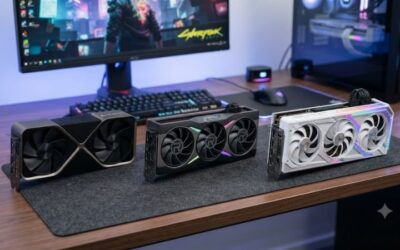
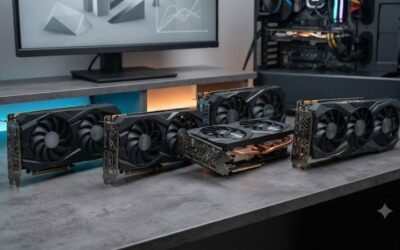
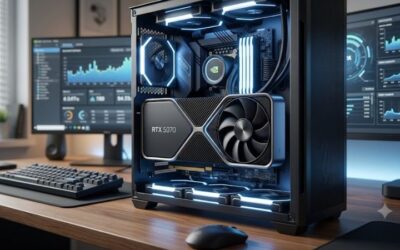
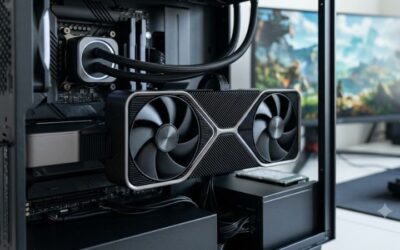
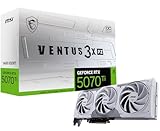
- Top Pick: GIGABYTE GeForce RTX 5070 Ti Gaming OC 16G Graphics Card, 16GB 256-bit GDDR7, PCIe 5.0, WINDFORCE Cooling System, GV-N507TGAMING OC-16GD Video Card
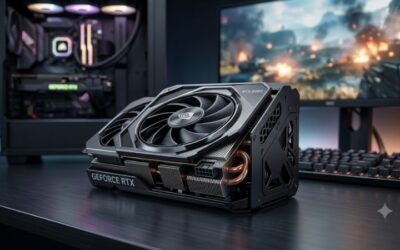
- Best Value: ASUS SFF-Ready Prime NVIDIA GeForce RTX 5070 Ti 16GB GDDR7 OC Edition 16GB GDDR7 Graphics Card (PCIe 5.0, HDMI/DP 2.1, 2.5-Slot, Axial-tech Fans, Dual BIOS), 3 Year Warranty
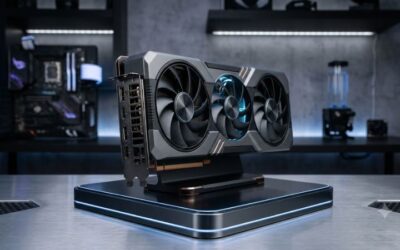
- Premium Choice: GIGABYTE GeForce RTX 5070 Ti Eagle OC ICE SFF 16G Graphics Card, 16GB 256-bit GDDR7, PCIe 5.0, WINDFORCE Cooling System, GV-N507TEAGLEOC ICE-16GD Video Card
Nvidia’s Blackwell mid-range has settled into a clear two-tier structure, and for most gamers building or upgrading in 2026 the decision comes down to a single pair of cards: the GeForce RTX 5070 and the GeForce RTX 5070 Ti. They share an architecture, a display stack and the full DLSS 4 feature set, including Multi Frame Generation — but underneath the marketing they are not the same class of GPU, and the gap between them is wider than the one-word difference in their names implies.
That gap matters more today than it did at launch. Ray tracing is now the default rather than the showcase setting, texture and asset budgets have crept steadily upward, and 1440p high-refresh has replaced 1080p as the mainstream target. Below we break down the real differences in silicon, memory, power draw and value, then explain exactly which buyer each card is built for.
As an Amazon Associate we earn from qualifying purchases at no extra cost to you. Product prices and availability are accurate as of the date shown and are subject to change.



⚡ Save on Your Next PC — Amazon Prime
Prime members get fast free shipping on the systems above, plus early access to Prime Day & Black Friday PC deals. New members get a 30-day free trial.
Watch: RTX 5070 vs 5070 Ti: Which to Buy in 2026? — Video Review
Quick Verdict
The RTX 5070 is the sensible value pick: it is the cheapest current-generation card that comfortably drives 1440p at high refresh rates with DLSS 4 enabled, and it slots into smaller cases and cheaper power supplies without drama. The RTX 5070 Ti is the card to buy if you want maximum settings with ray tracing at 1440p, occasionally game at 4K, run a dual-purpose gaming and creator machine, or simply want a GPU that will still feel comfortable three or four years from now. If your budget stretches to it without compromising your CPU or monitor, the Ti is the better long-term buy.
Key Differences
- GPU silicon: The RTX 5070 uses the smaller GB205 chip with 6,144 CUDA cores, while the 5070 Ti steps up to the cut-down GB203 die with 8,960 — roughly 46% more shader hardware, plus proportionally more RT and Tensor cores.
- Memory: 12GB of GDDR7 on a 192-bit bus versus 16GB on a 256-bit bus. The Ti’s extra capacity and bandwidth (around 896GB/s against 672GB/s) is the single biggest reason it ages better.
- Real-world performance: Expect the 5070 Ti to be roughly 20–25% faster at 1440p and closer to 30% ahead at 4K, where bandwidth and VRAM pressure work in its favour.
- Ray tracing headroom: Both cards handle standard RT effects well, but only the Ti has enough grunt for heavy path-traced titles at 1440p without leaning entirely on aggressive upscaling.
- Power and PSU: 250W versus 300W total board power. Nvidia suggests a 650W supply for the 5070 and 750W for the 5070 Ti, and Ti coolers are generally larger and heavier.
- Creator features: The 5070 Ti carries dual NVENC encoders to the 5070’s single unit, which matters for simultaneous streaming and recording or heavy video export work.
GeForce RTX 5070: The Efficient 1440p Workhorse
The RTX 5070 exists to make high-refresh 1440p affordable, and it does that job well. In the vast majority of current titles it clears 100fps at high settings before upscaling, and DLSS 4 transformer-model Super Resolution plus Multi Frame Generation push it far beyond that on compatible monitors. Its 250W draw means modest cooling requirements, quieter operation under load, and compatibility with the mid-tier power supplies already sitting in most existing builds.
The compromise is memory. 12GB is adequate today, but it is the first thing to buckle in ray-traced open-world games at 1440p with maximum textures, and it leaves little margin for 4K or heavy modding. If you play mostly competitive and mid-weight titles, run a 1440p display, or are pairing the GPU with a mainstream CPU, that trade-off is entirely reasonable — you are getting most of the experience for meaningfully less money.
GeForce RTX 5070 Ti: More Silicon, More VRAM, More Headroom
The 5070 Ti is effectively a scaled-down RTX 5080 rather than a beefed-up 5070, and it shows. The 16GB frame buffer removes the main anxiety around Blackwell’s mid-range, the 256-bit bus keeps ray tracing performance consistent instead of spiky, and there is enough raw throughput to treat