🛒 Best Price Today on Amazon
Prime members get fast, free shipping on everything above, plus member-only deals. New members get a 30-day free trial — cancel anytime.
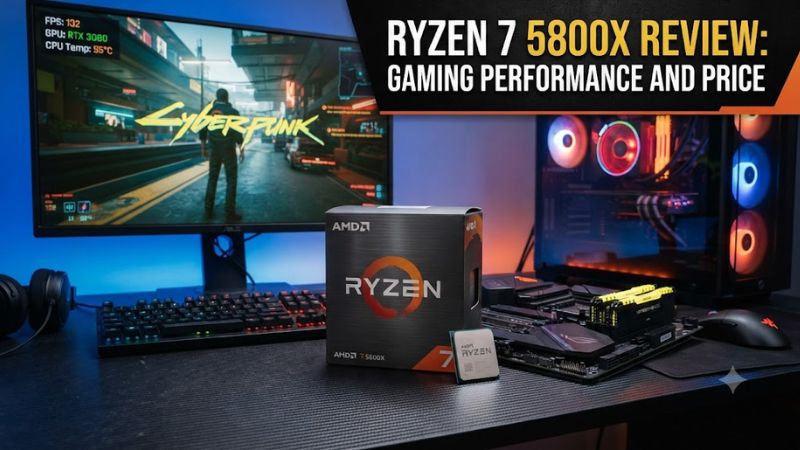
Ryzen 7 5800x review: gaming performance and price points to a capable eight-core AM4 CPU that now competes mainly on platform value rather than new-build performance. Its 3.8 GHz base clock, up to 4.7 GHz boost, DDR4 support and PCIe 4.0 remain useful, but newer AM5 options change the buying calculation in 2026.
How to Choose an AM4 Gaming CPU
The right choice depends first on whether you already own an AM4 board and DDR4 memory, because replacing those parts changes the value equation. The Ryzen 7 5800X fits existing AM4 systems, while the Ryzen 7 5800XT offers a higher advertised boost clock on the same platform. A new build should also consider AM5 alternatives.
Check Socket and Memory Compatibility
The most important point in a ryzen 7 5800x review is platform compatibility: the processor uses Socket AM4 and DDR4, with official memory support up to DDR4-3200. It supports PCIe 4.0, but motherboard support still matters for the available expansion configuration. A discrete graphics card is required because the CPU has no integrated graphics.
For an existing AM4 machine, the 5800X can therefore be a straightforward CPU upgrade when the motherboard firmware supports Ryzen 5000 processors. AMD lists Windows 10 and Windows 11 support, while the processor itself does not include a cooler. A suitable motherboard and separate CPU cooler are part of the actual system requirement.
Match Gaming Performance to the GPU
Gaming results depend heavily on the graphics card and resolution, so the processor should not be judged from one FPS figure. TechSpot’s Ryzen 7 5800X gaming suite used an NVIDIA RTX 3090 and reported an overall result roughly level with the Core i9-10900K, while showing much larger differences in individual games.
Tom’s Hardware also used an RTX 3090 to reduce GPU limitations in its gaming comparison. Its geometric-mean results found the 5800X and Ryzen 5 5600X essentially tied at both 1080p and 1440p, showing why extra CPU cores do not automatically translate into higher gaming FPS.
Consider Cooling and Power
The Ryzen 7 5800X carries a 105W default TDP and reaches a maximum operating temperature of 90°C according to AMD. AMD recommends a premium air cooler, and no thermal solution is included. That means the purchase price should be considered together with the cooling hardware rather than treating the CPU listing as the complete upgrade cost.
This matters particularly in compact or airflow-limited cases. The 5800X can deliver strong CPU performance, but a buyer moving from a lower-power Ryzen chip should check cooler compatibility, case clearance and motherboard VRM capability. There is no integrated graphics fallback, so troubleshooting also requires a discrete GPU.
Compare the Total Upgrade Cost
Current pricing makes the 5800X harder to judge from its original MSRP. Newegg listings recently showed examples around $219, while TechSpot’s price tracker recorded $254 on September 10, 2026. These figures show why the actual retailer price matters more than the original $449 launch price when assessing this older AM4 processor.
The total cost also includes a cooler if you do not already have one and potentially a motherboard BIOS update. For an existing AM4 owner, keeping DDR4 and the motherboard can make the upgrade attractive. For a new PC, adding AM5 motherboard and DDR5 costs changes the comparison substantially.
Top Picks
The 5800X remains relevant mainly as an AM4 upgrade, while newer choices serve different buyers. The table separates platform compatibility from performance so the recommendation does not treat an older socket as equivalent to a current platform. Prices fluctuate by retailer and are shown as practical market ranges rather than fixed launch pricing.
| Product | Best For | Key Spec | Compatibility | Watch Out For |
| Ryzen 7 5800X | Best Overall AM4 upgrade | 8C/16T, up to 4.7 GHz | AM4, DDR4, PCIe 4.0 | No iGPU, cooler not included |
| Ryzen 7 5800XT | Best For AM4 buyers wanting more clock headroom | 8C/16T, up to 4.8 GHz | AM4, DDR4, PCIe 4.0 | Same older platform |
| Ryzen 5 7600 | Best Value New Build | 6C/12T, up to 5.1 GHz | AM5, DDR5, PCIe 5.0 | Requires new platform |
| Ryzen 7 9700X | Best For Modern Eight-Core Build | 8C/16T, up to 5.5 GHz | AM5, DDR5, PCIe 5.0 | Higher platform cost |
Ryzen 7 5800X — Best Overall AM4 Upgrade
For an existing AM4 gaming PC, the 5800X is the most sensible focus of this ryzen 7 5800x review because it combines eight cores, sixteen threads, a 3.8 GHz base clock and up to 4.7 GHz boost. Its 32MB L3 cache and PCIe 4.0 support remain useful for a mature DDR4 platform.
The weakness is value against newer processors. Tom’s Hardware found essentially no meaningful gaming advantage over the six-core Ryzen 5 5600X in its 1080p and 1440p geometric means. Buyers should therefore favor the 5800X when they already have AM4 hardware or need its additional cores for mixed workloads, not simply because it carries the Ryzen 7 name.
Ryzen 7 5800XT — Best For AM4 Clock Headroom
The Ryzen 7 5800XT keeps the same Zen 3 architecture, AM4 socket, DDR4 memory platform and 105W default TDP, but raises the advertised maximum boost to 4.8 GHz. It also retains eight cores, sixteen threads and 32MB of L3 cache, making it the closest AMD-branded AM4 alternative to the 5800X.
Its real weakness is that the platform itself is mature rather than forward-looking. Someone who already owns an AM4 motherboard can consider it, but a new builder should account for the cost of DDR4 and an AM4 board versus moving to AM5. Do not buy it expecting a completely different gaming class from the 5800X.
Ryzen 5 7600 — Best Value New Build
The Ryzen 5 7600 is a more modern alternative when the buyer is building from scratch. It uses AM5, DDR5 and PCIe 5.0, has six cores and twelve threads, and boosts to 5.1 GHz. AMD also includes a Wraith Stealth cooler, giving the chip a different total-cost profile from the cooler-less 5800X.
The compromise is the platform transition. A 5800X owner can reuse an AM4 motherboard and DDR4 memory, whereas the 7600 requires an AM5 motherboard and DDR5. Someone who already owns a capable AM4 system should calculate the complete upgrade rather than comparing CPU prices alone, while new builders have fewer legacy components to preserve.
Ryzen 7 9700X — Best For Modern Eight-Core Builds
The Ryzen 7 9700X represents a substantially newer direction with Zen 5, AM5, DDR5 and PCIe 5.0. It has eight cores and sixteen threads, a 3.8 GHz base clock and up to 5.5 GHz boost, while its default TDP is 65W. AMD also supports EXPO, Precision Boost Overdrive and Ryzen Master on the platform.
Its weakness for an AM4 upgrade is the required platform change. The processor itself does not include a cooler, and the motherboard and DDR5 memory become additional costs. For someone already using AM4, that makes the 9700X an entirely different upgrade project; for a new gaming PC, however, its modern platform features make the 5800X much harder to justify.
FAQ
Is Ryzen 7 5800X Still Good for Gaming?
Yes, the Ryzen 7 5800X is still a capable gaming CPU, especially when upgrading an existing AM4 system without replacing the motherboard and DDR4 memory. TechSpot’s 1080p gaming suite with an RTX 3090 placed it roughly level with the Core i9-10900K overall, although individual game results varied considerably.
Its limitation is relative value rather than basic gaming capability. Tom’s Hardware found its overall 1080p and 1440p gaming performance essentially tied with the Ryzen 5 5600X, so a buyer should not expect eight cores alone to create a large FPS increase in typical games.
Is Ryzen 7 5800X Worth the Price in 2026?
The Ryzen 7 5800X can be worth the price in 2026 when its purchase lets an existing AM4 owner retain the motherboard and DDR4 memory. Recent retailer and price-tracker results put the processor around the low-to-mid $200 range, although listings vary significantly, so the exact deal should be checked before buying.
For a completely new PC, the calculation is less favorable because AM5 alternatives avoid investing in an older platform. The Ryzen 5 7600, for example, uses AM5 and DDR5 while providing a 5.1 GHz maximum boost, making it a more modern starting point even though it has fewer cores.
Does Ryzen 7 5800X Need a New Cooler?
Yes, a separate cooler is required because AMD does not include a thermal solution with the Ryzen 7 5800X and recommends a premium air cooler. The processor has a 105W default TDP and a 90°C maximum operating temperature, so cooler selection should account for the case, motherboard and intended workload.
The cooler requirement also affects the true upgrade budget. An existing AM4 owner may already have a compatible solution, while a new buyer needs to add one to the CPU cost. The CPU uses the AM4 socket, so physical cooler compatibility should be checked against the cooler manufacturer’s mounting hardware.
Can Ryzen 7 5800X Use DDR5 Memory?
No, the Ryzen 7 5800X officially supports DDR4 rather than DDR5, with AMD listing system memory support up to DDR4-3200. Its platform is Socket AM4 and PCIe 4.0, so DDR5 cannot simply be added as a drop-in memory upgrade.
A move to DDR5 therefore requires moving beyond AM4 to a compatible platform such as AM5. The Ryzen 5 7600 and Ryzen 7 9700X both use AM5 and DDR5, but that transition also requires an appropriate motherboard, making it a platform replacement rather than a memory-only change.
Final Thoughts
This ryzen 7 5800x review points to a CPU that still makes sense mainly as an AM4 upgrade. Its eight cores, sixteen threads and strong Zen 3 gaming results remain useful, but 2026 pricing and newer AM5 processors make it a poor default for every new build. Check your existing motherboard, DDR4 memory and total upgrade cost first.