🛒 Best Price Today on Amazon
Prime members get fast, free shipping on everything above, plus member-only deals. New members get a 30-day free trial — cancel anytime.
The ryzen 7 8700g review case is unusual: its Radeon 780M can handle 1080p gaming without a graphics card, yet its Zen 4 CPU and PCIe 4.0 limits weaken its value for systems that will add a discrete GPU. Current US listings put the chip around $273, so the platform cost matters.
How to Choose a Ryzen 7 8700G Gaming Build
For this processor, the first criterion is iGPU gaming, because Radeon 780M is the reason to choose it over conventional AM5 CPUs. The second is memory, since the iGPU uses system DDR5 bandwidth. The third is platform cost, while the fourth is upgrade intent: a future discrete GPU makes the 8700G harder to justify.
Radeon 780M Gaming Performance
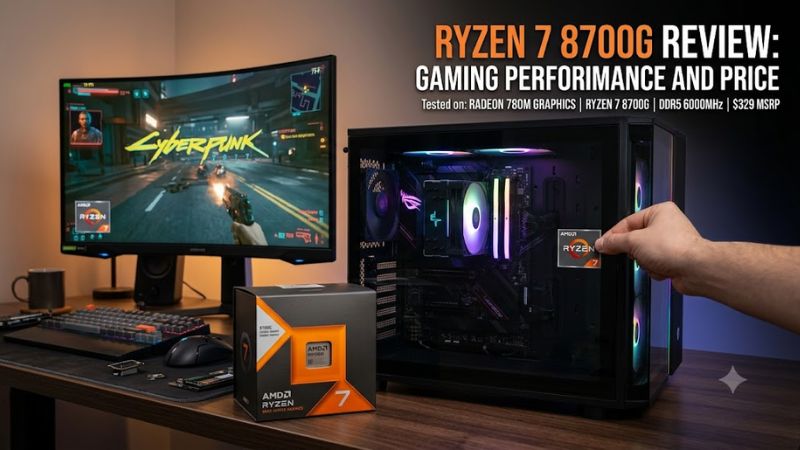
The Radeon 780M has 12 RDNA 3 compute units and a 2.9GHz graphics frequency, making integrated graphics the defining feature of the 8700G. Independent results show useful 1080p performance in esports and lighter games, while demanding releases generally require reduced settings or upscaling.
DDR5 Memory Matters
The 8700G uses two DDR5 memory channels, and its integrated GPU shares that memory with the CPU. AMD officially lists DDR5-5200 support for two single-rank or dual-rank modules, although review platforms have used faster kits when tuning performance. A matched dual-channel kit is therefore more relevant than simply buying more capacity.
AM5 Compatibility
The Ryzen 7 8700G requires an AM5 motherboard and DDR5 memory, so it cannot be dropped into an older AM4 system. AMD lists support across A620, B650, B650E, X670, X670E, B840, B850, X870 and X870E chipsets, while BIOS support can still vary by individual board.
Upgrade Plans Change the Value
The 8700G makes the most sense when a discrete graphics card is not part of the immediate build. Its PCIe 4.0 interface also offers fewer lanes than conventional Ryzen 7000 and 9000 desktop CPUs, so buyers planning a high-end GPU should compare the whole platform rather than focusing only on CPU cores.
Top Picks for Ryzen 7 8700G Buyers
The strongest reason to buy the 8700G is still its integrated graphics, not its CPU performance at a high price. As of October 8, 2026, Newegg lists a new boxed 8700G at $273, while AMD’s own store shows a $281 price but currently marks the product out of stock.
| Product | Best For | Key Spec | Compatibility | Watch Out For |
| AMD Ryzen 7 8700G | Best Overall iGPU build | 8C/16T, Radeon 780M | AM5, DDR5, PCIe 4.0 | Weak value with a planned dGPU |
| AMD Ryzen 5 9600X | Best Value with dGPU | 6C/12T, Zen 5, 5.4GHz boost | AM5, DDR5 | No comparable gaming iGPU |
| AMD Ryzen 7 9700X | Best For CPU-heavy gaming | 8C/16T, Zen 5, 5.5GHz boost | AM5, DDR5 | Requires a discrete GPU for serious gaming |
| AMD Ryzen 7 9800X3D | Best For high-end gaming | 8C/16T, 3D V-Cache | AM5, DDR5 | Higher system budget |
Best Overall: Ryzen 7 8700G
The AMD Ryzen 7 8700G remains the most attractive choice here when the system must operate without a discrete GPU. Its 8-core, 16-thread Zen 4 CPU reaches 5.1GHz, while Radeon 780M supplies 12 RDNA 3 compute units. Its real weakness is value once a separate GPU enters the budget.
A buyer should choose it for a compact PC, temporary gaming system or build where adding a graphics card is uncertain. The package includes AMD’s Wraith Spire cooler, and its 65W default TDP keeps the cooling requirement relatively modest. Someone already planning an RTX or Radeon graphics card should instead examine newer conventional Ryzen processors.
Best Value: Ryzen 5 9600X
The Ryzen 5 9600X is a stronger starting point for a new AM5 gaming system that will use a discrete GPU. It has six Zen 5 cores, 12 threads, a 5.4GHz maximum boost and 38MB of combined L2 and L3 cache, while current Newegg listings place it well below the 8700G in some configurations.
Its weakness is obvious for an iGPU-first build: the integrated Radeon graphics are basic and are not comparable with the 8700G’s 12-CU Radeon 780M. It also ships without a cooler, so the complete build cost needs to include compatible cooling. That makes it a better CPU choice, not a substitute for an APU.
Best For CPU Gaming: Ryzen 7 9700X
The Ryzen 7 9700X targets buyers who care about CPU performance with a discrete graphics card. It provides 8 Zen 5 cores, 16 threads and up to 5.5GHz boost, while retaining AM5 and DDR5 compatibility. Current Newegg listings show substantially lower pricing than the original launch positioning, improving its comparison with the older 8700G.
The important weakness is the same architectural trade-off seen with other conventional desktop CPUs: its small integrated Radeon graphics are intended for display output rather than serious gaming. If the PC will initially run without a graphics card, the 8700G remains the more practical choice despite its older Zen 4 design.
Best For High-End Gaming: Ryzen 7 9800X3D
The Ryzen 7 9800X3D is the type of current-generation AM5 processor that makes the 8700G difficult to recommend for a dedicated gaming machine. AMD’s newer Ryzen 9000X3D family uses 3D V-Cache, and contemporary 2026 CPU comparisons continue to position the 9800X3D among the leading gaming options.
Its weakness is system cost rather than compatibility: buyers still need DDR5 memory, an AM5 motherboard and a discrete GPU to exploit its gaming performance. Someone building a small, inexpensive PC without a graphics card should not pay for this class of CPU, because the 8700G solves a different problem.
FAQ: Ryzen 7 8700G Gaming and Price
Is the Ryzen 7 8700G good for 1080p gaming?
Yes, the Ryzen 7 8700G can deliver playable 1080p gaming through its Radeon 780M when settings are chosen appropriately. TechSpot recorded 49 FPS in Baldur’s Gate 3, 119 FPS in Counter-Strike 2, 132 FPS in Fortnite and 41 FPS in Cyberpunk 2077 at 1080p Low.
Those results show why the APU remains interesting despite its age. The benchmark source used a 32GB DDR5-6400 CL32 kit and an ASUS ROG Strix B650-A Gaming WiFi motherboard, so the figures should be treated as that review configuration rather than a universal result for every memory kit or motherboard.
How much does the Ryzen 7 8700G cost?
As of October 8, 2026, a current Newegg listing shows the boxed Ryzen 7 8700G at $273, while AMD’s store lists $281 but currently shows the product as out of stock. Prices vary by seller, condition and stock, so the retailer figure is better treated as a current market reference than a fixed MSRP.
The original AMD suggested price was $329 when the chip launched in January 2024. That lower current street price improves the 8700G’s position, but newer AM5 CPUs can now compete strongly when the build includes a discrete GPU, keeping the APU’s value tied closely to its Radeon 780M graphics.
Does the Ryzen 7 8700G need DDR5?
Yes, the Ryzen 7 8700G requires DDR5 system memory because its AM5 platform does not support DDR4. AMD specifies two memory channels and lists DDR5-5200 support for common two-module configurations, while independent testing has demonstrated additional performance potential with faster memory.
Memory selection matters more here than it would with a normal CPU paired with a discrete GPU because the Radeon 780M accesses system memory for graphics workloads. A dual-channel configuration is therefore important for this class of APU, especially when gaming without dedicated VRAM.
Should you buy the Ryzen 7 8700G with a graphics card?
No, the Ryzen 7 8700G is generally a poor choice when a discrete GPU is already part of the planned system. TechSpot found the standard Ryzen 7 7700 averaged 26% faster in its discrete-GPU gaming testing, while a Core i3-12100F paired with an RX 6600 substantially outperformed the 8700G’s integrated graphics at a similar historical budget.
The better reason to buy this APU is avoiding a discrete graphics card altogether. Its Radeon 780M provides useful gaming capability in a single 65W processor package, while AM5 leaves room for a later upgrade. That niche remains valid, but buyers should compare current CPU and GPU prices before committing.
Final Thoughts
The ryzen 7 8700g review verdict is straightforward: buy it for compact 1080p gaming without a discrete GPU, not as a conventional gaming CPU for a future graphics card. Its Radeon 780M remains capable, but AM5 platform costs, limited PCIe 4.0 connectivity and newer Zen 5 alternatives make the $273-class price difficult to justify for dGPU builds.