🛒 Best Price Today on Amazon
Prime members get fast, free shipping on everything above, plus member-only deals. New members get a 30-day free trial — cancel anytime.
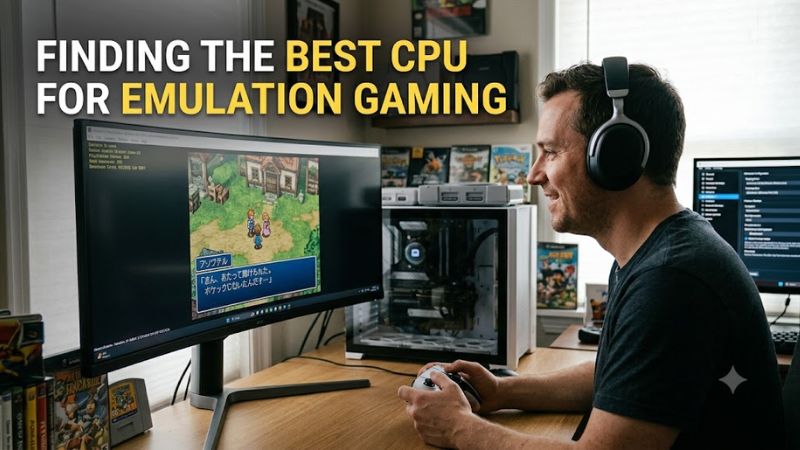
If you are choosing the best cpu for emulation gaming, prioritize fast single-thread performance, strong cache, modern instruction support, and a platform that fits your budget. Current Zen 5 X3D processors are especially relevant for demanding PS3, Xbox 360, Wii U, and Switch emulation, while Intel’s latest desktop platform remains an alternative for mixed workloads.
How to Choose a CPU for Emulation Gaming
The best cpu for emulation gaming depends first on the emulator and console generation you intend to run. Dolphin can be comparatively sensitive to per-core speed, while RPCS3 and Xenia can place heavier demands on CPU architecture, cache, and sustained throughput. A chip with many cores is useful for multitasking, but core count alone does not predict emulator performance.
Single-thread performance
For many emulators, high single-thread performance remains important because parts of the emulation workload cannot simply be divided across every available core. Modern Zen 5 CPUs combine high boost clocks with newer IPC improvements, giving the best cpu for emulation gaming buyers a strong foundation for demanding titles.
The Ryzen 7 9850X3D reaches up to 5.6 GHz with eight cores and 16 threads, while the Ryzen 9 9950X3D reaches up to 5.7 GHz with 16 cores and 32 threads. Both support AVX-512, which can matter for emulator workloads that make use of supported instruction paths.
Cache capacity
Large cache can be useful when an emulator repeatedly accesses data structures that benefit from staying closer to the CPU cores. That does not mean more cache automatically produces a proportional FPS increase, but it is one reason X3D processors appear frequently in emulator-focused comparisons.
The Ryzen 7 9850X3D has 96MB of L3 cache, while the Ryzen 9 9950X3D has 128MB. The newer 9950X3D2 increases total cache to 192MB of L3 and uses 3D V-Cache on both chiplets, making it a specialized option for users who also have heavily cache-sensitive workloads.
Emulator instruction support
Instruction-set support is worth checking before buying because different emulators can use different CPU capabilities. AMD’s current Zen 5 X3D desktop processors support AVX, AVX2, and AVX-512, alongside virtualization extensions and the usual x86-64 instruction set.
The best cpu for emulation gaming should therefore be selected against the actual emulator requirements rather than a generic gaming benchmark. RPCS3, for example, has its own compatibility and hardware guidance, and individual games can behave differently even on the same processor.
Platform compatibility
Platform cost matters because the CPU is only one part of the system. AMD’s current X3D desktop processors use AM5 and DDR5, with PCIe 5.0 connectivity. The Ryzen 7 9850X3D supports A620, B650/B650E, X670/X670E, B840/B850, and X870/X870E chipsets according to AMD.
Intel’s Core Ultra 7 270K Plus instead uses FCLGA1851 and DDR5, with compatibility across Intel 800-series desktop chipsets. Intel lists support for up to DDR5-7200 and PCIe 5.0/4.0, while the processor has 24 cores and 24 threads.
Top Picks for Emulation Gaming
The best cpu for emulation gaming changes with budget, emulator mix, and whether the PC is also used for rendering or other heavily threaded work. The four current-generation processors below cover different purchasing scenarios rather than treating every emulator as an identical workload.
| Product | Best For | Key Spec | Compatibility | Watch Out For |
| AMD Ryzen 9 9950X3D | Best Overall | 16C/32T, up to 5.7 GHz, 128MB L3 | AM5, DDR5, PCIe 5.0 | High-end platform and cooling cost |
| AMD Ryzen 7 9850X3D | Best Value | 8C/16T, up to 5.6 GHz, 96MB L3 | AM5, DDR5, PCIe 5.0 | Fewer cores for heavy multitasking |
| AMD Ryzen 9 9950X3D2 | Best For Maximum Cache | 16C/32T, up to 5.6 GHz, 192MB L3 | AM5, DDR5, PCIe 5.0 | Very high purchase price |
| Intel Core Ultra 7 270K Plus | Best For Intel Builds | 24C/24T, up to 5.5 GHz, 36MB cache | LGA1851, DDR5, PCIe 5.0/4.0 | Different platform from AM5 X3D parts |
AMD Ryzen 9 9950X3D
The Ryzen 9 9950X3D is aimed at users who want the best cpu for emulation gaming while retaining substantial multi-core capacity for compiling, rendering, streaming, or other background workloads. Its 16 Zen 5 cores, 32 threads, 128MB L3 cache, and up-to-5.7GHz boost make it a broad high-end choice.
Independent iTHardware testing includes Dolphin, RPCS3, and Xenia Canary, using Red Dead Redemption for the RPCS3 and Xenia portions. In a separately published 2026 RPCS3 result, the 9950X3D recorded 53.2 minimum and 45.0 average FPS in that specific test configuration; the source does not expose a render resolution in the accessible chart, so that number should not be treated as a universal result.
AMD Ryzen 7 9850X3D
The Ryzen 7 9850X3D is the more focused choice for a system where emulation and conventional gaming matter more than heavily threaded productivity. It has eight cores, 16 threads, a 5.6GHz maximum boost, 96MB L3 cache, and a 120W default TDP, while retaining AVX-512 support.
The same iTHardware RPCS3 chart recorded 52.9 minimum and 45.0 average FPS for this CPU in its Red Dead Redemption test configuration. That result is close to the 9950X3D in the chart, illustrating why extra cores do not automatically translate into a major gain in every emulator workload.
AMD Ryzen 9 9950X3D2
The Ryzen 9 9950X3D2 targets enthusiasts who specifically want very large cache capacity alongside 16 cores and 32 threads. AMD lists a 5.6GHz maximum boost, 4.3GHz base clock, and 192MB of L3 cache; its launch price was $899, placing it well above mainstream gaming CPU budgets.
In iTHardware’s RPCS3 Red Dead Redemption chart, the 9950X3D2 reached 56.7 minimum and 49.0 average FPS in one configuration, while another power configuration produced 52.5 and 45.0 FPS. Because the benchmark uses specific power settings and does not expose a resolution in the accessible chart, these figures are useful for comparison within that test rather than as a general performance guarantee.
Intel Core Ultra 7 270K Plus
The Core Ultra 7 270K Plus is the Intel option for buyers who prefer an LGA1851 system or want a CPU with a hybrid 8 Performance-core plus 16 Efficient-core design. It has 24 total cores and threads, up to 5.5GHz turbo, 36MB Smart Cache, and a 125W processor base power.
iTHardware includes the 270K Plus in its same CPU comparison suite, and its RPCS3 chart shows 46.4 minimum and 41.0 average FPS under the listed 250W configuration. Intel specifies LGA1851 and DDR5 support, so this option requires an Intel 800-series motherboard rather than the AM5 boards used by the Ryzen X3D processors.
FAQ
Is the Ryzen 7 9850X3D good for emulation?
Yes, the Ryzen 7 9850X3D is a strong fit for demanding emulators because it combines Zen 5 performance, eight cores, 16 threads, a 5.6GHz boost, 96MB of L3 cache, and AVX-512 support. It also uses AM5 and DDR5, so a new build needs a compatible motherboard and memory.
It is particularly relevant when the PC is primarily for gaming and emulation rather than heavily threaded productivity. Independent iTHardware testing includes Dolphin, RPCS3, and Xenia, while its RPCS3 chart places the 9850X3D at 45.0 average FPS in the specified Red Dead Redemption configuration.
Does emulation need more CPU cores?
No, emulation does not automatically require the highest possible core count, because workload scaling varies by emulator and game. Dolphin’s CPU behavior has historically favored fast individual cores, while more demanding emulators can use additional threads for selected workloads and background tasks.
That is why the best cpu for emulation gaming is not determined by core count alone. The 9850X3D has half the core count of the 9950X3D, yet the cited RPCS3 chart shows both averaging 45.0 FPS in different listed configurations, demonstrating that additional cores are not a universal substitute for per-core performance.
Is X3D useful for RPCS3 and other emulators?
X3D cache can be useful for workloads that benefit from greater cache capacity, but its effect varies by emulator, game, renderer, and CPU configuration. The iTHardware RPCS3 comparison includes several AMD X3D processors and shows measurable differences between them, but it does not establish one cache capacity as universally optimal.
For a new AM5 build, the 9850X3D and 9950X3D provide substantial cache without moving to the unusually expensive 9950X3D2. The latter has 192MB of L3, but its launch price of $899 makes it a specialized purchase rather than a simple upgrade for every emulator system.
What CPU platform should an emulation PC use?
An AMD AM5 system gives access to the current Ryzen X3D processors, DDR5 memory, and PCIe 5.0, while Intel’s Core Ultra 7 270K Plus uses LGA1851, DDR5, and Intel 800-series chipsets. Both platforms can support a modern discrete GPU, but motherboard and memory compatibility must match the chosen CPU.
For an existing PC, platform compatibility can matter more than a small CPU performance difference because changing from AM5 to LGA1851, or vice versa, requires a compatible motherboard. The CPU, motherboard, DDR5 kit, cooler, PSU capacity, and case clearance should therefore be checked together before purchase.
Final Thoughts
The best cpu for emulation gaming depends on the emulator mix rather than a single universal specification. The Ryzen 7 9850X3D targets gaming-focused builds, the Ryzen 9 9950X3D adds substantial multi-core capacity, the 9950X3D2 adds unusually large cache, and the Core Ultra 7 270K Plus provides an Intel LGA1851 route for a new DDR5 system.