🛒 Best Price Today on Amazon
Prime members get fast, free shipping on everything above, plus member-only deals. New members get a 30-day free trial — cancel anytime.
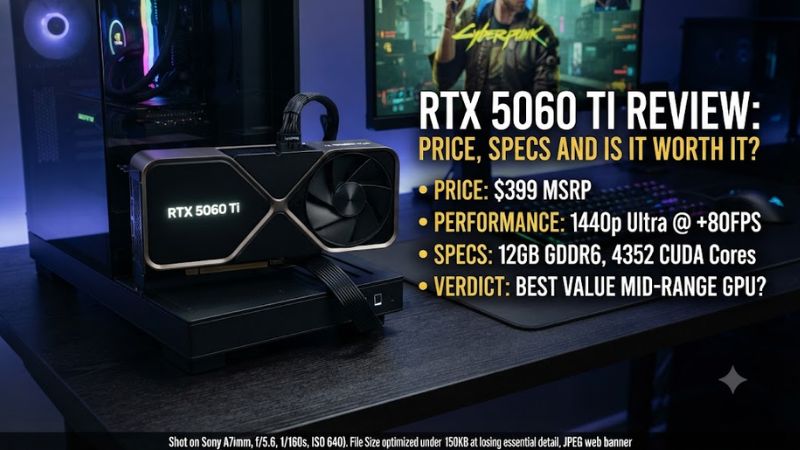
Rtx 5060 ti review: price, specs and is it worth it comes down to one major choice: 16GB or 8GB. Both use NVIDIA Blackwell, 4,608 CUDA cores, GDDR7 and a 180W board power target, but current pricing makes the 16GB model difficult to recommend at inflated retail prices.
How to Choose an RTX 5060 Ti
The practical choice depends on VRAM, resolution, features and system compatibility. NVIDIA lists the RTX 5060 Ti with either 16GB or 8GB of GDDR7 on a 128-bit bus, while both versions support DLSS 4, Multi Frame Generation, PCIe 5.0 and Resizable BAR.
Choose 16GB for modern AAA games
The 5060 Ti 16GB is the safer configuration for demanding games because its larger framebuffer gives more room for high-resolution textures and ray tracing. Tom’s Hardware found the 8GB model averaged 11% slower at 1080p Ultra and 18% slower at 1440p Ultra in its 21-game comparison.
The 16GB version also makes more sense if you plan to keep the card for several years. Its main weakness is price: NVIDIA’s launch MSRP was $429, but Tom’s Hardware reports current 16GB cards around $800 in October 2026, making the card much less attractive for gaming at today’s inflated prices.
Consider 8GB only for lighter workloads
The 5060 Ti 8GB remains capable at 1080p when settings are selected carefully, and its $379 launch MSRP was only $50 below the 16GB model. The problem is that newer games can exceed that memory capacity, particularly at Ultra settings, higher resolutions and with ray tracing enabled.
That makes the 8GB version more appropriate for competitive games, older titles or buyers who expect to replace the GPU sooner. The underlying GPU is otherwise the same: 4,608 CUDA cores, 28Gbps GDDR7 and a 128-bit interface, so the distinction is primarily memory capacity rather than shader hardware.
Match the card to 1080p or 1440p
The RTX 5060 Ti is primarily a 1080p and 1440p-class GPU. Tom’s Hardware’s 2026 hierarchy uses native rendering at 1080p, 1440p and 4K, with high or Ultra settings depending on the game and no upscaling or frame generation in the baseline results.
For 1440p, the 16GB model is the more sensible configuration because VRAM limitations become easier to encounter as image quality rises. For 4K, the GPU itself becomes a stronger limitation, so paying a premium for the 5060 Ti 16GB is difficult to justify when faster 16GB cards are available.
Check power, PCIe and case space
NVIDIA specifies 180W total graphics power and a 600W recommended system power supply for the RTX 5060 Ti. The card supports PCIe 5.0, while partner-board dimensions and slot thickness vary, so buyers must check the exact model against their case and motherboard.
The reference requirement allows either PCIe 8-pin power or a 300W-or-greater PCIe Gen 5 cable through the supplied adapter. A PCIe 4.0 motherboard can still host the card, but the exact board, PSU cabling and physical clearance should be checked before purchase rather than assumed from the GPU name alone.
Top Picks
The RTX 5060 Ti remains technically attractive, but current pricing changes the recommendation. Tom’s Hardware’s October 2026 data puts the RX 9060 XT 16GB around $464, RTX 5070 around $659 and RTX 5060 Ti 16GB around $800, while its benchmark suite uses 19 games with eight RT titles and native rendering.
| Product | Best For | Key Spec | Compatibility | Watch Out For |
| RTX 5060 Ti 16GB | Best Overall | 16GB GDDR7, 180W | PCIe 5.0, 600W PSU | Current price near $800 |
| RX 9060 XT 16GB | Best Value | 16GB GDDR6, 160W | PCIe 5.0, 450W PSU | Weaker Nvidia feature ecosystem |
| RTX 5070 | Best For 1440p | 12GB GDDR7, 225W | PCIe 5.0, 650W-class system | 12GB VRAM |
| RTX 5060 Ti 8GB | Best For 1080p | 8GB GDDR7, 180W | PCIe 5.0, 600W PSU | VRAM limits |
RTX 5060 Ti 16GB: Best Overall
The 5060 Ti 16GB is the strongest version of NVIDIA’s midrange card because it combines 4,608 CUDA cores with 16GB of 28Gbps GDDR7, 448GB/s bandwidth and Blackwell features such as DLSS 4 and Multi Frame Generation.
The problem is today’s price rather than its specification. At roughly $800 according to Tom’s Hardware’s October update, it sits far above its $429 launch price and becomes difficult to justify against faster GPUs. Buyers should choose it only when its price falls substantially or when NVIDIA’s software features are a specific priority.
Radeon RX 9060 XT 16GB: Best Value
The RX 9060 XT 16GB is the strongest value alternative when gaming performance per dollar matters more than NVIDIA-specific features. AMD lists 16GB of GDDR6, a 128-bit interface, 320GB/s bandwidth, 160W board power and a 450W minimum PSU recommendation.
Tom’s Hardware places its October 2026 median street price around $464, while its 2026 hierarchy records 48.6 FPS at 1440p in its combined native-resolution performance ranking. It is therefore a much more rational buy than an $800 5060 Ti 16GB for many conventional 1440p systems.
RTX 5070: Best For Higher 1440p Performance
The RTX 5070 is the more compelling step-up when the budget permits it. It carries 6,144 CUDA cores, 12GB of GDDR7 and a 225W power target, while retaining the DLSS 4 and Multi Frame Generation features found on the 5060 Ti.
Its weakness is the 12GB memory capacity, especially compared with 16GB alternatives. Tom’s Hardware’s October figures put the RTX 5070 around $659 with 74.0 FPS at 1440p in its combined native benchmark summary, giving it substantially more performance headroom than the 5060 Ti class.
RTX 5060 Ti 8GB: Best For 1080p
The RTX 5060 Ti 8GB is suitable when the target is 1080p gaming and the buyer accepts tighter memory limits. It retains the same 4,608 CUDA cores, 180W power target and 128-bit GDDR7 interface as the 16GB version, so the main compromise is framebuffer capacity.
That compromise is substantial in demanding games. Tom’s Hardware measured an 11% average deficit at 1080p Ultra and an 18% deficit at 1440p Ultra for the 8GB model, with RT-heavy games showing larger gaps. It should not be the default choice for a long-lived AAA-focused build.
FAQ about rtx 5060 ti review
The short answer is that the RTX 5060 Ti 16GB is technically the better version, but current 2026 street prices make alternatives more attractive for most gaming builds. The following answers separate the original MSRP from today’s unusually high market pricing.
Is the RTX 5060 Ti 16GB worth it?
The RTX 5060 Ti 16GB is worth considering when priced near its $429 launch MSRP, but an approximately $800 current median makes it poor gaming value.
Its 16GB GDDR7 capacity is genuinely useful in demanding games, and the card supports DLSS 4, Multi Frame Generation and PCIe 5.0. Those features make it attractive for users who specifically prefer NVIDIA, but they do not compensate for a near-doubling of launch pricing.
Is the RTX 5060 Ti 8GB good for gaming?
The RTX 5060 Ti 8GB is good for 1080p gaming at sensible settings, but its memory capacity makes it less suitable for demanding Ultra presets and longer-term AAA use.
Tom’s Hardware’s 21-game comparison found almost identical performance at 1080p Medium, but the gap widened to 11% at 1080p Ultra and 18% at 1440p Ultra. That makes the 8GB card a targeted budget choice rather than the preferred 5060 Ti configuration.
How much power does the NVIDIA GeForce RTX 5060 Ti need?
The NVIDIA GeForce RTX 5060 Ti has a 180W total graphics power rating and NVIDIA recommends a 600W system power supply.
The card can use one PCIe 8-pin cable or a PCIe Gen 5 cable rated for at least 300W through the supplied adapter. Partner cards vary in dimensions and cooler design, so the exact model’s case clearance and connector placement still need checking.
Should you buy the RTX 5060 Ti or RX 9060 XT 16GB?
The RX 9060 XT 16GB is the better value choice at the October 2026 prices reported by Tom’s Hardware, while the RTX 5060 Ti 16GB remains preferable for buyers prioritizing NVIDIA’s software and DLSS ecosystem.
AMD’s card has 16GB of GDDR6 and 160W board power, compared with 16GB GDDR7 and 180W on the 5060 Ti. At roughly $464 versus about $800, the current price difference is large enough that the Radeon is the more sensible gaming purchase unless NVIDIA-specific features are central to the build.
Final Thoughts
For this rtx 5060 ti review: price, specs and is it worth it, the 16GB version is clearly preferable to the 8GB model, but today’s inflated pricing changes the verdict. Near MSRP it is a strong 1080p/1440p option; near $800, faster or cheaper alternatives make more sense.