🛒 Best Price Today on Amazon
Prime members get fast, free shipping on everything above, plus member-only deals. New members get a 30-day free trial — cancel anytime.
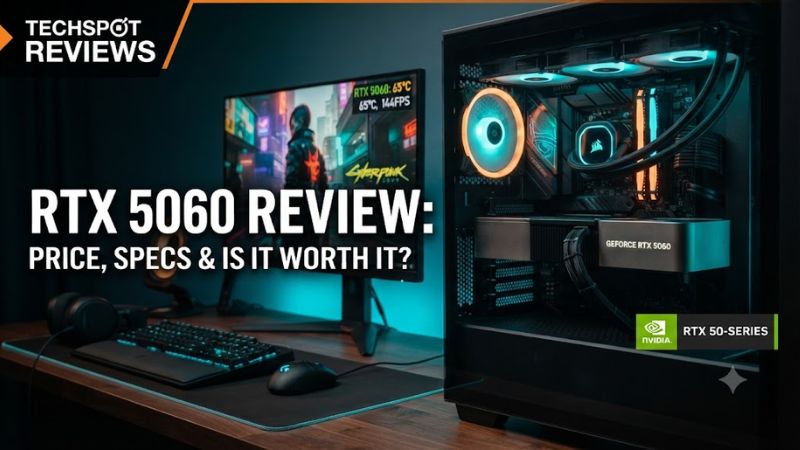
The rtx 5060 review: price, specs and is it worth it question is mainly about 1080p value. NVIDIA’s Blackwell card uses 8GB GDDR7, 3,840 CUDA cores and a 145W board power target, but current pricing and limited VRAM make the buying decision more conditional than the $299 launch MSRP suggests.
How to Choose an RTX 5060 Card
The right card depends on price, cooler size, power supply and case space rather than small factory-clock differences. NVIDIA lists PCIe 5.0 x8 connectivity, 8GB GDDR7 and a 550W recommended system power level, while partner cards vary in dimensions and boost clocks. Current U.S. pricing can also move well above the original $299 MSRP.
Price Should Come Before Factory Overclocking
For this GPU class, paying substantially more for a factory-overclocked model rarely makes sense when the underlying memory capacity remains 8GB. NVIDIA launched the card at $299, while TechSpot recorded a $450 U.S. market price in its Q3 2026 pricing snapshot. That makes street price more important than a modest clock-rate increase.
A sensible target is therefore close to the lowest available price for a reputable dual-fan model. TechSpot’s earlier review found the RTX 5060 around $330 at launch-market retail, while later 2026 pricing moved considerably higher. If a partner card costs much more than comparable GPUs, the value argument becomes weaker.
VRAM Matters More Than the Model Badge
Every desktop RTX 5060 configuration uses 8GB of GDDR7, so there is no 12GB or 16GB desktop RTX 5060 variant to choose instead. NVIDIA specifies 28Gbps memory on a 128-bit interface, giving the GPU 448GB/s of bandwidth. That fast memory helps throughput, but capacity remains the key limitation.
The RTX 5060 is most comfortable as a 1080p GPU. TechSpot found several demanding games where 1440p performance became inconsistent because 8GB could not hold all required data, including texture-related problems. Buyers targeting 1440p Ultra or heavy ray tracing should therefore consider a GPU with more memory.
Check PCIe, PSU and Case Compatibility
The RTX 5060 uses a PCIe 5.0 x8 interface, but partner cards fit standard PCIe graphics-card slots and are not restricted to only new motherboards. The important checks are an available full-length slot, adequate case clearance, an appropriate power connector and sufficient PSU capacity for the complete system.
For example, MSI’s Ventus 2X OC measures 197 × 120 × 41mm and calls for a 550W PSU with one 8-pin connector. ASUS’s Prime model is 268.3 × 120 × 50mm and also specifies a 550W PSU with one 8-pin connection, showing why model dimensions should be checked before purchase.
Top RTX 5060 Picks
The rtx 5060 review: price, specs and is it worth it verdict changes depending on which partner card you choose. The GPU itself remains the same 3,840-CUDA-core Blackwell design, so the meaningful differences are cooler design, physical size, factory boost setting, connector arrangement and features such as dual BIOS.
| Product | Best For | Key Spec | Compatibility | Watch Out For |
| Gigabyte RTX 5060 Gaming OC 8G | Best Overall | 2,595MHz boost, 8GB GDDR7 | PCIe 5.0, 8-pin, 550W | 281mm length |
| Gigabyte RTX 5060 Windforce OC 8G | Best Value | 2,512MHz boost, 8GB GDDR7 | PCIe 5.0, 8-pin, 550W | 8GB VRAM |
| MSI RTX 5060 Ventus 2X OC | Best For Small Cases | 2,527MHz boost, 197mm length | PCIe 5.0, 8-pin, 550W | 8GB VRAM |
| ASUS Prime RTX 5060 OC | Best For Larger Cooling | 2,595MHz OC mode, 2.5-slot | PCIe 5.0, 8-pin, 550W | 268.3mm length |
Gigabyte RTX 5060 Gaming OC 8G: Best Overall
Gigabyte’s Gaming OC version is the most feature-rich choice here, with a 2,595MHz core clock, 8GB GDDR7, a Windforce cooler and dual BIOS with Performance and Silent modes. Its 281 × 119 × 40mm dimensions make it less suitable for compact cases, but the larger cooler gives this model a more substantial design than shorter alternatives.
Buy it when the price premium is modest and your case has enough clearance for a 281mm card. Do not buy it simply for the highest factory clock if a cheaper RTX 5060 is available, because all models retain the same 8GB memory capacity and the same 3,840 CUDA cores.
Gigabyte RTX 5060 Windforce OC 8G: Best Value
Gigabyte’s Windforce OC is the value-oriented pick because its 199 × 116 × 40mm body is relatively compact while still providing a 2,512MHz boost clock and 8GB of GDDR7. Gigabyte specifies one 8-pin connector and a 550W recommended PSU, making the card straightforward for a typical mainstream desktop.
This model makes the most sense when it is priced near the RTX 5060 baseline rather than carrying a large premium. Newegg has listed the card at $349.99 in a recent indexed listing, but current GPU pricing is volatile, so that figure should be treated as a dated retail reference rather than a guaranteed price today.
MSI GeForce RTX 5060 Ventus 2X OC: Best For Small Cases
MSI’s Ventus 2X OC is one of the easier RTX 5060 cards to fit into a compact ATX or similar build, measuring only 197 × 120 × 41mm. It has a 2,527MHz boost clock, 8GB GDDR7, one 8-pin connector and a 550W recommended PSU, while its PCIe interface is Gen 5 x16 physically and x8 electrically.
The weakness is not unique to MSI: the card still has only 8GB of VRAM. Buyers should also verify available case length, expansion-slot clearance and airflow before ordering, because a compact graphics card does not automatically mean every small-form-factor chassis can accommodate it.
ASUS Prime RTX 5060 OC: Best For Larger Cooling
ASUS Prime offers a 2,565MHz default boost clock and a 2,595MHz OC mode, paired with 8GB GDDR7 and a 2.5-slot design. Its 268.3 × 120 × 50mm dimensions are considerably larger than MSI’s Ventus 2X OC, so this card is better suited to cases with comfortable expansion and cooler clearance.
The main reason not to choose it is size rather than GPU capability. ASUS specifies a 550W PSU and one 8-pin power connector, while the underlying GPU still has 8GB of memory. If your case is tight or the price premium is large, a shorter dual-fan model is the more practical purchase.
RTX 5060 FAQ
The rtx 5060 review: price, specs and is it worth it answer is straightforward for 1080p, but less favorable for buyers expecting high-end 1440p longevity. Independent results show performance around the RTX 4060 Ti and RTX 3070 class in many games, while VRAM limitations can become visible at higher settings and resolutions.
Is the RTX 5060 good for 1080p gaming?
Yes, the RTX 5060 is primarily a 1080p gaming GPU, with TechSpot’s 18-game suite placing it 22% ahead of the RTX 4060 on average and broadly around RTX 4060 Ti and RTX 3070 performance. Those results used the review suite’s standard game settings, with individual presets varying by title.
For context, TechSpot recorded 100 fps in Cyberpunk 2077 at 1080p and 101 fps in Hogwarts Legacy, while Star Wars Outlaws reached only 42 fps. These figures show why a single game should not define expectations: performance varies significantly with engine workload, settings and VRAM demand.
Does the RTX 5060 have enough VRAM?
The RTX 5060 has 8GB of GDDR7, and that capacity is generally more comfortable at 1080p than at 1440p. NVIDIA does not offer a 12GB or 16GB desktop version of this GPU, so buyers cannot solve the limitation by selecting a higher-memory RTX 5060 partner model.
TechSpot recorded several clear examples of the limitation: Stalker 2 averaged 47 fps at 1080p but fell to 6 fps at 1440p in its test, while The Last of Us Part I had inconsistent frame times at 1440p Ultra. These results were from TechSpot’s benchmark system using its stated game settings.
Is the RTX 5060 good for 1440p?
The RTX 5060 can run many games at 1440p, but it is not an ideal choice for a 1440p Ultra-focused build because 8GB of VRAM can constrain demanding titles. TechSpot recorded 66 fps in Cyberpunk 2077 and 57 fps in Jedi: Survivor at 1440p, showing that lighter workloads can still perform well.
The issue becomes more visible when texture memory or ray tracing requirements rise. In Alan Wake II, TechSpot recorded 36 fps at 1080p with DLSS Quality enabled, while its broader 1440p results showed several cases where 8GB cards encountered memory-related problems.
Is the RTX 5060 worth buying at current prices?
The RTX 5060 is worth considering when its street price is close to its $299 MSRP, but its value becomes harder to justify as pricing rises. NVIDIA launched the card at $299, while TechSpot’s September 2026 pricing data placed typical U.S. RTX 5060 pricing around $450, roughly 51% above MSRP.
That makes the buying threshold more important than the model name. For a new 1080p PC that benefits from DLSS and NVIDIA’s software ecosystem, a sensibly priced RTX 5060 remains useful; at a substantially inflated price, a GPU with more VRAM or stronger raster performance can make more sense.
Final Thoughts
The rtx 5060 review: price, specs and is it worth it verdict is positive mainly for affordable 1080p systems. Its 3,840 CUDA cores, 8GB GDDR7 and DLSS support provide strong mainstream performance, but 8GB VRAM and rising street prices limit its appeal for demanding 1440p gaming.