🛒 Best Price Today on Amazon
Prime members get fast, free shipping on everything above, plus member-only deals. New members get a 30-day free trial — cancel anytime.
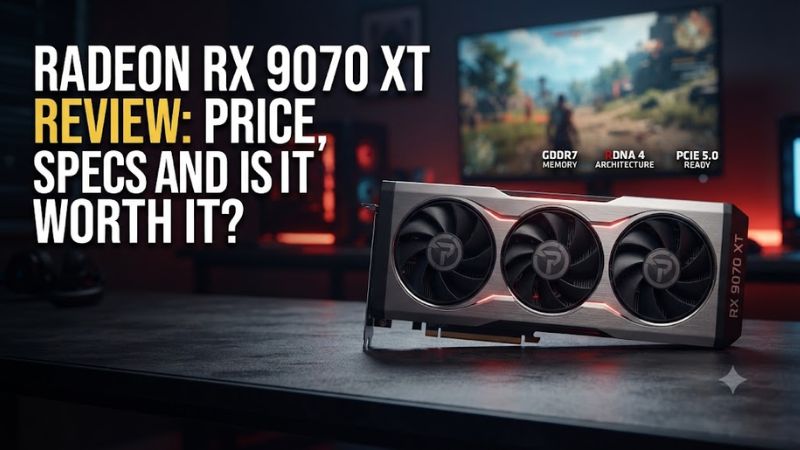
The radeon rx 9070 xt review: price, specs and is it worth it question now depends heavily on street pricing. AMD lists a $599 launch price, 16GB GDDR6 and 304W board power, while current US listings have climbed well above launch pricing. The card remains a strong 1440p and 4K option, but its value changes with availability.
How to Choose a High-End Gaming GPU
Choosing a high-end gaming GPU comes down to performance, price, power requirements and software features. The RX 9070 XT is aimed at buyers who want strong raster performance with 16GB of VRAM, while the RX 9070 targets lower power and cost. NVIDIA alternatives become more attractive when ray tracing, neural rendering or creator workloads matter more.
Match Performance to Resolution
For 1440p Ultra gaming, the RX 9070 XT remains a high-performance choice. Tom’s Hardware’s October 2026 hierarchy records 116.5 FPS at 1440p Ultra and 65.8 FPS at 4K Ultra, using its standardized rasterization suite. The RX 9070 XT therefore makes the most sense for high-refresh 1440p or entry-level 4K systems.
The radeon rx 9070 xt review: price, specs and is it worth it decision should not rely on one game. TechSpot’s 18-game review averaged 119 FPS at 1440p across its rasterized test suite, while individual games varied substantially. That spread makes a broad benchmark suite more useful than choosing a GPU from one favorable title.
Check VRAM and Memory
The RX 9070 XT has 16GB of GDDR6 on a 256-bit interface, with memory speed up to 20Gbps and bandwidth up to 640GB/s. Those specifications give it a substantial memory capacity for modern 1440p and 4K gaming, particularly where texture-heavy settings make lower-capacity cards less comfortable.
The RX 9070 also carries 16GB of GDDR6 and the same 256-bit interface, while the RTX 5070 Ti uses 16GB of faster GDDR7 memory. NVIDIA’s card has 896GB/s of bandwidth, compared with up to 640GB/s for AMD, but memory bandwidth alone does not determine gaming performance across different architectures.
Check Power and Physical Compatibility
AMD specifies a 304W typical board power and a 750W minimum PSU recommendation for the RX 9070 XT. The card uses two 8-pin power connectors and a PCIe 5.0 x16 interface. Buyers should still check the exact board-partner card because cooler dimensions, slot width and connector placement vary between models.
Platform compatibility is broad rather than tied to a particular CPU socket. AMD lists Windows 10 64-bit, Windows 11 64-bit and Linux x86-64 support, while the PCIe interface can operate with compatible older platforms. A suitable motherboard slot, adequate PSU capacity and enough case clearance remain necessary.
Weigh Features Against Price
The RX 9070 XT supports AMD FSR, Radeon Super Resolution, Fluid Motion Frames and Smart Access Memory, with FSR 4 support for compatible games. Its RDNA 4 design also brings substantially stronger ray-tracing capability than older Radeon generations, although Nvidia retains an advantage in demanding ray-traced workloads and neural-rendering features.
That makes the radeon rx 9070 xt review: price, specs and is it worth it question especially sensitive to the final checkout price. PC Gamer’s October 1 price watch listed an RX 9070 XT at $760 in the US, while Tom’s Hardware listed a $759 median street price, both materially above AMD’s $599 launch price.
Top Picks
The RX 9070 XT is not automatically the right purchase at every price, so four current-generation alternatives clarify where it fits. Tom’s Hardware’s October 2026 hierarchy places the RX 9070 XT at 116.5 FPS at 1440p Ultra, versus 104.0 for the RX 9070, 116.8 for the RTX 5070 Ti and 48.6 for the RX 9060 XT 16GB.
| Product | Best For | Key Spec | Compatibility | Watch Out For |
| Radeon RX 9070 XT | Best Overall | 16GB GDDR6, 304W | PCIe 5.0 x16, 750W PSU | Street price above $599 |
| Radeon RX 9070 | Best Value | 16GB GDDR6, 220W | PCIe 5.0 x16, 650W PSU | Slower than XT |
| GeForce RTX 5070 Ti | Best For Ray Tracing | 16GB GDDR7, 300W | PCIe-compatible, 750W PSU | Very high street price |
| Radeon RX 9060 XT 16GB | Best For Lower-Cost 1440p | 16GB GDDR6, 160W | PCIe 5.0 x16, 450W PSU | Much slower at 4K |
Best Overall: Radeon RX 9070 XT
The radeon rx 9070 xt review: price, specs and is it worth it verdict is strongest when the card is priced close to its original $599 positioning. It combines 4,096 stream processors, 16GB GDDR6, a 256-bit bus and 304W board power, making it a balanced choice for demanding 1440p and moderate 4K gaming.
Its weakness is not the core hardware but current pricing. Tom’s Hardware’s October 2026 data puts the median street price around $759, while PC Gamer lists a $760 lowest current US price. At that level, buyers should compare it directly with the RTX 5070 Ti rather than assuming AMD’s launch value still applies.
Best Value: Radeon RX 9070
The Radeon RX 9070 is the better fit for buyers who want similar memory capacity with lower power consumption. AMD specifies 16GB GDDR6, 56 compute units, 220W board power and a 650W PSU recommendation, while Tom’s Hardware records 104.0 FPS at 1440p Ultra in its current raster hierarchy.
Its main drawback is the smaller performance margin over cheaper options once prices move upward. Tom’s Hardware lists a $634 median street price, compared with $759 for the XT, while the RX 9070 reaches 74.8 FPS at 1440p in its broader gaming table. That makes pricing between the two models the deciding factor.
Best For Ray Tracing: GeForce RTX 5070 Ti
The RTX 5070 Ti is the stronger choice for buyers who prioritize demanding ray tracing and Nvidia’s software ecosystem. It has 16GB of GDDR7, 8,960 CUDA cores, 300W total graphics power and a 750W system-power requirement. Its higher memory bandwidth also helps distinguish it from AMD’s 16GB GDDR6 design.
The problem is price. NVIDIA’s official starting price is $749, but PC Gamer lists $1,150 at Newegg, and Tom’s Hardware gives a $1,099 median street price. Its performance lead over the RX 9070 XT is modest in rasterized gaming, so paying the premium makes more sense for ray tracing and Nvidia-specific features.
Best For Lower-Cost 1440p: Radeon RX 9060 XT 16GB
The RX 9060 XT 16GB is designed for a lower power and price tier while retaining 16GB of VRAM. AMD specifies 32 compute units, 16GB memory, 160W board power and a $349 starting price. Its 1440p Ultra result of 48.6 FPS in Tom’s Hardware’s current hierarchy places it well below the RX 9070 XT.
That lower performance is also its real limitation. The RX 9060 XT 16GB is sensible when the goal is high-quality 1440p gaming without a 750W-class PSU, but it is not a substitute for the RX 9070 XT in demanding 4K workloads. Its lower power requirement can make it easier to integrate into modest systems.
FAQ
The radeon rx 9070 xt review: price, specs and is it worth it answer is yes for the right price, particularly for rasterized 1440p and 4K gaming. The launch MSRP was $599, but current US pricing is substantially higher. That price shift matters because the card competes directly with much more expensive alternatives and its value advantage narrows as street pricing rises.
Is the Radeon RX 9070 XT worth buying in 2026?
Yes, the RX 9070 XT is worth buying when its price is reasonable relative to the RTX 5070 Ti and RX 9070. AMD’s card combines 16GB of VRAM with strong raster performance, and Tom’s Hardware’s October 2026 hierarchy places it at 116.5 FPS at 1440p Ultra and 65.8 FPS at 4K Ultra.
At around $760, however, the purchase requires more scrutiny than it did at launch. Tom’s Hardware reports a $759 median street price, while PC Gamer lists $760 as its current US low price. Buyers paying that much should compare ray-tracing requirements, software preferences and alternative GPU pricing before committing.
How much does the Radeon RX 9070 XT cost?
The RX 9070 XT launched at $599 in the United States, while current October 2026 US pricing is around $759 to $760 in the sources checked. AMD’s original product announcement established the $599 SEP, and current price tracking shows the retail market has moved well above that level.
That difference is important because the card’s strongest value argument came from its original positioning against Nvidia’s RTX 5070 Ti. If the RX 9070 XT approaches the RTX 5070 Ti’s street price, the decision becomes more about ray tracing, software and individual game performance than a straightforward price-per-frame advantage.
What PSU does the Radeon RX 9070 XT need?
AMD recommends a 750W power supply for the RX 9070 XT, and the card uses two 8-pin auxiliary power connectors. AMD also lists 304W typical board power, so the PSU choice should account for the rest of the system rather than treating the GPU figure as the complete system load.
The card uses PCIe 5.0 x16 and supports Windows 10 64-bit, Windows 11 64-bit and Linux x86-64. A motherboard with a compatible full-length PCIe slot is therefore required, while case clearance must be checked against the exact board-partner model because physical dimensions differ.
Is the RX 9070 XT better than the RTX 5070 Ti?
No, neither card is universally better; the RX 9070 XT is generally the value-oriented choice, while the RTX 5070 Ti has an advantage in demanding ray tracing and Nvidia-specific rendering features. Tom’s Hardware’s raster hierarchy places them almost level at 1440p Ultra, with 116.5 FPS for AMD and 116.8 FPS for Nvidia.
The price difference changes the conclusion. Current US tracking shows the RX 9070 XT around $759 to $760, compared with roughly $1,099 to $1,150 for the RTX 5070 Ti. At those prices, AMD offers a much lower entry cost, while Nvidia’s premium is easier to justify for ray tracing, DLSS and related workloads.
Final Thoughts
The radeon rx 9070 xt review: price, specs and is it worth it conclusion is straightforward: the hardware remains strong, but today’s price matters more than the launch MSRP. Its 16GB VRAM, 1440p performance and capable 4K results make it compelling, while ray tracing and inflated street pricing remain the main reasons to compare alternatives.