🛒 Best Price Today on Amazon
Prime members get fast, free shipping on everything above, plus member-only deals. New members get a 30-day free trial — cancel anytime.
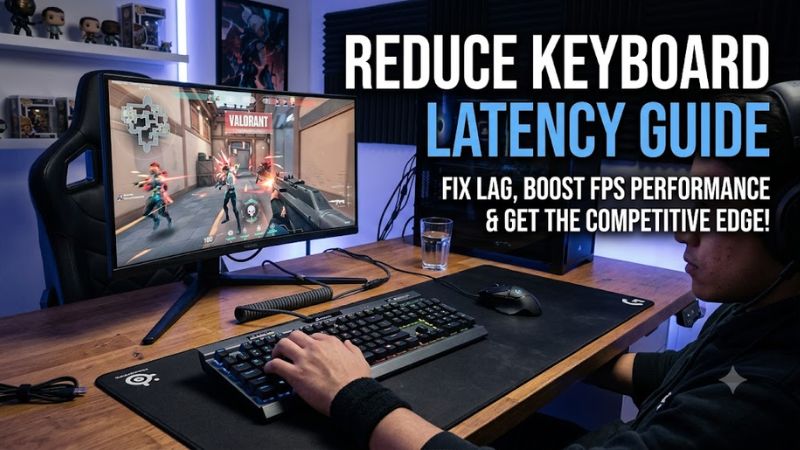
Understanding response time is vital for competitive players who want every press registered without delay. Following this keyboard latency guide helps players identify every hidden source of delay between pressing a switch and displaying the action on screen. Modern peripherals process commands in milliseconds through complex hardware loops.
What Keyboard Latency Really Comes Down To
Total response time depends on physical movement, internal processing, and transmission intervals over the connection protocol. Measuring delay requires examining how quickly the switch actuates, how the onboard controller handles signal bounce, and how frequently USB packets reach Windows. Balancing these layers creates optimal input speed.
Physical Switch Actuation
Physical actuation is the initial stage where mechanical stem movement closes an electrical contact or interrupts a light beam. Standard mechanical switches feature a pre-travel distance between 1.5mm and 2.0mm before registering a signal. Optical and Hall Effect magnetic switches bypass metallic contact, removing physical bounce delay.
Actuation distance directly determines the elapsed time between starting a keypress and triggering the circuit. Lowering travel distance from 2.0mm to 1.0mm shortens physical actuation delay by several milliseconds during fast movement. Readers studying this keyboard latency guide can select switches matched to their required actuation depth.
Firmware Scan Rates and Debounce Algorithms
Firmware scan rate defines how many times per second the internal microcontroller checks the switch matrix for state changes. A matrix scanning at 1000Hz evaluates keys every 1.0ms, whereas advanced controllers scan at 8000Hz or every 0.125ms. Faster matrix scanning reduces the gap between physical contact and signal creation.
Debounce algorithms prevent false double-presses caused by metallic leaves vibrating upon contact. Traditional mechanical keyboards delay signal transmission by 2ms to 10ms to filter out this noise. Optical and Hall Effect sensors do not suffer from metal contact bounce, allowing manufacturers to set debounce delays near zero milliseconds.
USB Polling Rates and Transmission Overhead
USB polling rate specifies how frequently the operating system requests updated input data from the device controller. Operating at 125Hz introduces up to 8.0ms of waiting time per report cycle, while standard 1000Hz limits maximum report delay to 1.0ms. Ultra-high polling modes at 8000Hz compress this reporting window down to 0.125ms.
Transmission efficiency also relies on connection protocols and system processing overhead. Dedicated 2.4GHz wireless dongles achieve 1000Hz reporting comparable to wired USB, while Bluetooth power-saving modes add 15ms to 40ms of latency. Integrating a keyboard latency guide step ensures system USB controllers process inputs without dropouts.
What Doesn’t Help
Third-party RAM optimization software, registry cleaner utilities, and system telemetry tweaks do not lower input response times. These tools target memory allocation or background OS logging rather than USB polling schedules or microcontroller interrupts. Relying on unverified system cleaners can create instability without fixing hardware delays.
Increasing CPU overclock frequencies or modifying graphic driver pre-rendered frame settings will not accelerate keyboard matrix scan cycles. Controller hardware processes inputs independently before passing packets to the OS kernel. Understanding these boundaries in our keyboard latency guide prevents spending time on ineffective software tweaks.
How to Lower Keyboard Latency: Step by Step
Systematic adjustment of software parameters and connection routes yields measurable reductions in input lag. Users can configure polling intervals, adjust debounce algorithms, enable dynamic trigger resetting, and optimize physical port connections. Applying these steps establishes an efficient signal pipeline for competitive gaming.
| Setting | Where | Effect | Risk | | USB Polling Rate | Peripheral Companion Software | Increases report frequency from 125Hz to 1000Hz+ | Minor CPU usage increase at 8000Hz | | Debounce Delay | Keyboard Firmware Configuration | Reduces switch contact wait time down to 1ms | Potential accidental double-registering | | Rapid Trigger Mode | Hall Effect Companion App | Resets key state instantly upon upward movement | Requires lighter finger pressure control | | USB Port Location | Direct Motherboard I/O Panel | Bypasses unpowered hub controller latency | Removes front-panel cable extensions |
Step 1: Adjust USB Polling Rate to 1000Hz or Higher
Open the keyboard companion software and navigate to the hardware performance or device settings tab. Locate the USB polling rate drop-down menu and select 1000Hz as the default baseline for standard play. Higher settings like 4000Hz or 8000Hz reduce worst-case report intervals from 1.0ms down to 0.25ms or 0.125ms on supported hardware.
Confirm the change by checking timing behavior in utility applications like Keyboard Inspector on Windows 11. If system micro-stutters occur at 8000Hz, revert the setting back to 1000Hz within the device app to maintain system stability. This keyboard latency guide rule keeps hardware performance balanced against background processor load.
Step 2: Lower Switch Debounce Delay
Access the firmware parameter section inside your keyboard configuration utility software. Locate the debounce slider or numerical input box, which defaults to 5ms or 10ms on traditional mechanical boards. Reduce this setting incrementally down to 1ms or 2ms to decrease the artificial delay added before sending keypress signals to Windows.
Validate switch behavior by typing text blocks in notepad to verify no unintended double letters appear. If chattering occurs, increase debounce timing by 1ms increments until typing returns to normal. Owners using optical or Hall Effect switches can set debounce to 0ms because optical beams and magnetic sensors avoid contact bounce.
Step 3: Enable Rapid Trigger on Analog Magnetic Boards
Open the magnetic switch control interface and enable the Rapid Trigger feature across your active gaming keys. Set the dynamic actuation threshold between 0.1mm and 0.5mm for immediate key deactivation when releasing pressure. This removes the requirement for the switch stem to return past a fixed physical reset point before re-actuating.
Verify key responsiveness in fast-paced titles that demand quick direction changes, such as counter-strafing in shooters. If accidental key triggers happen while resting fingers, raise the reset threshold to 0.8mm inside the app. Following this keyboard latency guide recommendation ensures rapid key resets without compromising typing precision.
Step 4: Connect Directly to Motherboard I/O Ports
Disconnect the keyboard USB cable from front-panel chassis ports, unpowered desktop hubs, or pass-through monitor connectors. Plug the cable directly into a rear motherboard USB 3.2 port connected to the primary chipset controller. Direct motherboard routing prevents signal degradation and hub packet queue delay across intermediate hardware.
Verify controller connection status inside Windows Device Manager under Universal Serial Bus controllers. If connection drops or power interruptions occur, disable USB selective suspend in Windows power options to prevent sleeping ports. Reverting to front ports is only necessary if rear port access causes physical cable routing constraints.
Frequently Asked Questions
Addressing common technical queries helps gamers distinguish effective configuration steps from marketing claims. Reviewing key response metrics, connection protocols, software tweaks, and switch hardware clarifies real-world expectations. The following answers summarize essential facts regarding peripheral input lag performance.
Does an 8000Hz polling rate improve reaction times?
An 8000Hz polling rate reduces worst-case USB transmission latency by 0.875ms compared to 1000Hz, but it does not alter human muscle reaction speed. The primary benefit is tighter signal consistency and reduced timing variance rather than a noticeable personal speed boost. Most competitive players find 1000Hz polling completely adequate.
Higher polling frequencies place extra interrupt demand on CPU cores during rapid key movements. Gamers running high-refresh monitors above 240Hz gain the most benefit from reduced signal jitter. Consulting our keyboard latency guide helps users decide whether upgrading to ultra-high polling peripherals fits their current setup.
Does wireless 2.4GHz add noticeable input lag?
Modern 2.4GHz wireless connections add virtually no latency compared to wired USB, delivering identical 1000Hz report rates. Proprietary wireless protocols transmit key reports in under 1.0ms when the USB dongle remains within close proximity. Only Bluetooth connections introduce substantial input delay ranging from 15ms to 40ms.
Positioning the 2.4GHz receiver near the keyboard using an extension adapter minimizes radio frequency interference from Wi-Fi routers. Keeping battery charge levels above twenty percent prevents automatic low-power modes that reduce polling frequency. Wireless gaming peripherals maintain competitive response times under clean signal conditions.
Can Windows registry tweaks reduce keystroke delay?
Windows registry tweaks cannot lower physical switch actuation speed or USB hardware controller transmission cycles. Editing key repeat delay or buffer settings in the registry only changes character repetition rates when holding a key down in text editors. Hardware input processing operates independently of operating system key-repeat timers.
Modifying system registry keys risks system instability without offering performance gains in competitive games. Players seeking lower input lag should focus on hardware switch selection, polling rate configuration, and debounce management. Applying a keyboard latency guide isolates genuine hardware tweaks from useless registry modifications.
Why do optical switches offer faster key response?
Optical switches offer faster key response because light beams actuate instantly without metal leaf contact bounce. Bypassing physical contact allows controller firmware to run zero-millisecond debounce delays without causing accidental double-click errors. This design removes 2ms to 8ms of processing delay found on mechanical boards.
Infrared light sensors also maintain consistent timing performance over millions of keystrokes because physical leaves do not degrade. Combining optical switches with low pre-travel stems produces rapid signal delivery to USB controllers. Understanding switch architecture in this keyboard latency guide assists in picking responsive gear.
Final Thoughts
Minimizing input lag requires aligning physical switch choice, firmware settings, and direct USB connectivity. Upgrading to optical or magnetic switches, optimizing debounce algorithms, and selecting stable 1000Hz polling delivers responsive gameplay. Reference this keyboard latency guide whenever upgrading hardware or tuning system settings.