Selecting a modern hdr gaming monitor requires understanding panel technology, peak luminance, and local dimming systems. Brightness capabilities range from entry-level VESA DisplayHDR 400 models to flagship displays with thousand-nit peak brightness. Players need to match panel characteristics with graphics hardware and target games.
How to Choose an HDR Gaming Monitor
Evaluating high dynamic range performance requires looking past marketing labels on retail packaging. True dynamic range relies on high native contrast, granular local dimming zones, and wide color gamuts. Standard edge-lit liquid crystal displays cannot isolate bright highlights from dark background elements without blooming artifacts.
Contrast Ratio and Local Dimming Zones
Local dimming functionality determines how effectively a display handles scenes with high contrast variance. Mini-LED backlights utilize hundreds or thousands of individual light-emitting diode zones to dim specific screen regions without affecting adjacent pixels. Higher zone counts reduce halos around white text and small game user interface elements.
Selecting a panel with full-array local dimming ensures that shadow details remain deep without washing out bright highlights. For budget buyers, the AOC Q27G3XMN features 336 dimming zones, making it an accessible HDR gaming monitor entry point. Proper zone control prevents black levels from rising when bright objects move across dark scenes.
Panel Technology and Burn-In Protections
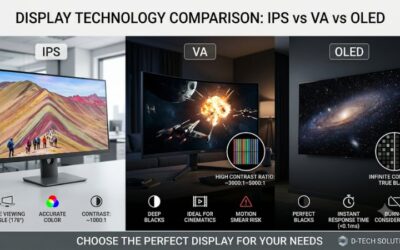
Organic Light-Emitting Diode panels remove traditional backlights by allowing every pixel to emit its own light independently. Per-pixel dimming produces infinite contrast ratios and prevents blooming around fine visual details completely. Organic self-lit pixels respond instantly to signal changes, reducing ghosting during fast camera movement.
Modern OLED displays incorporate active pixel cleaning cycles and integrated heatsinks to mitigate permanent image retention risks. The Dell Alienware AW3225QF utilizes a curved Quantum Dot OLED panel with robust custom cooling to maintain sustained panel brightness. Hardware thermal management ensures long-term panel stability under heavy gaming workloads.
Peak Brightness and VESA DisplayHDR Ratings
Peak brightness ratings measure short-duration light output in small window sizes during high dynamic range playback. The VESA DisplayHDR tier system ranks panels from DisplayHDR 400 up to DisplayHDR 1400 based on luminance and color gamut coverage. Basic DisplayHDR 400 displays lack local dimming, producing flat contrast in demanding visual titles.
Demanding high dynamic range titles require at least 600 nits peak luminance paired with local dimming for impactful visual specular highlights. High-end displays like the INNOCN 27M2V reach 1,000 nits peak brightness while covering over 99 percent of the DCI-P3 color space. Bright highlights add realism to sunlight reflections, explosions, and muzzle flashes.
Display Pipeline Compatibility and Interface Ports
High bandwidth display interfaces are essential for driving high resolution panels at elevated refresh rates without color compression. DisplayPort 1.4 supports 4K resolution at 120Hz using Display Stream Compression, maintaining full 10-bit color depth. HDMI 2.1 offers 48Gbps uncompressed bandwidth for high refresh rates on current PC graphics cards.
Competitive gamers demanding high refresh rates require display controller pipelines optimized for low latency and high signal throughput. The ASUS ROG Swift OLED PG27AQDP features DisplayPort 1.4 and HDMI 2.1 ports to deliver its 480Hz refresh rate. GPU display output compatibility must match input standards to avoid chroma subsampling in high-refresh modes.
Top Picks for HDR Gaming Monitors
Selecting the correct display depends on individual preferences for panel technology, resolution, and competitive refresh rates. The current market spans high-refresh organic light-emitting displays, full-array Mini-LED panels, and budget-friendly desktop solutions. Below is a comparison of top displays evaluated across key performance metrics.
| Product | Best For | Key Spec | Compatibility | Watch Out For | | Dell Alienware AW3225QF | Best Overall | 32″ 4K 240Hz QD-OLED | HDMI 2.1 / DP 1.4 | Aggressive 1700R curve | | AOC Q27G3XMN | Best Value | 27″ 1440p 180Hz Mini-LED | DP 1.4 / HDMI 2.0 | Narrower VA viewing angles | | ASUS ROG Swift OLED PG27AQDP | Best for Esports | 27″ 1440p 480Hz WOLED | DP 1.4 / HDMI 2.1 | Text clarity on WOLED | | INNOCN 27M2V | Best for Content Creation | 27″ 4K 160Hz Mini-LED | DP 1.4 / HDMI 2.1 / USB-C | Slow menu navigation |
Dell Alienware AW3225QF
The Dell Alienware AW3225QF provides top-tier visual performance for enthusiasts seeking a premium HDR gaming monitor for cinematic titles. Featuring a 31.6-inch 4K Quantum Dot OLED panel running at 240Hz, it provides infinite contrast and true black levels. This display suits gaming rigs equipped with graphics hardware capable of 4K output.
Peak brightness reaches 1,000 nits in a 3 percent window, highlighting subtle lighting details in supported game titles. However, the fixed 1700R curvature may not suit users who perform desktop document editing or color-critical design work. Buyers with mid-range graphics hardware should avoid this 4K monitor due to steep rendering requirements.
AOC Q27G3XMN
The AOC Q27G3XMN offers true local dimming technology at an accessible price point for budget-conscious PC builders. Equipped with a 27-inch 2560×1440 VA panel and 336 Mini-LED dimming zones, it delivers a VESA DisplayHDR 1000 certified experience. It connects via DisplayPort 1.4 or dual HDMI 2.0 ports at a smooth 180Hz refresh rate.
This budget HDR gaming monitor reaches 1,000 nits peak luminance, providing punchy specular highlights that cheaper edge-lit models cannot match. The primary trade-off involves VA panel viewing angles, which show color shift when viewed off-center on a desk. Competitive players seeking motion clarity without VA smearing should avoid VA panels.
ASUS ROG Swift OLED PG27AQDP
The ASUS ROG Swift OLED PG27AQDP targets competitive esports players who prioritize instant motion response above all else. Its 26.5-inch WOLED panel operates at a native 2560×1440 resolution with an ultra-fast 480Hz refresh rate and 0.03ms response times. Dual HDMI 2.1 and DisplayPort 1.4 ports provide full bandwidth for high frame rate systems.
Per-pixel self-lit technology ensures zero motion blur and perfect black levels during high-speed action in competitive titles. However, the subpixel layout on WOLED panels causes slight fringe artifacts on desktop text in Windows productivity applications. Casual gamers who primarily watch movies or edit media should opt for higher-density 4K displays.
INNOCN 27M2V
The INNOCN 27M2V combines sharp 4K resolution with precise backlight control, serving as a versatile HDR gaming monitor for creators. Featuring a 27-inch IPS panel with 1,152 local dimming zones, it delivers high color accuracy across DCI-P3 and Adobe RGB spectrums. The display features a 90W USB-C port alongside DisplayPort 1.4 and HDMI 2.1 inputs.
A peak luminance of 1,000 nits ensures vivid contrast reproduction without suffering from pixel degradation seen on organic displays. The main limitation lies in its slow dynamic dimming algorithms, which create subtle halos around moving cursor elements in desktop modes. Users who dislike full-array backlight local dimming behavior should choose OLED panels.
Frequently Asked Questions
Understanding common setup questions helps gamers configure display settings properly in Windows and in individual title menus. High dynamic range signals require specific software and hardware configurations to function correctly without image distortion. Below are direct answers to frequent user queries regarding setup and dynamic range feature support.
Does High Dynamic Range Increase Input Lag?
High dynamic range processing does not introduce conversion latency on modern gaming displays equipped with fast scalers. Signal processing for 10-bit color metadata occurs hardware-side inside the display controller with minimal delay overhead. Choosing an HDR gaming monitor with variable refresh rate support ensures low latency during gameplay.
Enabling full-array local dimming on older TV displays can introduce frame delay, but dedicated desktop monitors feature rapid zone processing. Players using NVIDIA G-Sync or AMD FreeSync will experience responsive input behavior across all refresh rate ranges. Keeping GPU drivers updated ensures display pipeline handshakes complete without adding frame latency.
Is DisplayPort 1.4 Sufficient for High Dynamic Range Content?
DisplayPort 1.4 is fully sufficient for high dynamic range content when paired with Display Stream Compression technology. The bandwidth limit of DisplayPort 1.4 accommodates 4K resolution at 144Hz or 1440p resolution at 240Hz with 10-bit color depth. Modern graphics cards automatically negotiate compression without degrading visual signal fidelity.
Uncompressed 4K resolution at refresh rates exceeding 144Hz requires HDMI 2.1 bandwidth or DisplayPort 2.1 display interfaces. Users connecting high-refresh 4K panels should ensure their graphics card features HDMI 2.1 to bypass compression where required. Display Stream Compression operates visually losslessly across standard desktop and gaming workloads.
Why Does Windows Desktop Look Washed Out with High Dynamic Range?
Windows desktop looks washed out because standard desktop applications operate in the sRGB color space rather than high dynamic range. Enabling system-wide dynamic range maps standard desktop colors incorrectly unless configured using the Windows HDR Calibration app. Utilizing a modern HDR gaming monitor requires calibrating SDR brightness sliders in settings.
The built-in Windows SDR intensity slider controls background luminance levels for standard desktop windows when dynamic mode remains active. Adjusting this slider prevents desktop backgrounds and browser interfaces from appearing grey or overexposed during routine desktop tasks. Keyboard shortcuts allow quick toggling of dynamic range modes when launching games.
Do High Dynamic Range Displays Require Specific Graphics Cards?
High dynamic range displays require a graphics card with HDMI 2.0, DisplayPort 1.4, or newer digital output standards. NVIDIA GeForce GTX 10-series GPUs and AMD Radeon RX 400-series GPUs or newer feature full hardware decoding for 10-bit color signals. Modern discrete graphics processors handle high dynamic range metadata without frame rate penalties.
Older graphics processing units lacking DisplayPort 1.4 cannot output 10-bit color at high refresh rates without reducing color subsampling. Upgrading to a modern graphics card ensures complete compatibility with advanced wide color gamut formats like HDR10. Integrated graphics on modern CPUs also support video playback but lack speed for 3D rendering.
Final Thoughts
Selecting the right display comes down to prioritizing pixel response, peak luminance, and local dimming performance for your system. OLED panels offer unmatched contrast for dark-room gaming, while Mini-LED displays deliver bright highlight punch without retention concerns. Matching an HDR gaming monitor to your GPU ensures an optimal visual experience.