Choosing the best gaming monitor involves balancing screen resolution, panel technology, and refresh rates with your graphics processor. High refresh rates reduce input latency in competitive shooter titles, while high dynamic range panels deliver deep contrast for narrative games. Selecting the right display improves visual clarity.
How to Choose a Gaming Monitor
Evaluating a display requires matching physical specs to desktop space and graphical hardware capabilities. A best gaming monitor must balance contrast performance, response speed, image clarity, and interface options. Understanding panel variants ensures long term visual clarity across modern PC game releases today.
Panel Tech and Response Speed
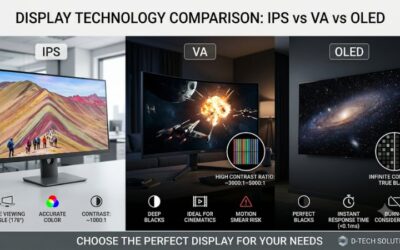
Modern displays utilize IPS, VA, or OLED panels to convert digital signals into rendered imagery. In RTINGS panel benchmarks at 2560×1440 resolution, QD-OLED panels achieve 0.03 ms response times. Buyers seeking the best gaming monitor for speed will find that the Alienware AW2725DF fits this profile.
Selecting the ideal panel structure depends on your target environment and primary usage. Standard Fast IPS panels offer high color accuracy and wide viewing angles, while QD-OLED tech delivers pixel level dimming with infinite contrast ratios. Evaluating response speed prevents motion ghosting in high frame rate competitive shooters.
Resolution and Pixel Density
Screen resolution dictates pixel density and overall workload on your graphics card. A resolution of 2560×1440 on a 27-inch screen yields roughly 109 pixels per inch, delivering sharp visual detail without overwhelming mid-range GPUs. Users wanting accessible 1440p gaming on a budget will benefit from picks like the Dell G2724D display.
Higher resolutions like 3840×2160 increase sharpness but demand powerful graphics processors with high VRAM capacity. Maintaining adequate pixel density keeps text sharp and foliage detailed without introducing spatial anti-aliasing artifacts. Balancing resolution with system hardware ensures optimal frame rates during gameplay.
Refresh Rates and Adaptive Sync
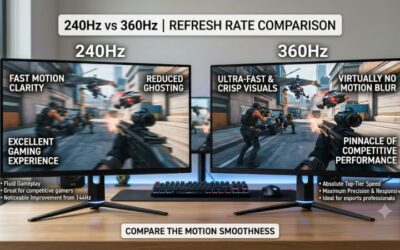
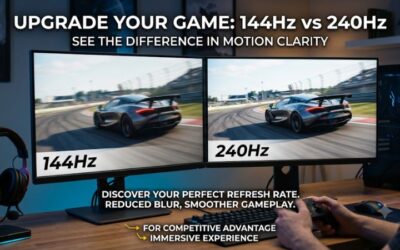
Refresh rates dictate how many individual frames a monitor displays each second. Higher values like 180Hz or 360Hz create smoother motion tracking for high speed action. Features like NVIDIA G-Sync and AMD FreeSync Premium match panel refresh rates to GPU render speeds, eliminating screen tearing without introducing system input lag.
High refresh rates work alongside full dynamic range backlights to produce vivid scenes. Monitors utilizing Mini-LED backlighting with local dimming zones provide high peak brightness for HDR games. Users searching for the best gaming monitor options for HDR will appreciate models like the AOC Q27G3XMN.
Video Inputs and Cable Compatibility
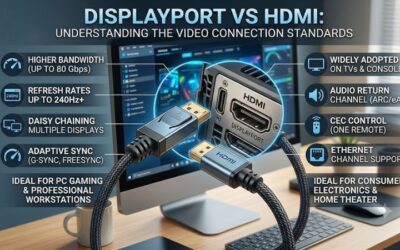
Video port compatibility determines whether a display can utilize its full refresh rate and color depth settings. DisplayPort 1.4 supports high bandwidth video transmission on PC GPUs, while HDMI 2.1 accommodates modern gaming consoles at high refresh rates. Cable bandwidth limitations can restrict monitor resolution or color sub-sampling.
Modern desktop setups often require versatile inputs like DisplayPort, HDMI, and USB Type-C. USB-C ports with DisplayPort Alt Mode allow laptop connectivity alongside desktop rigs, enabling clean cable routing. System builders seeking flexible workspace integration will find full port functionality on the ASUS ROG Strix XG27ACS.
Top Picks for Gaming Displays
Selecting a panel requires weighing performance metrics against hardware specifications and retail prices. Each display category serves distinct user needs, from high refresh esports competition to budget entry level setups. Evaluating connectivity options helps locate the best gaming monitor for your PC rig.
| Product | Best For | Key Spec | Compatibility | Watch Out For |
| Alienware AW2725DF | Best Overall | 2560×1440 360Hz QD-OLED | DisplayPort 1.4 or HDMI 2.1 | Capped at 144Hz over HDMI |
| Dell G2724D | Best Value | 2560×1440 165Hz Fast IPS | DisplayPort 1.4 or HDMI 2.1 | Lacks USB ports and audio jack |
| AOC Q27G3XMN | Best HDR Visuals | 2560×1440 180Hz Mini-LED | DisplayPort 1.4 or HDMI 2.0 | Narrower viewing angles on VA |
| ASUS ROG Strix XG27ACS | Best USB-C All-Rounder | 2560×1440 180Hz Fast IPS | DisplayPort 1.4 or USB-C | Lower peak brightness in HDR |
Alienware AW2725DF
Esports competitors and high refresh rate enthusiasts will find high value in the Alienware AW2725DF. This 27-inch 2560×1440 display serves as a top choice for a best gaming monitor with its 360Hz QD-OLED panel and ultra fast 0.03 ms response time. In RTINGS motion benchmarks, this panel clears fast motion blur during competitive play.
The primary limitation of this display is its HDMI port implementation, which limits refresh rates to 144Hz over HDMI connections. PC gamers must connect via DisplayPort 1.4 to reach the native 360Hz capability. Users who primarily play on consoles or require ultra bright matte anti-glare screens should look at IPS alternatives.
Dell G2724D
Budget conscious gamers seeking sharp 1440p resolution will benefit from the Dell G2724D. Featuring a 27-inch Fast IPS panel, a 165Hz refresh rate, and 400 nits brightness, this monitor delivers crisp image quality. In Tom’s Hardware gaming benchmarks, its 1ms response time keeps fast action clear across modern game titles.
One notable weakness of the Dell G2724D is its complete omission of integrated USB hub ports and a 3.5mm audio passthrough port. Audio must route directly through your motherboard or dedicated desktop DAC. Buyers who require integrated USB hubs or built in speaker outputs should select higher tier workstation displays.
AOC Q27G3XMN
Gamers prioritizing high contrast dynamic visuals without paying premium OLED prices will find the AOC Q27G3XMN ideal. This 27-inch 2560×1440 display utilizes a Mini-LED VA panel running at 180Hz with 336 dimming zones. In DisplayNinja benchmarks, its 1000 nits peak HDR brightness generates deep blacks alongside bright highlights.
The main weakness stems from its VA panel structure, which exhibits color shifting when viewed from off center angles. Users must view the display straight on for accurate gamma performance. Content creators requiring color accuracy across wide viewing angles should consider Fast IPS options rather than Mini-LED VA screens.
ASUS ROG Strix XG27ACS
Gamers using combined desktop and laptop setups will appreciate the versatile ASUS ROG Strix XG27ACS. Featuring a 27-inch 2560×1440 Fast IPS panel at 180Hz, it includes DisplayPort 1.4, HDMI 2.0, and a USB Type-C port with DisplayPort Alt Mode. In RTINGS panel benchmarks, its 1ms response time provides clean motion rendering.
Its main disadvantage is a limited peak HDR brightness level of roughly 350 nits, which limits dynamic range impact in bright game environments. Buyers looking for true high dynamic range highlights should select Mini-LED or QD-OLED options. Players who only play in SDR space will find this display’s colors highly vibrant.
Frequently Asked Questions
Understanding display specifications helps buyers make informed decisions when upgrading gaming setups. Common queries involve choosing panel technologies, sizing resolution to GPU power, choosing video cables, and avoiding image retention. Here are clear answers regarding the best gaming monitor choices.
What panel type works best for fast competitive multiplayer games?
OLED panels work best for competitive multiplayer games due to near instantaneous pixel response times under 0.03 ms. This ultra low latency minimizes motion blur during fast camera panning in shooters like Overwatch 2. Fast IPS panels serve as a solid alternative when seeking high refresh rates on tighter hardware budgets.
While standard IPS displays deliver sub 1ms GtG response times, OLED technology removes pixel transitions almost entirely. Minimizing blur improves target tracking across high frame rate scenarios. Players competing at high refresh levels benefit from pairing OLED panels with high performance graphics processing units.
Does 1440p resolution require high end graphics hardware to run?
Selecting a best gaming monitor with 1440p resolution requires mid-range graphics cards like the NVIDIA GeForce RTX 4060 Ti or AMD Radeon RX 7700 XT to sustain high frame rates. Modern games at 2560×1440 demand moderate VRAM capacity and rendering bandwidth. Lower tier GPUs can run 1440p using temporal upscaling tools.
Upgrading to a 1440p display delivers a noticeable sharp image improvement over standard 1080p without forcing full 4K hardware upgrades. Mid-range GPUs maintain smooth frame rates in current titles when paired with variable refresh rate displays. Balancing panel resolution with graphics power secures long term performance.
Is DisplayPort required over HDMI for variable refresh rate technology?
DisplayPort is required for NVIDIA G-Sync compatibility on older monitor models, while newer HDMI 2.1 connections support HDMI Forum VRR. Connecting through DisplayPort 1.4 ensures maximum refresh bandwidth and variable refresh support across both NVIDIA and AMD graphics cards. Cable choices determine adaptive sync options.
Using standard HDMI 2.0 cables can limit refresh rates to 144Hz or disable G-Sync functionality on PC systems. Gamers should connect desktop PCs via DisplayPort 1.4 cables to ensure full bandwidth transmission. Console players connecting PlayStation 5 or Xbox Series X consoles must utilize HDMI 2.1 to enable 120Hz VRR mode.
Do OLED displays cause burn in during long desktop gaming sessions?
Modern OLED displays mitigate permanent image retention through built in pixel refresh maintenance cycles and pixel shifting software features. Hardware manufacturers incorporate heat dissipation layers to lower panel temperatures during static desktop use. Following basic maintenance precautions protects panel lifespan over time.
Setting desktop taskbars to auto-hide and using dynamic screen savers prevents static UI elements from staying on screen indefinitely. Operating pixel refresh routines when prompted by display firmware maintains uniform subpixel brightness. Modern QD-OLED monitors include multi year burn in coverage warranties for peace of mind.
Final Thoughts
Selecting the best gaming monitor involves matching your GPU performance with optimal resolution, panel speed, and port connectivity. Options ranging from 360Hz QD-OLED panels to budget Fast IPS screens meet varied competitive and visual needs. Matching hardware specs to your workspace ensures smooth gameplay across modern titles.