🛒 Best Price Today on Amazon
Prime members get fast, free shipping on everything above, plus member-only deals. New members get a 30-day free trial — cancel anytime.
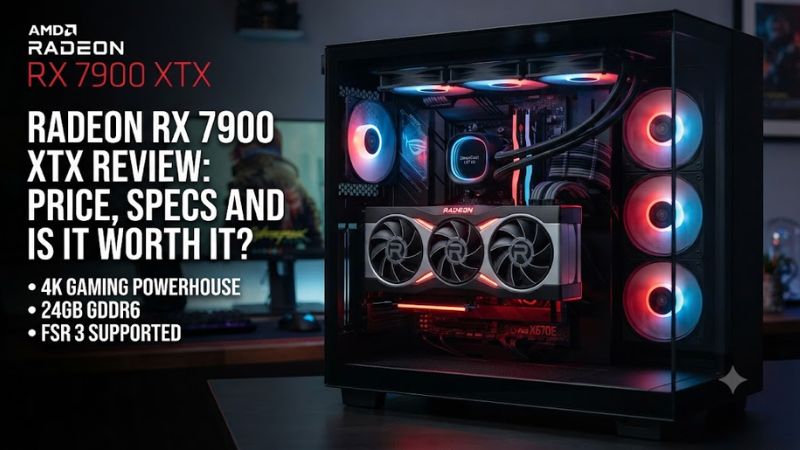
At a $999 launch MSRP, radeon rx 7900 xtx review: price, specs and is it worth it now comes down to value and availability. AMD’s RDNA 3 flagship still offers 24GB of GDDR6 and strong raster performance, but newer GPUs make ray tracing, upscaling and current retail pricing more important when choosing a 4K card.
How to Choose a High-End Radeon GPU
The right choice depends on four factors: street price, raster performance, ray tracing, and platform compatibility. The RX 7900 XTX targets native 4K gaming, while the RX 9070 XT is the newer AMD option, and NVIDIA alternatives offer stronger ray tracing and frame-generation features.
Check the Current Price
For this radeon rx 7900 xtx review: price, specs and is it worth it, launch MSRP is only a reference because availability has changed. Tom’s Hardware currently lists the RX 7900 XTX as out of stock, while independent price tracking recorded recent qualifying U.S. retail observations around 929–930. That makes the asking price critical.
If you find a new card near its historical low of $749, its 24GB memory and raster output become much more attractive. At roughly $1,000 or higher, a newer RX 9070 XT deserves closer attention because it is readily represented in current-generation pricing and brings newer RDNA 4 features.
Match the Gaming Workload
The RX 7900 XTX remains particularly compelling for rasterized 1440p and 4K games. TechSpot’s 16-game suite put it 4% ahead of the RTX 4080 at 4K on average, although individual games varied considerably. Its 24GB GDDR6 capacity also gives high-resolution texture workloads plenty of memory headroom.
Ray tracing changes that equation. TechSpot recorded the card 13% behind the RTX 4080 in native 4K F1 22 with ray tracing, while Cyberpunk 2077 reached only 20 fps at native 4K in its RT workload. That does not make the XTX unsuitable for RT, but it narrows its appeal for RT-heavy builds.
Verify Power and Case Fit
AMD specifies a 355W typical board power and recommends an 800W-or-greater power supply, with two 8-pin auxiliary connectors. The reference card is 287mm long and 2.5 slots wide, although board-partner designs can be larger, so case clearance should be checked against the exact model.
Platform requirements are straightforward because the GPU uses PCIe 4.0 x16 and GDDR6 is built into the graphics card. It does not require DDR5 system memory, so compatible DDR4 or DDR5 platforms can work; the important checks are motherboard PCIe support, PSU capacity, connector availability and physical clearance.
Consider the Newer Alternatives
The newer RX 9070 XT uses RDNA 4, 16GB of GDDR6 and a PCIe 5.0 x16 interface, while AMD rates it at 304W with a 750W minimum PSU recommendation. TechSpot found it broadly competitive with the RTX 5070 Ti at 4K, while its ray tracing performance is substantially ahead of the older RX 7900 XTX in several workloads.
That makes the buying decision less about whether the XTX is fast and more about what its price buys today. If the older card is substantially discounted, its 24GB capacity and raster performance remain useful; if pricing approaches newer models, the newer architectures provide a stronger feature set for a fresh build.
Top Picks for High-End PC Gaming
The radeon rx 7900 xtx review: price, specs and is it worth it question has a conditional answer in 2026: buy it when the price reflects its older generation, not simply because its original $999 MSRP looked attractive. Current alternatives can offer better availability, newer features or stronger ray tracing.
| Product | Best For | Key Spec | Compatibility | Watch Out For |
| Radeon RX 9070 XT | Best Overall | 16GB GDDR6, 304W | PCIe 5.0 x16, 750W PSU | Less VRAM than XTX |
| Radeon RX 7900 XTX | Best Value at a deep discount | 24GB GDDR6, 355W | PCIe 4.0 x16, 800W PSU | Limited new-stock availability |
| GeForce RTX 5070 Ti | Best For Ray Tracing | 16GB GDDR7, 8960 CUDA cores | PCIe 5.0, 750W-class system | Current prices can be very high |
| GeForce RTX 5080 | Best For High-End 4K | 16GB GDDR7, 360W | PCIe 5.0, 850W system | Current retail price is far above MSRP |
Radeon RX 9070 XT: Best Overall
The RX 9070 XT is the strongest current AMD alternative for most buyers who want a new high-end card. AMD lists 16GB of GDDR6, 64 compute units, up to 2.97GHz boost and 304W typical board power, while current U.S. pricing tracked by PC Gamer is around $760.
Its main weakness is memory capacity: 16GB is less than the XTX’s 24GB. Someone buying specifically for very large texture workloads or long-term VRAM headroom should not treat those capacities as interchangeable. For ordinary 1440p and 4K gaming, however, the newer architecture makes it a more sensible current-generation starting point.
Radeon RX 7900 XTX: Best Value at a Deep Discount
The RX 7900 XTX remains the card to watch if a retailer clears old inventory at a genuinely low price. Its 6,144 stream processors, 24GB GDDR6, 384-bit memory interface and 355W board rating give it a substantial hardware foundation for native-resolution raster gaming.
The weakness is availability rather than basic capability. Tom’s Hardware currently records the model as out of stock in its U.S. price tracker, so a new purchase may require accepting a higher seller price or remaining-stock premium. Do not buy it at an inflated price simply to obtain the older flagship name.
GeForce RTX 5070 Ti: Best For Ray Tracing
The RTX 5070 Ti pairs 16GB of GDDR7 with 8,960 CUDA cores and NVIDIA’s fourth-generation ray-tracing hardware. TechSpot’s 4K results placed it about 13% behind the RTX 5080 on average and ahead of the RX 7900 XT in its raster suite, while its RT results remained stronger than older Radeon RDNA 3 cards.
Its major drawback is current pricing. PC Gamer recently listed U.S. availability around $1,150, far above NVIDIA’s $749 starting price, which weakens its value proposition. It makes more sense for buyers who specifically prioritize DLSS and ray tracing than for someone seeking maximum raster performance per dollar.
GeForce RTX 5080: Best For High-End 4K
The RTX 5080 is a newer Blackwell option with 16GB of GDDR7, a 256-bit interface, 10,752 CUDA cores and 360W total graphics power. NVIDIA lists an $999 starting price, but current U.S. retail tracking shows substantially higher prices, including listings around $1,650.
That pricing is its clearest weakness. The RTX 5080 brings newer DLSS and ray-tracing capabilities, but paying roughly $1,650 changes the value equation considerably. It is not a sensible upgrade target for someone whose main goal is simply replacing an already capable RX 7900 XTX for conventional rasterized 4K gaming.
FAQ: Radeon RX 7900 XTX Buying Questions
The short answer to radeon rx 7900 xtx review: price, specs and is it worth it is that it can still be worthwhile below newer-card pricing, especially for raster-focused 4K gaming, but its availability and weaker ray tracing make the purchase highly price-dependent.
Is the RX 7900 XTX still good for 4K gaming?
Yes, the RX 7900 XTX remains a strong 4K rasterization GPU. TechSpot’s 16-game benchmark at 4K placed it 4% ahead of the RTX 4080 on average, while individual games ranged considerably, showing why a single title should not define its overall performance.
Its 24GB GDDR6 memory is also a useful advantage for high-resolution assets. That capacity does not automatically make the GPU faster, but it gives demanding games more memory headroom than many 16GB alternatives, particularly when texture settings are pushed high.
How much power does the RX 7900 XTX need?
AMD recommends an 800W-or-greater PSU for the RX 7900 XTX and specifies two 8-pin auxiliary power connectors. The recommendation is based on a system using a Ryzen 9 5900X, so unusually power-hungry CPUs or heavily configured systems can change the practical requirement.
The card itself carries a 355W typical board-power rating. A buyer should therefore verify the PSU’s continuous capacity, available PCIe power cables and case airflow rather than choosing a supply from wattage alone. The exact board-partner model should also be checked for its own power and size specifications.
Is the RX 7900 XTX better than the RX 9070 XT?
No, not universally; the RX 9070 XT is the newer architecture, while the RX 7900 XTX offers more VRAM and can remain faster in some raster workloads. TechSpot’s 2025 review found the 9070 XT 13% behind the XTX in its 1440p comparison, but later driver data narrowed several gaps and showed strong 4K competitiveness.
The newer Radeon is therefore preferable for buyers who want a current-generation product with stronger ray tracing, while the XTX makes more sense when its 24GB memory and raster performance are available at a substantially lower price. Availability should be part of that calculation because current XTX stock is limited.
Is the RX 7900 XTX worth buying in 2026?
Yes, but only when its selling price is meaningfully below newer high-end alternatives. Its original $999 MSRP is no longer a useful standalone value indicator because the model is from the previous generation, and current tracking shows new-stock availability is limited in the U.S.
For a new gaming PC, the RX 9070 XT is the safer starting point when prices are close, while the XTX becomes more interesting when discounted heavily. Buyers focused on ray tracing or NVIDIA-specific features should instead compare current GeForce options before committing to the older Radeon flagship.
Final Thoughts
The radeon rx 7900 xtx review: price, specs and is it worth it verdict is straightforward: it remains a powerful 24GB 4K raster GPU, but its value depends on discounting. At a favorable price it can make sense; near current premium retail pricing, newer Radeon and GeForce cards offer a more convincing feature and availability package.