🛒 Best Price Today on Amazon
Prime members get fast, free shipping on everything above, plus member-only deals. New members get a 30-day free trial — cancel anytime.
For a best motherboard for a streaming setup, prioritize USB connectivity, network options, expansion slots and CPU power delivery rather than chasing gaming FPS. Current AM5 boards pair DDR5 with Ryzen 7000, 8000 and 9000 processors, while creator-focused models add faster networking and USB4 for capture, storage and production gear.
How to Choose a Motherboard for Streaming
A streaming PC usually connects more devices than a conventional gaming system: microphone interfaces, webcams, capture cards, external storage and controllers can all compete for I/O. A good board therefore needs enough rear and internal USB connections, useful PCIe expansion, fast networking and power delivery appropriate for the chosen CPU.
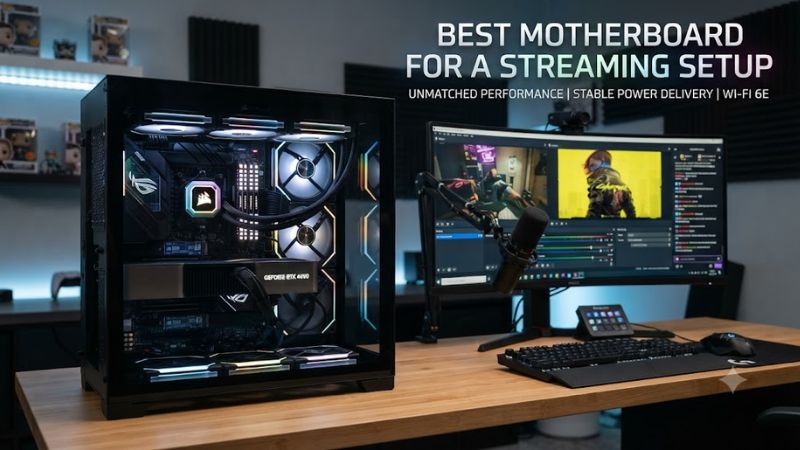
USB connectivity for streaming gear
The best motherboard for a streaming setup should leave enough USB bandwidth for cameras, audio interfaces, controllers and storage without forcing every device through a hub. The ASUS ProArt X870E-Creator offers seven rear USB 10Gbps Type-A ports, USB4 and a 20Gbps Type-C connection, making its I/O unusually creator-oriented.
For a lower-cost system, the ASRock B850 LiveMixer WiFi takes a different approach by providing a large overall USB count, including rear USB 10Gbps and several slower ports. That layout suits streamers with many basic peripherals, although USB capability is distributed across different speeds rather than concentrated around USB4.
Networking and capture-card expansion
A best motherboard for a streaming setup should match the network connection and expansion cards you actually plan to use. The ProArt X870E-Creator combines 10Gb Ethernet, 2.5Gb Ethernet, Wi-Fi 7 and PCIe 5.0 support, while the B850 LiveMixer provides 2.5Gb Ethernet, Wi-Fi 7 and two additional PCIe 4.0 x4 slots.
Capture cards normally occupy a PCIe slot, so slot layout matters alongside the graphics card. The B850 LiveMixer has one CPU-connected PCIe 5.0 x16 slot plus two chipset-connected PCIe 4.0 x4 slots, but ASRock notes that one of those slots is disabled when a particular M.2 connector is populated.
CPU power and sustained workloads
Streaming workload depends heavily on the CPU and encoding method, so the motherboard should provide suitable power delivery for the processor instead of being selected around VRM phase counts alone. MSI’s B850 Tomahawk uses a 14+2+1 power design with 80A Smart Power Stages and dual 8-pin CPU power connectors.
The ASUS ROG Strix B850-F uses 16+2+2 80A power stages, four DDR5 slots and substantial VRM cooling. These specifications fit higher-end AM5 processors, but they do not by themselves determine stream quality; CPU encoding settings, GPU hardware encoding and the rest of the system still matter.
Socket, RAM and case compatibility
For a best motherboard for a streaming setup built today, AM5 offers DDR5 support and compatibility with Ryzen 7000, 8000 and 9000 desktop processors across current 600- and 800-series chipsets, subject to the manufacturer’s CPU list and BIOS requirements. Every pick below uses DDR5 and an ATX form factor, so the case must support ATX boards.
All four choices require an AM5 CPU and DDR5 memory, while their PCIe layouts differ. The ASUS ProArt and ROG Strix boards use a 24-pin main connector plus dual 8-pin CPU power, and the MSI Tomahawk uses the same dual 8-pin CPU arrangement; check the PSU connectors and case clearance before purchasing.
Top Picks for Streaming Motherboards
The four picks below cover different streaming priorities rather than identical builds. The ProArt model emphasizes creator connectivity, the MSI Tomahawk targets a mainstream AM5 system, the LiveMixer focuses on many peripherals and expansion, while the ROG Strix B850-F balances gaming features with creator-friendly connectivity.
| Product | Best For | Key Spec | Compatibility | Watch Out For |
| ASUS ProArt X870E-Creator WiFi | Best Overall | Dual USB4, 10GbE + 2.5GbE | AM5, DDR5, ATX | Premium feature set |
| MSI MAG B850 Tomahawk WiFi | Best Value | 5GbE, Wi-Fi 7, PCIe 5.0 | AM5, DDR5, ATX | No 10GbE |
| ASRock B850 LiveMixer WiFi | Best For Peripheral-Heavy Builds | Large USB count, 3 PCIe x16-length slots | AM5, DDR5, ATX | Only two SATA ports |
| ASUS ROG Strix B850-F Gaming WiFi | Best For Gaming + Streaming | Four M.2, Wi-Fi 7, 2.5GbE | AM5, DDR5, ATX | Only two SATA ports |
Best Overall: ASUS ProArt X870E-Creator WiFi
The ASUS ProArt X870E-Creator WiFi is the strongest match for a best motherboard for a streaming setup when the PC doubles as a production workstation. It supports Ryzen 9000, 8000 and 7000 processors, four DDR5 DIMMs, four M.2 drives, dual USB4 and both 10GbE and 2.5GbE networking.
Its real weakness is cost and feature overlap: a streamer using one Ethernet connection, a few USB peripherals and one NVMe drive may not use much of its creator-focused I/O. It also requires an ATX-compatible case and two CPU power connectors, so it is better suited to a feature-rich workstation-style build than a minimal streaming PC.
Best Value: MSI MAG B850 Tomahawk WiFi
The MSI MAG B850 Tomahawk WiFi fits a best motherboard for a streaming setup when the build needs strong mainstream connectivity without moving to an X870E creator board. It supports Ryzen 9000, 8000 and 7000 CPUs, four DDR5 DIMMs, one PCIe 5.0 x16 slot, three M.2 sockets, 5GbE and Wi-Fi 7.
Its limitation is that it does not provide the ProArt’s 10GbE or dual USB4 arrangement. It is therefore less compelling for a streamer who also moves large files over a fast wired network or regularly connects high-speed external storage. It makes more sense for a conventional single-PC gaming and streaming build.
Best For Peripheral-Heavy Builds: ASRock B850 LiveMixer WiFi
The ASRock B850 LiveMixer WiFi is designed around the crowded I/O needs that make a best motherboard for a streaming setup different from a basic gaming board. It has four DDR5 slots, one PCIe 5.0 x16 slot, two PCIe 4.0 x4 slots, three M.2 sockets, 2.5GbE and Wi-Fi 7.
Its main compromise is storage connectivity: ASRock lists two SATA ports, so a build using several SATA hard drives or 2.5-inch SSDs has less room than the ProArt or Tomahawk. It is also an ATX board, so compact cases designed only for micro-ATX or Mini-ITX systems are unsuitable.
Best For Gaming + Streaming: ASUS ROG Strix B850-F Gaming WiFi
The ASUS ROG Strix B850-F Gaming WiFi is a sensible best motherboard for a streaming setup when gaming remains the primary workload. It supports Ryzen 7000, 8000 and 9000 processors, four DDR5 DIMMs, four M.2 slots, PCIe 5.0 graphics support, 2.5Gb Ethernet and Wi-Fi 7.
Its weakness is storage expansion through SATA, with two SATA 6Gb/s ports, while rear connectivity is less creator-heavy than the ProArt design. Buyers who need several SATA drives, 10GbE or dual USB4 should look elsewhere, while a gaming-focused streamer can use its four M.2 slots instead.
FAQ
Does a streaming PC need an expensive motherboard?
No, a streaming PC does not need an expensive motherboard if the board provides the required CPU support, USB ports, networking and expansion slots. A mainstream B850 board can accommodate Ryzen 9000, 8000 and 7000 processors while offering DDR5 and PCIe 5.0 support.
The extra money on models such as the ProArt X870E-Creator mainly buys additional connectivity and expansion rather than a separate streaming feature. For example, its dual USB4 and 10GbE connections target creator workflows that may involve fast external storage or network transfers.
Is AM5 a good platform for streaming?
AM5 is a current platform for streaming because AMD supports Ryzen 7000, 8000 and 9000 desktop processors across its current Socket AM5 ecosystem, with DDR5 memory and PCIe 5.0 available on selected chipsets.
The exact motherboard still matters because USB, Ethernet, M.2 and PCIe configurations vary substantially between models. Before buying, compare the CPU support list, memory support list and PCIe/M.2 sharing rules for the specific board rather than assuming every AM5 model has the same layout.
How many M.2 slots does a streaming PC need?
Two M.2 slots can cover a typical gaming-and-streaming system, while four slots provide more room for separating games, recordings and other large files. The ProArt X870E-Creator and ROG Strix B850-F each provide four M.2 slots.
M.2 count should not be considered alone because some boards share bandwidth between M.2 connectors and expansion slots. ASUS documents this behavior on the B850-F, while ASRock documents a similar interaction between M2_3 and one PCIe slot on the LiveMixer.
Does the motherboard affect streaming FPS?
The motherboard can affect the available platform features and CPU configuration, but it is not normally the primary source of streaming FPS differences between otherwise comparable systems. Encoding hardware, CPU/GPU selection, game settings and OBS configuration have a much larger role in the final workload.
For that reason, choose the board around connectivity, compatibility and expansion rather than expecting a premium chipset alone to increase frame rates. The practical advantage of a higher-end model is access to features such as 10GbE, USB4, additional M.2 capacity or more expansion flexibility.
Final Thoughts
The best motherboard for a streaming setup depends on the devices, CPU, storage and network already planned for the PC. The ProArt X870E-Creator targets creator-heavy systems, while the B850 Tomahawk, LiveMixer and ROG Strix B850-F cover more conventional AM5 streaming builds with different I/O and expansion priorities.