🛒 Best Price Today on Amazon
Prime members get fast, free shipping on everything above, plus member-only deals. New members get a 30-day free trial — cancel anytime.
A 360Hz monitor needs up to 360 frames per second to fully refresh every frame, but best gpu for 1080p 360hz esports depends heavily on the game, CPU, settings, and whether you also play demanding AAA titles. Current RTX 50 and RX 9000 cards offer enough GPU performance, but the platform must be balanced.
How to Choose a 1080p 360Hz Esports GPU
For 1080p 360Hz gaming, the key factors are the actual esports workload, CPU balance, VRAM, and platform compatibility. A GPU that looks excessive for Valorant may make more sense if you also play heavier games. The RTX 5070, RX 9060 XT 16GB, RX 9070, and RTX 5070 Ti cover different versions of this use case.
Match the GPU to the Game
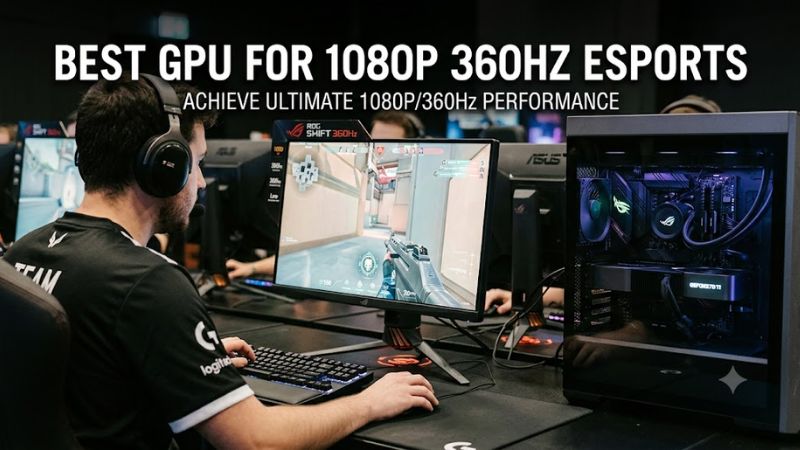
The first question is whether your games are primarily CPU-limited esports titles or GPU-heavier competitive games. Counter-Strike 2 and Valorant can place substantial pressure on the processor at low 1080p settings, so the best gpu for 1080p 360hz esports is not automatically the most powerful card available.
For a mixed esports library, the RTX 5070 provides a useful middle point. NVIDIA lists 12GB of GDDR7, a 250W total graphics power rating, and a 650W required system power figure for its reference configuration. It also supports DLSS 4 and DisplayPort output.
Keep the CPU in Balance
A 360Hz target changes the balance between CPU and GPU because each displayed frame has only about 2.78 milliseconds available. If the processor cannot prepare frames quickly enough, replacing a capable graphics card with a faster one may produce limited gains at competitive settings.
The RTX 5070 Ti is the higher-performance option here, with 16GB of GDDR7 and a 750W required system power figure. It suits players who want more GPU headroom for demanding games while retaining a 1080p competitive setup, but its extra GPU capacity does not remove CPU limits in CPU-bound esports titles.
Consider VRAM and Your Game Mix
VRAM matters less for simple competitive settings than for high-resolution textures and demanding modern games, but it becomes more relevant when one PC handles both esports and AAA gaming. The best gpu for 1080p 360hz esports therefore depends on whether 1080p low settings are your only workload.
The RX 9060 XT 16GB offers 16GB of GDDR6, a 160W typical board power rating, and a 450W minimum PSU recommendation from AMD. Its 16GB capacity gives it more memory headroom than the RTX 5070, although its overall GPU performance is lower in Tom’s Hardware’s 2026 rasterization hierarchy.
Check the Complete Platform
Compatibility includes more than whether a graphics card fits the PCIe slot. Check the PSU recommendation, power connectors, physical card dimensions, monitor connection, CPU platform, and case clearance before ordering. Manufacturer board designs can differ substantially in size even when the GPU model is identical.
The RX 9070 uses PCIe 5.0 x16, 16GB of GDDR6, two 8-pin power connectors, and a 650W minimum PSU recommendation. AMD also lists Windows 10 64-bit, Windows 11, and Linux x86-64 support, making it straightforward to place into a modern desktop platform.
Top Picks for 1080p 360Hz Esports
The four cards below represent different ways to build around a 360Hz 1080p display. Tom’s Hardware’s 2026 hierarchy uses separate 1080p Ultra, 1440p Ultra, and 4K Ultra rasterization results, so those figures should not be treated as direct 360Hz esports FPS measurements.
| Product | Best For | Key Spec | Compatibility | Watch Out For |
| NVIDIA GeForce RTX 5070 | Best Overall | 12GB GDDR7, 250W | PCIe platform, 650W system power | 12GB VRAM |
| AMD Radeon RX 9060 XT 16GB | Best Value | 16GB GDDR6, 160W | PCIe 5.0 x16, 450W PSU | Lower performance tier |
| AMD Radeon RX 9070 | Best For Mixed Gaming | 16GB GDDR6, 220W | PCIe 5.0 x16, 650W PSU | More power than 9060 XT |
| NVIDIA GeForce RTX 5070 Ti | Best For GPU Headroom | 16GB GDDR7, 300W | PCIe platform, 750W system power | Higher cost and power |
Best Overall: GeForce RTX 5070
The GeForce RTX 5070 is the best-balanced choice in this roundup for a 1080p 360Hz system that also plays a broader selection of games. It combines 12GB GDDR7 with Blackwell architecture, DLSS 4 support, and a 250W total graphics power rating, while NVIDIA specifies 650W required system power.
The main weakness is its 12GB memory capacity compared with 16GB alternatives. Tom’s Hardware places the RTX 5070 at 65.1% of its RTX 5090 baseline in 1080p Ultra rasterization, while the RX 9070 reaches 69.1%; this is a mixed-game benchmark rather than an esports test.
Best Value: Radeon RX 9060 XT 16GB
The Radeon RX 9060 XT 16GB is the value-oriented choice when the system is primarily intended for 1080p competitive gaming and you also want substantial VRAM capacity. AMD lists 16GB GDDR6, a 160W typical board power rating, one 8-pin connector, and a 450W minimum PSU recommendation.
Its weakness is that its lower GPU performance leaves less headroom for demanding games than the RX 9070 or RTX 5070. Tom’s Hardware records 48.2% of its RTX 5090 baseline at 1080p Ultra for the RX 9060 XT 16GB, compared with 65.1% for the RTX 5070.
Best For Mixed Gaming: Radeon RX 9070
The Radeon RX 9070 suits buyers who want a 1080p 360Hz esports system without restricting the machine to lightweight competitive games. AMD specifies 16GB GDDR6, a 220W typical board power rating, PCIe 5.0 x16, and a 650W minimum PSU recommendation, giving it considerably more GPU capacity than the RX 9060 XT.
Its real weakness for a pure esports build is that some of its additional performance can remain unused when the game becomes CPU-limited at low 1080p settings. Tom’s Hardware reports 69.1% of its RTX 5090 baseline at 1080p Ultra, above the RTX 5070’s 65.1%, although these figures represent a broad raster suite rather than competitive-game results.
Best For GPU Headroom: GeForce RTX 5070 Ti
The RTX 5070 Ti is the high-headroom option for users who want their 1080p 360Hz PC to handle heavier games as well. NVIDIA lists 16GB GDDR7, 8,960 CUDA cores, a 300W total graphics power rating, and 750W required system power, alongside DLSS 4 support.
The weakness is its higher power requirement and substantially higher reference price than the RTX 5070. Tom’s Hardware records 76.2% of its RTX 5090 baseline at 1080p Ultra, but that extra GPU performance does not guarantee 360 FPS in CPU-limited esports titles.
Frequently Asked Questions
These questions matter because a 360Hz monitor changes how you should interpret GPU specifications: the display can refresh every 2.78 milliseconds, but the graphics card, processor, game engine, and settings all contribute to whether frames arrive quickly enough.
Is a 360Hz Monitor Worth It for Esports?
A 360Hz monitor can show more frequent frame updates than a 240Hz display when the PC produces sufficiently high frame rates, with a 360Hz refresh occurring every 2.78 milliseconds. That makes CPU and GPU balance particularly relevant for competitive settings at 1080p.
For the best gpu for 1080p 360hz esports setup, do not use the monitor’s refresh rate as a guarantee of performance. A benchmark at 1080p Ultra in a mixed game suite cannot establish 360 FPS in Counter-Strike 2 or Valorant, because different engines and settings produce different CPU and GPU loads.
Does a 360Hz Setup Need an RTX 5070?
No, a 360Hz setup does not inherently require an RTX 5070, because the required GPU depends on the game, settings, CPU, and target frame rate. Lightweight esports games can become CPU-limited before a modern midrange GPU is fully occupied.
The RTX 5070 becomes more relevant when the system also runs demanding games or when you want additional GPU headroom. NVIDIA specifies 12GB GDDR7, 250W total graphics power, and 650W required system power, so the complete build should be checked against those platform requirements.
Is 16GB VRAM Better for 1080p Esports?
Sixteen gigabytes of VRAM is not automatically necessary for 1080p esports, but it can be useful when the same PC also runs demanding games or uses higher texture settings. VRAM capacity should therefore be considered alongside GPU performance rather than treated as a direct FPS measurement.
The RX 9060 XT 16GB and RX 9070 both provide 16GB GDDR6, while the RTX 5070 provides 12GB GDDR7. AMD lists the RX 9060 XT at 160W and the RX 9070 at 220W typical board power, showing that memory capacity alone does not determine overall GPU performance.
Can a GPU Alone Deliver 360 FPS?
No, a GPU alone cannot guarantee 360 FPS because CPU performance, game-engine limits, memory configuration, drivers, background workloads, and graphics settings can all affect frame delivery. This is particularly important at 1080p with competitive settings, where GPU demand can fall substantially.
For that reason, the best gpu for 1080p 360hz esports should be selected as part of a balanced platform. A faster GPU can help when the graphics processor is the limiting component, but changing to a higher GPU tier has less effect when the processor is already limiting frame production.
Final Thoughts
The best gpu for 1080p 360hz esports depends on whether your priority is competitive titles alone or a broader gaming library. The RTX 5070 offers a balanced platform, RX 9060 XT 16GB emphasizes value and memory capacity, RX 9070 adds GPU headroom, and RTX 5070 Ti targets heavier workloads.