🛒 Best Price Today on Amazon
Prime members get fast, free shipping on everything above, plus member-only deals. New members get a 30-day free trial — cancel anytime.
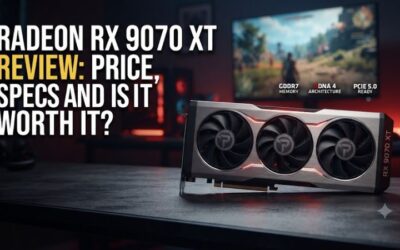
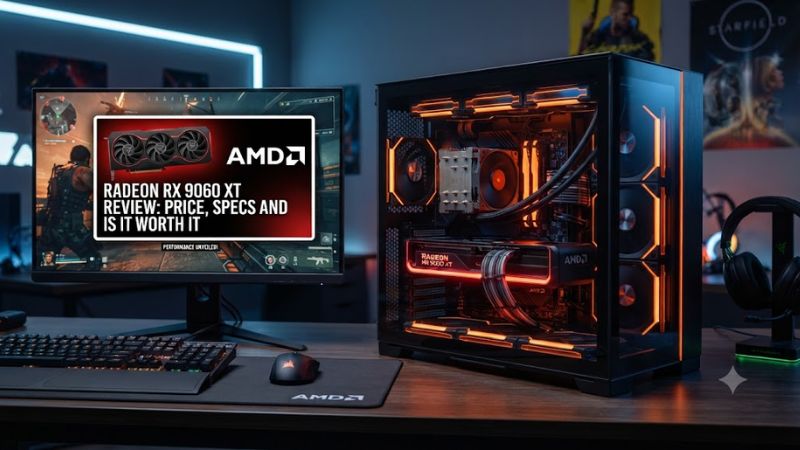
AMD positions the RX 9060 XT as an affordable RDNA 4 card for mainstream gaming, but its two memory versions make the buying decision less simple. This Radeon RX 9060 XT review: price, specs and is it worth it focuses on the 16GB model, its weaker 8GB sibling, real gaming results, compatibility and value in October 2026.
What Matters Before Buying the Radeon RX 9060 XT
The RX 9060 XT 16GB combines 2,048 stream processors, 16GB of GDDR6 and a 128-bit interface with a 160W typical board power rating. AMD specifies PCIe 5.0 x16, one 8-pin power connector and a 450W minimum PSU recommendation. The 8GB version keeps the same core configuration but drops memory capacity and board power to 150W.
Choose the 16GB Model for Modern Gaming
The 16GB RX 9060 XT is the version most PC gamers should consider because additional memory provides more room for high-resolution textures and demanding 1440p workloads. Both versions share 32 Compute Units, 32 Ray Accelerators and the same 3,130MHz maximum boost frequency, so memory capacity is the major specification separating them.
The difference becomes important when a game exceeds an 8GB allocation. TechSpot found serious performance problems with the 8GB model in several demanding games, while its 16GB review showed much stronger overall 1440p behavior. Spending more for 16GB therefore buys useful headroom rather than merely a larger number on the box.
Check Power, PCIe and Case Compatibility
AMD rates the 16GB card at 160W typical board power and specifies a 450W minimum PSU plus one conventional 8-pin PCIe power connection. The GPU uses a PCIe 5.0 x16 interface, although a compatible older PCIe slot can operate PCIe hardware at the platform’s supported generation rather than requiring a PCIe 5.0 motherboard.
Physical dimensions are not universal because AMD sells the GPU through board partners rather than one standard retail cooler. Check the exact Sapphire, PowerColor, ASUS, ASRock, Gigabyte or XFX model against your case’s maximum GPU length, thickness and slot clearance. Power-connector placement can also affect the space needed beside a side panel.
Understand What RDNA 4 Adds
The Radeon RX 9060 XT uses AMD’s RDNA 4 generation with 32 Ray Accelerators and 64 AI Accelerators. It also supports DisplayPort 2.1a, HDMI 2.1b, AV1 encode and decode, AMD Software Adrenalin Edition, Radeon Anti-Lag 2 and AMD’s current FSR technologies, giving the card a broader feature set than earlier mainstream Radeon generations.
Those improvements do not mean every ray-traced workload performs equally well. Independent results show competitive behavior in lighter RT games but much weaker results in particularly demanding effects such as Black Myth: Wukong. Buyers prioritizing heavy ray tracing should compare current GeForce pricing rather than judging the RX 9060 XT only by rasterized performance.
Treat Price as Part of the Specification
AMD launched the RX 9060 XT at $299 for 8GB and $349 for 16GB, making the larger model only $50 more expensive at suggested pricing. That launch relationship strongly favors 16GB, but current US prices no longer consistently follow MSRP, so the actual checkout price matters as much as the original specification sheet.
As of October 2026, recent Newegg listings show many 16GB cards substantially above their $349 launch target, including listings around the $500 level. A temporary June 2026 promotion had several models at $399.99, illustrating how widely street prices can move. This Radeon RX 9060 XT review therefore treats MSRP as a reference, not today’s guaranteed price.
Radeon RX 9060 XT Performance, Specs and Value
The RX 9060 XT 16GB is primarily a 1080p and 1440p graphics card rather than an uncompromised 4K option. TechSpot’s 18-game native 1440p suite averaged 70 FPS and placed it roughly level with the RX 7700 XT while only about one percent behind the RTX 5060 Ti 16GB. Ray tracing remains a more significant limitation.
| Item | RX 9060 XT 16GB | RX 9060 XT 8GB | What It Means | Watch Out For |
| Launch price | $349 | $299 | 16GB cost $50 more | Street prices can be much higher |
| VRAM | 16GB GDDR6 | 8GB GDDR6 | 16GB has more texture headroom | 8GB can become VRAM-limited |
| Board power | 160W | 150W | Moderate power requirement | Partner cards vary in cooling |
| Platform | PCIe 5.0 x16, 1×8-pin | PCIe 5.0 x16, 1×8-pin | Simple PSU connection | Check exact card dimensions |
Rasterized 1440p Performance Is the Main Strength
For this Radeon RX 9060 XT review, TechSpot provides a useful comparable gaming set: 18 games at native 1440p with each title’s stated high-end preset and no blanket use of upscaling. The RX 9060 XT 16GB averaged 70 FPS overall, essentially matching the RTX 5060 Ti and delivering performance in the RX 7700 XT class.
Individual games vary considerably. TechSpot recorded 101 FPS in God of War Ragnarök at 1440p, 105 FPS in Delta Force and 65 FPS in The Last of Us Part I using Ultra settings. Oblivion Remastered managed only 41 FPS at native 1440p Ultra, showing why a single average cannot describe every modern game.
Ray Tracing Is Improved but Still Uneven
Ray tracing is where the RX 9060 XT 16GB loses some of its value advantage against NVIDIA. Across TechSpot’s dedicated RT suite, the Radeon averaged 65 FPS overall and finished 20 percent behind the RTX 5060 Ti. Those results used game-specific RT configurations at 1080p or 1440p, sometimes with quality upscaling where the source specified it.
The spread between games matters more than that aggregate. Spider-Man Remastered reached 88 FPS at 1440p on the Radeon, while Black Myth: Wukong managed 26 FPS at upscaled 1080p with very-high ray tracing. Gamers who routinely enable demanding RT effects should therefore weigh GeForce alternatives more heavily.
The 8GB Version Has a Real Weakness
The $299 launch price makes the 8GB card look attractive, but its reduced framebuffer can cause performance behavior that the specifications alone do not show. TechSpot found low 1% results and severe limitations in several memory-heavy workloads, even though the GPU core, 20Gbps GDDR6 speed and 128-bit memory bus otherwise resemble the 16GB version.
This is why the Radeon RX 9060 XT review verdict changes significantly between versions. An 8GB card can still handle many 1080p games, but paying $50 less at MSRP gives up half the VRAM. With demanding textures and 1440p gaming becoming common in this performance tier, the 16GB card is the more sensible long-term configuration.
Value Depends on the Price You Actually Find
At its $349 launch MSRP, the 16GB RX 9060 XT was highly competitive. TechSpot calculated that it offered stronger cost-per-frame value than the RTX 5060 Ti 16GB at their respective suggested prices, while PC Gamer likewise regarded its lower launch price as a major advantage despite the GeForce card being somewhat faster overall.
That argument weakens sharply when a board-partner RX 9060 XT costs around $500 or more. Recent US listings place some 16GB models in that territory, far above launch MSRP. At such prices, compare the RX 9060 XT against every current GPU available for similar money instead of assuming that the strong 2025 launch-value verdict still applies in October 2026.
Radeon RX 9060 XT FAQ
The questions below address the decisions most likely to change whether this GPU belongs in a gaming PC. The Radeon RX 9060 XT review conclusion is straightforward: the 16GB version is technically well suited to 1080p and 1440p gaming, but today’s selling price determines whether it remains attractive compared with newer or discounted alternatives.
Is the Radeon RX 9060 XT 16GB Worth Buying?
Yes, the RX 9060 XT 16GB is worth buying when its price remains reasonably close to competing mainstream GPUs. Its combination of 16GB GDDR6, 70-FPS average performance in TechSpot’s native 1440p 18-game suite and modest 160W board rating makes it a capable gaming option without requiring an unusually large PSU.
It becomes harder to recommend when retailer pricing rises far above the $349 launch target. With current listings sometimes around $500, the correct decision is to compare local prices on the same day you buy. The RX 9060 XT’s performance has not become worse, but its price-to-performance position can change significantly with market conditions.
Should I Buy the 8GB or 16GB RX 9060 XT?
Buy the 16GB RX 9060 XT unless the 8GB version is dramatically cheaper and you primarily play lighter 1080p games. The two cards use the same 2,048 stream processors, 128-bit bus and 20Gbps GDDR6 memory speed, but cutting capacity in half creates much greater exposure to VRAM limits in demanding titles.
Independent comparisons reinforce that distinction. TechSpot reported problematic behavior from the 8GB model when memory requirements rose, whereas the 16GB version remained a credible native-1440p card. Saving $50 based on launch pricing is difficult to justify for a gaming build intended to keep running new AAA releases for several years.
Is the RX 9060 XT Good for 1440p Gaming?
Yes, the RX 9060 XT 16GB is a capable 1440p gaming GPU when ray tracing is moderate or disabled. TechSpot’s 18-game native-1440p collection averaged 70 FPS, with individual results ranging from demanding games near the 40-FPS range to lighter or better-performing titles exceeding 100 FPS under the source’s stated quality presets.
Upscaling can improve frame rates when native performance is insufficient, but it should not be mixed with native benchmark figures when comparing cards. FSR support gives users another performance option, while 16GB of memory offers comfortable capacity for this market segment. Heavy RT remains the scenario where competing NVIDIA hardware deserves closer attention.
What PSU and Motherboard Does the RX 9060 XT Need?
AMD recommends at least a 450W PSU for both standard RX 9060 XT versions, and its specification lists one 8-pin auxiliary power connector. The card exposes a PCIe 5.0 x16 interface, so a desktop motherboard needs a suitable full-length PCIe graphics slot, while the exact operating PCIe generation depends on the host platform.
You do not need DDR5 specifically for the graphics card because system-memory support is determined by the CPU and motherboard platform. Case fit is model-specific, so verify the exact partner card’s length and slot thickness before purchase. Windows 10 64-bit, Windows 11 64-bit and Linux x86-64 are listed among AMD’s supported operating systems.
Final Thoughts
The Radeon RX 9060 XT review verdict favors the 16GB card: it offers strong 1080p and capable 1440p raster performance, modest 160W board power and enough VRAM for demanding games. The 8GB model is harder to justify, while inflated 2026 retail pricing can erase much of the value that made the 16GB version attractive at its $349 launch MSRP.