🛒 Best Price Today on Amazon
Prime members get fast, free shipping on everything above, plus member-only deals. New members get a 30-day free trial — cancel anytime.

Meta Quest 3S 128GB | Virtual Reality — VR Headset — Gorilla Tag Bundle
Included for 'Best vr headset for beat saber: Complete, Clear Buying Picks' because the listing specifies Virtual Reality — VR Headset — Gorilla Tag Bundle, details this guide uses to compare options.
View on Amazon
Meta Quest 3S 128GB | Virtual Reality — VR Headset (Renewed Premium)
Included for 'Best vr headset for beat saber: Complete, Clear Buying Picks' because the listing specifies Virtual Reality — VR Headset (Renewed Premium), details this guide uses to compare options.
View on Amazon
Meta Quest 3 512GB | Virtual Reality — VR Headset — Renewed Premium
Included for 'Best vr headset for beat saber: Complete, Clear Buying Picks' because the listing specifies Virtual Reality — VR Headset — Renewed Premium, details this guide uses to compare options.
View on AmazonFor most players, best vr headset for beat saber means Meta Quest 3 for its standalone play, Quest 3S for value, PS VR2 for PS5, or Pimax Crystal Light for high-resolution PC VR. All four support tracked controllers and high-refresh VR, but their platform requirements and optical designs differ.
How to Choose a VR Headset for Beat Saber
The right headset depends mainly on tracking, refresh rate, optics, and platform compatibility. Beat Saber rewards responsive controller tracking and a stable display more directly than extreme graphical horsepower, while room-scale play also makes comfort and field of view relevant. Steam lists Windows 10/11 and SteamVR for the PC version, while console versions have their own hardware requirements.
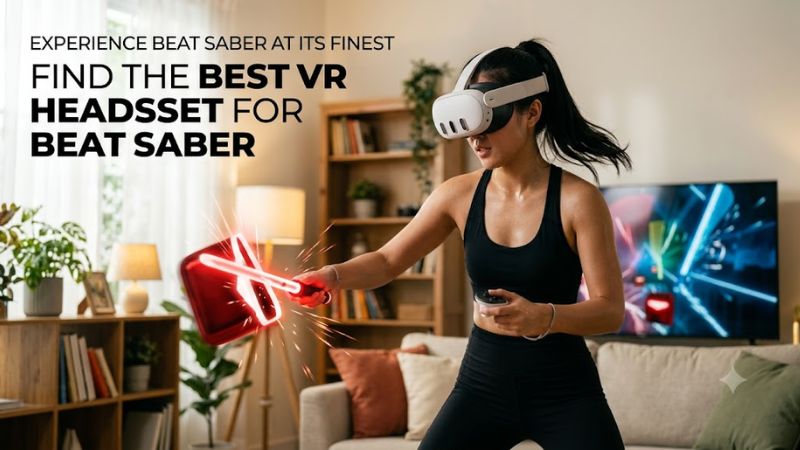
Tracking and controller response
Tracking should be the first criterion because Beat Saber requires rapid controller movements, directional swings, and frequent arm crossings. Quest 3 and Quest 3S use Touch Plus controllers with inside-out tracking, while PS VR2 uses Sense controllers tracked by four headset cameras. Independent testing of earlier Quest hardware found the platform capable of handling Expert+ movements, while modern Quest tracking retains the same inside-out approach.
For a Beat Saber-focused setup, a headset with consistent controller tracking matters more than having the highest panel resolution. Pimax Crystal Light also uses four-camera inside-out tracking and supports 120Hz, making it a legitimate PC option, but its much heavier 815g headset adds a different comfort consideration during active sessions.
Refresh rate and display clarity
Refresh rate affects how frequently the display updates, so it is relevant to a fast rhythm game. Quest 3 and Quest 3S support up to 120Hz, while PS VR2 supports 90Hz and 120Hz. Pimax Crystal Light supports 72Hz, 90Hz, and 120Hz. These are display capabilities, not a guarantee that every game or rendering mode will operate at the maximum setting.
Optics also matter when reading incoming notes. Quest 3 uses a 2064×2208-per-eye LCD with pancake optics, while Quest 3S uses 1832×1920-per-eye LCD optics based on the older Quest optical stack. PS VR2 uses two 2000×2040 OLED displays with Fresnel lenses, while Crystal Light uses 2880×2880-per-eye QLED panels with glass aspheric lenses.
Standalone versus PC VR
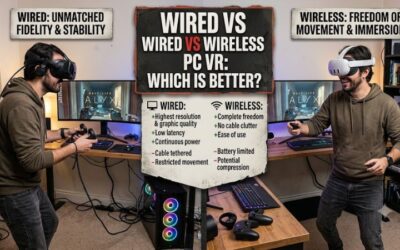
A standalone headset avoids the need for a gaming PC during normal Beat Saber sessions. Quest 3 and Quest 3S run Quest software locally and can also connect to Windows PCs through Meta Quest Link or Air Link. That gives them two practical modes, although PC streaming introduces a separate network and rendering path compared with native play.
If you already own a capable PC, the best vr headset for beat saber can instead be a PC-focused model. Steam lists Windows 10/11, SteamVR, and a GTX 960-class minimum GPU for Beat Saber, but a higher-resolution headset can require considerably more rendering power. PS VR2 also works on PC through its adapter, although Sony lists specific Windows, DisplayPort, USB, and GPU requirements.
Compatibility and play space
Compatibility should be checked before comparing image quality. Quest 3 and 3S support standalone Quest software plus PC VR, PS VR2 requires a PS5 for console play, and Crystal Light is a PC VR headset using DisplayPort. Beat Saber itself is available on Quest, SteamVR, and PS5 with PS VR2 support.
Physical space is another consideration for rhythm games. Meta specifies a minimum room-scale area of 6.5 by 6.5 feet for supported Quest room-scale experiences, while PlayStation lists a 2m × 2m minimum for PS VR2 room-scale games. A clear play area matters because Beat Saber includes ducking, side-stepping, and wide arm movements.
Top Picks
These four picks cover different hardware situations rather than one identical buyer profile. The table separates the platforms, core display specifications, and main limitation so the best vr headset for beat saber depends on whether you prioritize standalone play, entry cost, PS5 integration, or PC image resolution. Current manufacturer specifications were used where available.
| Product | Best For | Key Spec | Compatibility | Watch Out For |
| Meta Quest 3 | Best Overall | 2064×2208 per eye, up to 120Hz | Standalone; Windows PC via Link/Air Link | LCD rather than OLED |
| Meta Quest 3S | Best Value | 1832×1920 per eye, up to 120Hz | Standalone; Windows PC via Link/Air Link | Older Fresnel-style optical stack |
| Sony PlayStation VR2 | Best For PS5 | 2000×2040 OLED per eye, 90/120Hz | PS5; PC through PS VR2 PC Adapter | Requires cable and PS5 for console play |
| Pimax Crystal Light | Best For PC VR | 2880×2880 per eye, up to 120Hz | Windows PC, DisplayPort 1.4a, USB 3.0 | 815g headset and high GPU demand |
Meta Quest 3 — Best Overall
Meta Quest 3 is the strongest all-purpose choice for buyers who want native Beat Saber without a console or gaming PC. Its Snapdragon XR2 Gen 2 platform has 8GB of memory, while its LCD panels provide 2064×2208 pixels per eye and up to 120Hz. Pancake optics and continuous IPD adjustment distinguish it from Quest 3S.
The main weakness is that its LCD display does not provide the OLED contrast of PS VR2, while the standard head strap is basic. It also carries a higher current US starting price than Quest 3S. Buyers who only want inexpensive native Beat Saber and do not care about sharper pancake optics have a cheaper Quest option.
Meta Quest 3S — Best Value
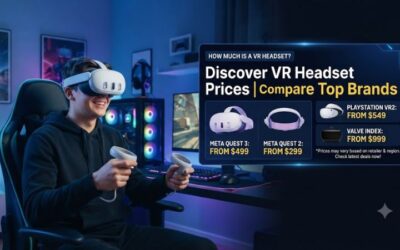
Quest 3S keeps the same Snapdragon XR2 Gen 2 platform and 8GB memory as Quest 3, while retaining Touch Plus controllers and standalone operation. Its 1832×1920-per-eye LCD and 120Hz maximum refresh rate are sufficient for Beat Saber, and its current US price starts at $349.99 for 128GB.
The trade-off is its optical system. Quest 3S uses the Quest 2-derived optical stack, with lower per-eye display resolution and three preset IPD positions rather than Quest 3’s continuous slider. It is less suitable for buyers who spend heavily on visual clarity or expect the headset to serve as a premium PC VR display.
PlayStation VR2 — Best For PS5
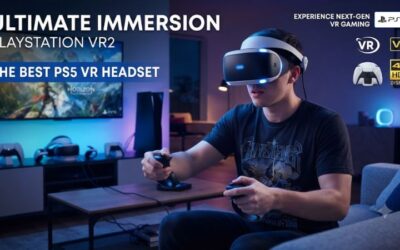
PS VR2 suits players who already own a PS5 and want Beat Saber inside the PlayStation ecosystem. It has two 2000×2040 OLED displays, 90Hz and 120Hz refresh modes, four headset cameras for tracking, and Sense controllers. Sony lists Beat Saber specifically as a PS5 title requiring PS VR2 and its Sense controllers.
Its main weakness is platform dependency: console play requires a PS5, and the headset is tethered by cable. Sony’s current recommended retail price is $399.99 in the US, while PC use requires the separate PS VR2 PC Adapter plus a compatible Windows system. Buyers without a PS5 should factor in that additional platform cost.
Pimax Crystal Light — Best For PC VR
Pimax Crystal Light targets PC VR users who prioritize display resolution. Its manufacturer lists 2880×2880 pixels per eye, glass aspheric lenses, 110-degree horizontal field of view, 72/90/120Hz modes, four-camera inside-out tracking, and DisplayPort 1.4a connectivity. The current listed configuration is aimed at demanding PC VR use.
The drawback is physical weight and system demand. Pimax lists the headset at 815g, substantially above the 560g PS VR2 specification, while native high-resolution rendering can place more load on the GPU. It is not the practical choice for someone seeking a lightweight standalone Beat Saber headset or a console-based setup.
FAQ
The four practical questions are answered directly: Quest 3 suits the broadest standalone use, Quest 3S lowers the entry cost, PS VR2 fits PS5 owners, and Crystal Light is aimed at high-resolution PC VR. The choice therefore depends more on platform and optical priorities than on Beat Saber compatibility alone.
Is Quest 3 good for Beat Saber?
Quest 3 is well matched to Beat Saber because its Touch Plus controllers use inside-out tracking and its display supports up to 120Hz. Meta lists 2064×2208 pixels per eye, 8GB memory, Snapdragon XR2 Gen 2, and standalone operation. Independent Quest tracking research also specifically examined demanding Beat Saber play.
The key advantage is flexibility rather than a special Beat Saber mode. You can run the game natively or use Quest Link or Air Link for PC VR. Buyers should still provide enough clear floor space and remember that battery-powered standalone play differs from a wired PC headset in session length and setup.
Is Quest 3S enough for Expert+?
Quest 3S has the same XR2 Gen 2 platform and 8GB memory as Quest 3, along with the same Touch Plus controller family. Meta also specifies a maximum 120Hz display refresh rate, so its core tracking and processing platform is not a cut-down Quest 2 replacement.
The compromise is visual rather than fundamental game compatibility. Its 1832×1920-per-eye display and Quest 2-derived optics provide less visual clarity than Quest 3, while its preset IPD positions offer less adjustment. Players focused mainly on fast rhythm gameplay can accept that trade-off; optics-focused buyers may not.
Can PS VR2 play Beat Saber?
PS VR2 supports Beat Saber directly on PS5, with Sony listing the headset and PS VR2 Sense controllers as requirements. The headset uses 2000×2040-per-eye OLED displays and supports 90Hz and 120Hz refresh rates. Its four tracking cameras provide inside-out tracking without an external camera.
PS VR2 can also operate with a Windows PC through Sony’s PC Adapter. Sony specifies Windows 10/11 64-bit, 8GB or more RAM, DisplayPort 1.4, USB 3.0, Bluetooth 4.0 or newer, and compatible graphics hardware; RTX 3060-class or RX 6600 XT-class hardware is recommended for stronger performance.
Does Beat Saber need a powerful gaming PC?
Native Quest play does not require a gaming PC, while the Steam version does. Steam lists Windows 10/11 64-bit, SteamVR, a Core i5 Sandy Bridge-class processor, 4GB RAM, and GTX 960-class graphics as minimum requirements; recommended specifications rise to an i7 Skylake-class CPU, 8GB RAM, and GTX 1060-class graphics.
Those Steam requirements describe Beat Saber itself, not every high-resolution PC VR headset. Crystal Light’s 2880×2880-per-eye native resolution can require substantially more rendering capacity than the game’s minimum specification, so PC owners should distinguish game requirements from headset rendering requirements before choosing hardware.
Final Thoughts
The best vr headset for beat saber depends on the platform you already use: Quest 3 emphasizes flexible standalone and PC VR play, Quest 3S targets lower cost, PS VR2 fits PS5 owners, and Crystal Light targets high-resolution PC VR. Tracking, refresh rate, optics, and available play space should guide the final purchase.