🛒 Best Price Today on Amazon
Prime members get fast, free shipping on everything above, plus member-only deals. New members get a 30-day free trial — cancel anytime.

Meta Quest 3S 128GB | Virtual Reality — VR Headset — Gorilla Tag Bundle
Included for 'Best VR headset for fitness games: Complete Best Picks' because the listing specifies Virtual Reality — VR Headset — Gorilla Tag Bundle, details this guide uses to compare options.
View on Amazon
Meta Quest 3S 128GB | Virtual Reality — VR Headset (Renewed Premium)
Included for 'Best VR headset for fitness games: Complete Best Picks' because the listing specifies Virtual Reality — VR Headset (Renewed Premium), details this guide uses to compare options.
View on Amazon
Meta Quest 3 512GB | VR Headset — Get Batman: Arkham Shadow Included
Included for 'Best VR headset for fitness games: Complete Best Picks' because the listing specifies VR Headset — Get Batman: Arkham Shadow Included, details this guide uses to compare options.
View on AmazonThe best VR headset for fitness games depends on workout style, platform and fit: Quest 3 favors optical clarity and wireless access, Quest 3S lowers the entry cost, PS VR2 suits PS5 owners, while PICO 4 Ultra emphasizes balanced weight and full-body tracking.
How to Choose a VR Fitness Headset
For fitness, prioritize freedom of movement, optics, game availability and compatibility before raw display specifications. A headset should support the workout software you actually want, fit securely during repeated arm movement, and match the hardware already in your room. The four criteria below point to models that meet different needs.
Wireless freedom and room movement
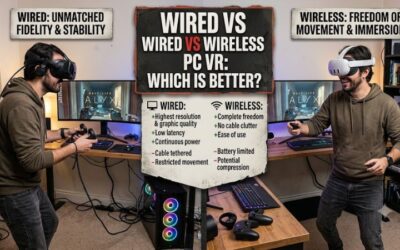
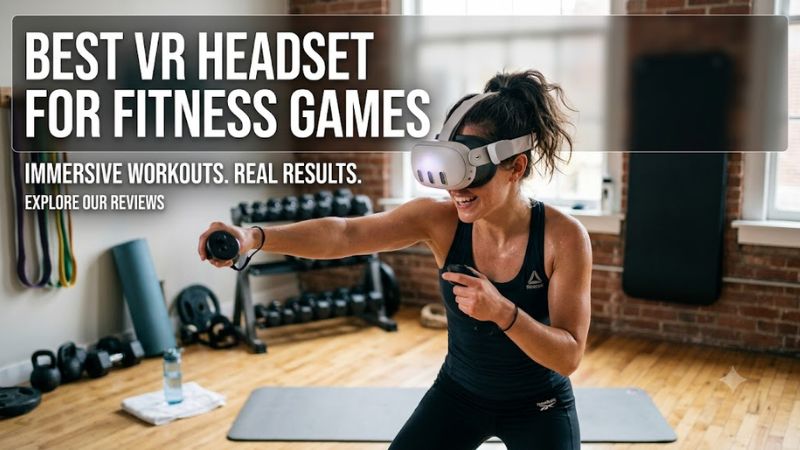
A wireless standalone design avoids a cable running from your head to a PC or console, which matters for boxing, dancing and room-scale workouts. Quest 3 and Quest 3S both run the Quest ecosystem without a computer, while PICO 4 Ultra is also a standalone headset with optional PC streaming.
The best VR headset for fitness games should also leave enough physical space for your chosen routine. PS VR2 can support room-scale workouts such as Les Mills XR Bodycombat, but that title specifies a 2 m × 2 m play area and requires a PS5, so its cable and console requirements need to be considered before buying.
Optical clarity and fast movement
Quest 3 uses a 2064 × 2208-per-eye physical display, while Quest 3S uses 1832 × 1920 per eye. Meta lists a 1680 × 1760 render resolution at 100% render scale for both devices, showing why physical panel resolution and rendered game resolution should not be treated as the same measurement.
PICO 4 Ultra uses 2160 × 2160 pixels per eye, pancake lenses and a refresh rate up to 90 Hz. PS VR2 uses two 2000 × 2040 OLED displays with 90 Hz and 120 Hz modes. These differences matter most when reading interfaces, tracking visual targets or switching quickly between workout movements.
Fitness software and platform compatibility
Game availability can matter more than a small specification difference. Quest supports fitness titles such as FitXR, while PlayStation lists Beat Saber, Les Mills Bodycombat and OhShape Ultimate among PS VR fitness options. PICO has its own store and PC streaming, but its software catalog is separate from Meta’s Quest ecosystem.
For PC users, PS VR2 requires additional hardware and software: Sony specifies Windows 10 or 11 64-bit, 8 GB RAM, DisplayPort 1.4, USB 3.0, Bluetooth 4.0 or later, and a compatible graphics card. The minimum GPU list includes GTX 1650 or later and specified Radeon models; Sony recommends RTX 3060 or RX 6600 XT or later for stronger performance.
Fit, weight and workout tracking
A fitness headset spends more time moving with your body than a seated VR setup, so weight distribution deserves attention. PICO 4 Ultra weighs approximately 580 g and distributes about 304 g at the front and 276 g at the rear. Its battery placement acts as a counterweight rather than concentrating the headset mass entirely at the front.
PICO also offers optional Motion Trackers for full-body tracking, while Meta’s Quest platform has a broader selection of established fitness software. PS VR2 weighs about 560 g without cables and uses headset and controller motion sensing. Consider the workout style first: tracking accessories can add capability, but they also add equipment to maintain.
Top Picks for Fitness Games
The four models below cover different buying situations rather than identical hardware targets. Quest 3 combines pancake optics with standalone access, Quest 3S uses the same XR2 Gen 2 platform with Fresnel optics, PS VR2 targets PS5 and PC users, and PICO 4 Ultra adds balanced construction and optional full-body tracking.
| Product | Best For | Key Spec | Compatibility | Watch Out For |
| Meta Quest 3 | Best Overall | 2064 × 2208 per eye; XR2 Gen 2 | Standalone; PC VR | Stock fit may need refinement for intense workouts |
| Meta Quest 3S | Best Value | 1832 × 1920 per eye; XR2 Gen 2 | Standalone; PC VR | Fresnel optics are less sharp than Quest 3 |
| PlayStation VR2 | Best For PS5 | 2000 × 2040 OLED per eye; up to 120 Hz | PS5; Windows PC with adapter | Requires a cable; PS5 needed for console VR |
| PICO 4 Ultra | Best For Full-Body Tracking | 2160 × 2160 per eye; 12 GB RAM | Standalone; Windows PC streaming | Smaller software ecosystem than Quest |
Meta Quest 3 for the broadest fitness setup
The best VR headset for fitness games for many PC gamers is Quest 3 when wireless standalone play, sharper optics and access to the Quest software ecosystem are priorities. Its Snapdragon XR2 Gen 2 platform matches Quest 3S, while the 2064 × 2208-per-eye display and pancake optics distinguish its visual system.
Quest 3 makes sense for buyers who want one headset for fitness and conventional VR gaming, but it is not the right purchase for someone whose main library is locked to PlayStation. Its real weakness for workouts is not processing capability; fit remains personal, and active users may prefer a different strap or facial interface after comparing their preferred workout movements.
Meta Quest 3S for lower-cost entry
The best VR headset for fitness games on a tighter hardware budget is Quest 3S because it uses the same Snapdragon XR2 Gen 2 platform as Quest 3 while adopting the lower-resolution Fresnel optical system. Meta lists 1832 × 1920 pixels per eye and a 1680 × 1760 default render scale.
Quest 3S is a sensible match for someone starting with rhythm, boxing or dance titles who does not need the sharper optics of Quest 3. Its weakness is the optical trade-off: the Fresnel lenses do not provide the same pancake-lens design as Quest 3. Buyers focused on visual clarity or broader VR use should consider Quest 3 instead.
PlayStation VR2 for PS5 owners
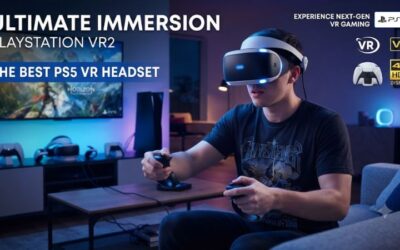
PS VR2 suits fitness players who already have a PS5 and want OLED displays, headset feedback and PlayStation fitness software. Sony specifies 2000 × 2040 pixels per eye, 90 Hz and 120 Hz refresh modes, plus eye tracking and headset vibration. Les Mills XR Bodycombat specifically requires PS5 and PS VR2 Sense controllers.
The major weakness is platform dependence. PS VR2 is not a standalone wireless headset, and PC use requires Sony’s PC adapter plus a DisplayPort 1.4 connection and compatible hardware. Someone without a PS5 who mainly wants untethered exercise should not buy PS VR2 solely for fitness unless the additional platform requirements fit their existing setup.
PICO 4 Ultra for full-body movement
PICO 4 Ultra is the best VR headset for fitness games for users interested in balanced weight distribution and optional full-body tracking. Its 2160 × 2160-per-eye displays use pancake lenses, while the Snapdragon XR2 Gen 2 platform is paired with 12 GB RAM. PICO also lists Motion Tracker support for tracking 24 skeleton points.
Its main weakness is software availability relative to the Quest ecosystem. PICO lists more than 650 VR apps and more than 40 MR apps on its store, but the catalog is distinct from Meta’s. Buyers should verify their specific fitness titles before purchasing, particularly if a subscription service or game is central to their routine.
FAQ: VR Headsets for Fitness Games
The four quick answers are: Quest 3 fits broad wireless use, Quest 3S lowers the hardware cost, PS VR2 fits PS5 owners, and PICO 4 Ultra suits users interested in balanced weight and optional body tracking. Those distinctions come from documented hardware, platform and software differences rather than workout benchmark scores.
Is Quest 3 better than Quest 3S for fitness?
The best VR headset for fitness games between these two depends on whether optical clarity matters enough to justify Quest 3. Both use the Snapdragon XR2 Gen 2 platform, but Quest 3 has 2064 × 2208-per-eye physical displays and pancake lenses, while Quest 3S uses 1832 × 1920-per-eye Fresnel optics.
Quest 3S still provides the same basic standalone Quest platform and processor generation, so the choice is primarily about optics, physical design and budget rather than a different performance class. For users who mainly play fast-moving fitness games and care less about visual sharpness, the 3S specification can be sufficient.
Do you need a gaming PC for VR fitness?
You do not need a PC for standalone Quest 3, Quest 3S or PICO 4 Ultra fitness applications. Those headsets can run supported software directly on the headset, while PC streaming is an additional option. PS VR2 is different because its main console platform is PS5, with PC operation requiring the specified adapter and PC hardware.
For PC fitness use, hardware requirements depend on the headset and software rather than fitness itself. Sony’s PS VR2 PC minimum includes 8 GB RAM and a GTX 1650 or compatible Radeon GPU, while Sony recommends RTX 3060 or RX 6600 XT or later for stronger performance.
Which headset works for boxing and room-scale workouts?
Quest 3, Quest 3S and PICO 4 Ultra are wireless standalone options suited to movement-heavy VR, provided the chosen application supports the headset. PS VR2 also supports room-scale fitness software, but its cable and PS5 requirement change the physical setup. Les Mills XR Bodycombat specifies a 2 m × 2 m room-scale area.
Clear floor space matters regardless of headset. A workout involving punches, lateral movement or crouching needs more practical clearance than a seated application, and the software’s stated play-area requirement should be treated as the starting point rather than proof that every room is suitable for every movement.
Does PICO 4 Ultra track your whole body?
PICO 4 Ultra supports optional Motion Trackers designed for full-body tracking, with PICO describing 6DoF tracking across 24 skeleton points. The tracker itself weighs approximately 27 g, and the system can recognize stepping movements when configured for full-body tracking.
That capability does not mean every fitness game automatically uses full-body tracking. Software support remains important, and PICO’s store is separate from Quest’s. Check the specific game’s compatibility and whether Motion Tracker support is implemented before treating the accessory as a required part of a fitness setup.
Final Thoughts
The best VR headset for fitness games comes down to the platform and workout style you already use. Quest 3 balances standalone access and sharper optics, Quest 3S keeps the same XR2 Gen 2 generation at a lower tier, PS VR2 targets PS5 and PC users, while PICO 4 Ultra adds balanced construction and optional body tracking.