🛒 Best Price Today on Amazon
Prime members get fast, free shipping on everything above, plus member-only deals. New members get a 30-day free trial — cancel anytime.

Meta Quest 3S 128GB | Virtual Reality — VR Headset (Renewed Premium)
Included for 'Best vr headset for pc gaming: Complete, Reliable Picks' because the listing specifies Virtual Reality — VR Headset (Renewed Premium), details this guide uses to compare options.
View on Amazon
Meta Quest 3S 256GB | VR Headset — Get Batman: Arkham Shadow Included
Included for 'Best vr headset for pc gaming: Complete, Reliable Picks' because the listing specifies VR Headset — Get Batman: Arkham Shadow Included, details this guide uses to compare options.
View on Amazon
Meta Quest 3 512GB | VR Headset — Get Batman: Arkham Shadow Included
Included for 'Best vr headset for pc gaming: Complete, Reliable Picks' because the listing specifies VR Headset — Get Batman: Arkham Shadow Included, details this guide uses to compare options.
View on AmazonFor shoppers comparing the best vr headset for pc gaming, the main choice is between wireless convenience, optical clarity, simulation detail, and setup complexity. Meta Quest 3 covers PC VR through Link or Air Link, while Pimax Crystal Light and Bigscreen Beyond 2 target wired, higher-fidelity PC systems.
How to Choose a PC VR Headset
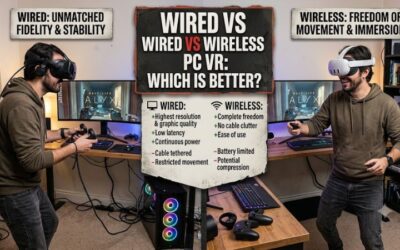
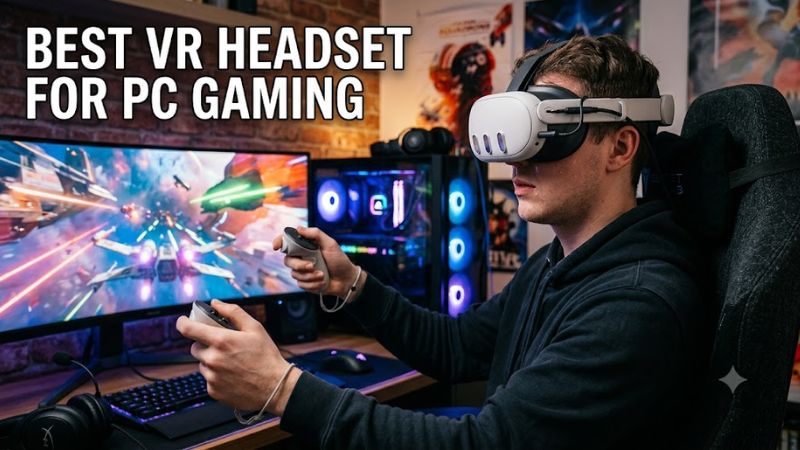
The best vr headset for pc gaming depends first on how your PC connects to the headset, then on display quality, tracking, and the amount of extra hardware required. Quest 3 and Quest 3S support PC VR through Meta Quest Link or Air Link, while dedicated PC headsets such as Crystal Light and Beyond 2 require wired connections and more specific PC hardware.
PC Connection and Compatibility
A PC VR headset should match the ports and operating system already available on your gaming PC. Quest 3 and Quest 3S can use USB-C Link or Wi-Fi, making them flexible choices for Windows systems. Bigscreen Beyond 2 requires Windows 10 or 11, DisplayPort 1.4, USB 3.0, and SteamVR base stations.
For buyers comparing the best vr headset for pc gaming, GPU requirements also matter because the headset does not determine the rendering workload by itself. Pimax lists RTX 2070-class hardware as a minimum for Crystal Light, while Beyond 2 lists RTX 2070 or RX 5700 XT with DisplayPort 1.4 and DSC.
Resolution and Lens Design
Resolution is only one part of visual quality, because lens design affects how much of the panel appears clear as you move your eyes. Quest 3 uses 2064×2208-per-eye LCD panels and pancake optics, while Crystal Light uses 2880×2880-per-eye QLED displays with glass aspheric lenses.
For the best vr headset for pc gaming, consider the type of software you play. Higher resolution can help cockpit instruments and distant objects in simulation games, while pancake optics can make general PC VR viewing more flexible. Crystal Light offers 35 PPD and 110-degree horizontal FOV, while Quest 3 lists 25 PPD and 110-degree horizontal FOV.
Tracking and Room Setup
Inside-out tracking uses cameras on the headset, reducing the need for external tracking hardware. Quest 3, Quest 3S, and Crystal Light use inside-out tracking, whereas Beyond 2 relies on SteamVR base stations. The difference affects installation, desk space, controller compatibility, and how much equipment must remain around your play area.
If you want the best vr headset for pc gaming without adding tracking stations, an inside-out model is easier to accommodate. Beyond 2 can support SteamVR accessories and trackers, but its minimum setup includes a SteamVR base station system, so the headset itself is only one part of the complete PC VR setup.
Budget and Total Setup Cost
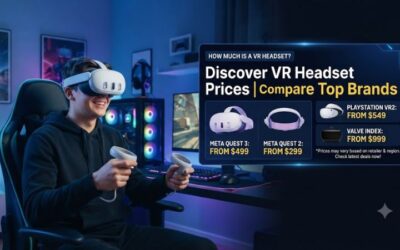
The purchase price should be compared with required accessories rather than treated as the complete system cost. Meta lists Quest 3 from $599.99 and Quest 3S from $349.99, while Pimax lists Crystal Light at $899 and Bigscreen lists Beyond 2 from $959 after its August 2026 price change.
That makes the best vr headset for pc gaming highly dependent on what you already own. Quest models can avoid separate base stations, while Beyond 2 requires SteamVR tracking hardware. Crystal Light connects directly through DisplayPort 1.4 and USB 3.0, but its higher-resolution display can justify a stronger gaming PC for demanding simulation workloads.
Top Picks for PC Gaming
The best vr headset for pc gaming varies by workload rather than one universal specification. Quest 3 balances standalone and PC VR use, Quest 3S lowers the entry price, Crystal Light targets high-resolution simulation, and Beyond 2 prioritizes a very light headset with micro-OLED displays and SteamVR tracking.
| Product | Best For | Key Spec | Compatibility | Watch Out For |
| Meta Quest 3 | Best Overall | 2064×2208 per eye; 120 Hz | Windows PC via Link/Air Link | Wireless streaming adds a network-dependent connection |
| Meta Quest 3S | Best Value | 1832×1920 per eye; 120 Hz | Windows PC via Link/Air Link | Fresnel optics and lower display resolution |
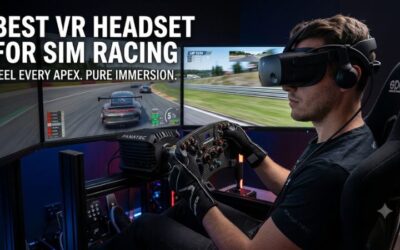
| Pimax Crystal Light | Best For Sim Racing | 2880×2880 per eye; 72/90/120 Hz | Windows 10/11; DP 1.4a; USB 3.0 | 815 g headset and demanding PC requirements |
| Bigscreen Beyond 2 | Best For Lightweight PC VR | 2560×2560 per eye; 75/90 Hz | Windows 10/11; DP 1.4; USB 3.0; SteamVR base stations | Base stations and controllers are separate requirements |
Meta Quest 3 — Best Overall
Quest 3 is the best vr headset for pc gaming for buyers who want both standalone VR and PC VR in one device. Meta lists 2064×2208 resolution per eye, 25 PPD, 120 Hz maximum refresh, Wi-Fi 6E certification, and continuous IPD adjustment. PC VR works through Meta Quest Link or Air Link.
Its main weakness is that wireless PC VR depends on the network path between the computer and headset, while wired Link adds a cable. Buyers who specifically want native DisplayPort output or OLED contrast should look elsewhere, because Quest 3 uses LCD panels and PC VR is delivered through the Link ecosystem rather than a direct DisplayPort connection.
Meta Quest 3S — Best Value
Quest 3S is the best vr headset for pc gaming when a lower purchase price matters more than optical refinement. Meta lists the same Snapdragon XR2 Gen 2 family, 8 GB of memory, 120 Hz maximum refresh, and PC VR support as Quest 3, while its per-eye resolution is 1832×1920 and its IPD uses three preset positions.
The trade-off is its older-style optical design and lower display resolution compared with Quest 3. It should not be the first choice for someone prioritizing clearer text, cockpit gauges, or a larger visual sweet spot, but it remains compatible with Meta Quest Link and Air Link on a suitable Windows PC.
Pimax Crystal Light — Best For Sim Racing
Crystal Light suits PC players who prioritize display resolution for racing and flight simulation. Pimax specifies 2880×2880 pixels per eye, 35 PPD, 110-degree horizontal FOV, glass aspheric lenses, and refresh rates of 72, 90, and 120 Hz. Its connection uses DisplayPort 1.4a and USB 3.0.
The weakness is the hardware demand and physical weight: Pimax lists 815 g and specifies RTX 2070-class minimum graphics hardware, with stronger GPUs for higher-quality simulation settings. Buyers seeking wireless PC VR or a lightweight headset should consider another design instead, because Crystal Light is built around direct wired PC rendering.
Bigscreen Beyond 2 — Best For Lightweight PC VR
Beyond 2 is the best vr headset for pc gaming for buyers who prioritize low headset weight and micro-OLED display technology. Bigscreen lists 107 g, 2560×2560 resolution per eye, 75 and 90 Hz refresh rates, 108° horizontal and 96° vertical FOV, plus pancake optics with independently adjustable IPD.
Its real weakness is the complete setup requirement. Beyond 2 does not operate independently, does not support wireless operation, and requires SteamVR base stations plus compatible controllers. Buyers wanting a self-contained headset or simple inside-out tracking should not choose it solely because of its 107 g headset weight.
FAQ
The best vr headset for pc gaming is not identical for every buyer: Quest 3 emphasizes flexibility, Quest 3S lowers cost, Crystal Light targets high-resolution simulation, and Beyond 2 prioritizes very low headset weight. These differences are reflected in manufacturer specifications rather than a single performance score.
Is Quest 3 Good for PC VR?
Yes, Quest 3 supports PC VR through Meta Quest Link and Air Link, so it can connect to a Windows gaming PC for compatible PC VR software. Meta lists 2064×2208 resolution per eye, 120 Hz maximum refresh, Wi-Fi 6E certification, and support for both wired and wireless PC VR connections.
Quest 3 is less suitable if your priority is an uncompromised DisplayPort connection or OLED display technology. Its LCD panels and Link-based PC connection make it a different design from Crystal Light and Beyond 2, which are purpose-built around wired PC rendering. The choice therefore depends on the connection and display characteristics you value.
What PC Specs Do VR Headsets Need?
PC requirements vary substantially by headset. Pimax lists RTX 2070-class graphics hardware and 16 GB RAM as minimum requirements for Crystal Light, while Bigscreen lists an RTX 2070 or RX 5700 XT, 16 GB RAM, Windows 10 or 11, DisplayPort 1.4, and USB 3.0 for Beyond 2.
PlayStation VR2 has a different minimum specification for PC use: Sony lists Windows 10 or 11, 8 GB RAM, a compatible GTX 1650-class-or-newer GPU, DisplayPort 1.4, USB 3.0, and Bluetooth 4.0 or later. These requirements should be checked against the specific headset rather than generalized across PC VR hardware.
Is a Higher Resolution Always Better?
No. Higher resolution can provide more display detail, but the overall optical system, field of view, lens design, rendering workload, and game settings also affect what the user sees. Quest 3 provides 2064×2208 per eye, while Crystal Light provides 2880×2880 per eye and 35 PPD.
A higher-resolution headset can also place more work on the GPU, especially in simulation titles. Pimax explicitly separates its Crystal Light PC requirements into minimum, recommended, and best-experience levels, showing that the same headset can require different hardware depending on the desired graphics quality and application workload.
Do You Need Base Stations for PC VR?
No, base stations are not universally required for PC VR. Quest 3, Quest 3S, and Crystal Light use inside-out tracking, while Bigscreen Beyond 2 requires SteamVR base stations for tracking. The tracking architecture should therefore be checked before buying rather than assumed from the headset category.
Beyond 2 specifically lists SteamVR Base Stations version 1.0 or 2.0 as part of its minimum requirements, while its headset package includes the headset, soft strap, fiber-optic cable, link box, and cleaning cloth. Buyers choosing Beyond 2 should therefore budget for the broader SteamVR setup, not just the headset.
Final Thoughts
For shoppers comparing the best vr headset for pc gaming, the practical split is straightforward: Quest 3 and Quest 3S favor flexible PC and standalone use, Crystal Light targets high-resolution simulation, and Beyond 2 focuses on low headset weight and micro-OLED displays. Check GPU, ports, tracking, and total setup cost before buying.