🛒 Best Price Today on Amazon
Prime members get fast, free shipping on everything above, plus member-only deals. New members get a 30-day free trial — cancel anytime.
Best vr headset for seated gaming depends on whether you value wireless convenience, optical clarity, low weight, or a direct PC connection. For desk play, racing, flight simulation, and long-session use, these factors matter more than room-scale tracking. This roundup uses current 2026 products and separates each pick by setup.
How to Choose a Seated VR Headset
Choosing a headset for seated-play starts with the view through the lenses, because a narrow sweet spot is noticeable when reading cockpit gauges or virtual monitors. Next come weight-balance, connection type, and PC requirements. The four picks below fit different combinations of those needs. Your chair and connection style matter too.
Lens Clarity and Sweet Spot
Optics matter because seated-players often stare at fixed-menu items, gauges, or virtual-screen layouts instead of moving around. Quest 3 uses pancake lenses, while Crystal Light uses glass aspheric lenses. PS VR2 uses OLED with Fresnel optics, and Beyond 2 uses micro-OLED with pancake optics, so resolution is only one part of the view.
For the best vr headset for seated gaming, compare the clear viewing area as well as pixel count. Quest 3 has 2,064 × 2,208 pixels per eye and 515 g weight in PC Gamer’s specifications, while UploadVR highlights its pancake lenses. Crystal Light reaches 2,880 × 2,880 per eye and up to 120 Hz, targeting simulation detail.
Weight and Seated Comfort
Seated comfort depends on balance, facial pressure, strap design, and cable-position rather than weight alone. Bigscreen Beyond 2 is 107 g for the headset, but requires SteamVR base-stations and separate controllers. Crystal Light is 815 g, while PS VR2 is about 560 g, making cable-management and session-length important.
Long-sessions favor a setup that matches your chair and play style. A heavier visor can be easier to tolerate when you barely move, while a light headset can reduce the load during frequent head-turns. Beyond 2 is unusually light, but its ecosystem adds hardware; Crystal Light is heavier yet directly targets cockpit users.
PC Connection and Compatibility
Compatibility can matter more than display-specifications. Quest 3 supports Meta Horizon Link on Windows through USB-C or Wi-Fi, while PS VR2 requires Sony’s PC adapter, DisplayPort 1.4, USB 3.0, and Bluetooth. Crystal Light and Beyond 2 are more PC-focused, with direct DisplayPort connections and specific Windows requirements.
Meta’s current documentation supports Quest 3 with Meta Horizon Link on Windows 10 or later 64-bit systems, using a USB-C data cable or Wi-Fi. For seated play, that flexibility is useful when switching between wired and wireless PCVR. It also avoids the base-stations required by Beyond 2, while retaining a standalone-headset mode.
Game Type and GPU Headroom
Game-type and GPU-headroom should finish the decision. Quest 3 suits mixed standalone and PC use, PS VR2 adds OLED contrast, Crystal Light targets high-detail simulation, and Beyond 2 targets a lightweight SteamVR setup. Pimax lists RTX 3080-class hardware as recommended for flight/racing, showing how much the PC requirement can vary.
These four picks cover the main seated-PCVR approaches in 2026: flexible wireless and standalone use, lower-cost OLED PC VR, high-resolution simulation, and an exceptionally light SteamVR headset. Prices are US-references around September 26, 2026, while adapters, cables, base-stations, controllers, and inserts can change the final cost.
Top Picks
The shortlist separates general PCVR from specialist hardware rather than treating one feature as decisive. Quest 3 emphasizes flexibility, PS VR2 emphasizes OLED contrast, Crystal Light emphasizes simulation detail, and Beyond 2 emphasizes low visor weight. Check compatibility before comparing prices, because accessories can change total setup.
| Product | Best For | Key Spec | Compatibility | Watch Out |
| Quest 3 | Overall | 2064×2208/eye; 515g | Windows; USB/Wi-Fi | Compression |
| PS VR2 | Value | 2000×2040/eye; OLED | Windows; DP1.4; adapter | PC limits |
| Crystal Light | Sim | 2880×2880/eye; 815g | Windows; DP1.4a; USB3 | Weight; GPU |
| Beyond 2 | Low weight | 2560×2560/eye; 107g | Windows; SteamVR stations | Separate controllers |
Meta Quest 3 — Best Overall
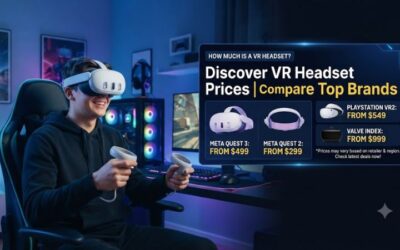
For best vr headset for seated gaming, Meta Quest 3 is the Best Overall pick when one headset needs to cover PCVR and standalone play. Its 512GB model is listed at $599.99 by major US retailers. It combines pancake optics, inside-out tracking, USB or Wi-Fi PC connection, and a standalone library, but wireless PCVR uses streaming.
Quest 3 uses 2,064 × 2,208 pixels per eye and weighs 515 g in PC Gamer’s specifications. It works with Windows PCs through Meta Horizon Link, using USB-C or Wi-Fi. Do not buy it if your priority is a native DisplayPort feed for maximum PC-image fidelity and every session stays in a cockpit for PCVR.
PlayStation VR2 — Best Value
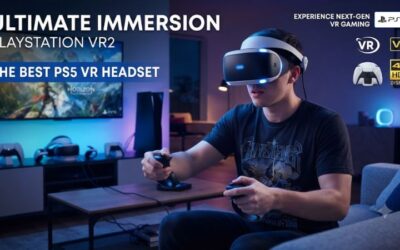
PlayStation VR2 is the Best Value pick for seated PCVR when OLED-contrast and a lower headset price matter more than wireless-operation. Sony reduced its recommended retail price to $399.99 in 2025, before the PC adapter and DisplayPort cable. On PC, several PS5-specific features are unavailable, narrowing its PC-feature set.
PS VR2 has 2,000 × 2,040 pixels per eye, OLED displays, and a 110-degree field of view on its native platform. UploadVR notes deep blacks but also visible mura and a softer image than some LCD alternatives. Do not buy it for wireless PCVR or PC eye-tracked foveated rendering, and budget for the adapter and cable.
Pimax Crystal Light — Best For Sim Racing
Pimax Crystal Light is the Best For sim racing and flight-simulation because its 2,880 × 2,880-per-eye displays and DisplayPort connection emphasize fine visual detail. Pimax lists 72, 90, and 120 Hz modes and an 815 g weight. The tradeoff is substantial mass and a higher-PC requirement than mainstream standalone-headsets.
Pimax specifies Windows 10/11, 16GB RAM, USB 3.0, DisplayPort 1.4a, and an RTX 2070-class minimum tier, with RTX 3080-class hardware recommended for flight/racing. PCGamesN describes it as suited to those genres. Do not buy it if you want compact wireless-play or a lighter headset for active-VR now.
Bigscreen Beyond 2 — Best For Low Weight
Bigscreen Beyond 2 is the Best For lightweight long-session PCVR, with a 107 g headset, 2,560 × 2,560-per-eye micro-OLED displays, and 75 or 90 Hz operation. Its August 2026 price starts at $959. The catch is significant: base-stations and controllers are separate requirements, so it suits an existing SteamVR setup.
Bigscreen requires Windows 10 or 11, a quad-core Intel or AMD CPU, 16GB RAM, an RTX 2070 or RX 5700 XT-class GPU, DisplayPort 1.4, two USB 3.0 ports, and SteamVR base-stations. Controllers are not included. Do not buy Beyond 2 if you want an all-in-one package or need glasses inside the headset.
FAQ
Four practical questions usually settle the choice quickly: whether seated gaming changes requirements, whether wireless is useful, how much GPU power is needed, and which tradeoffs matter for long sessions. The answers below keep those distinctions separate so a specification from one headset is not applied to another.
Does seated gaming change which VR headset I should buy?
Yes, seated gaming changes the priorities because room-scale tracking and battery mobility matter less while optical clarity, weight-balance, cable-routing, and reading detail matter more. A cockpit user can tolerate a tether more easily than someone moving around, while a desktop player may value a wide clear lens area for virtual monitors.
For best vr headset for seated gaming decisions, start by identifying what stays in front of you for most sessions. Racing and flight users should emphasize resolution and a direct-PC connection; general players may prefer Quest 3’s wireless option. A fixed chair also makes a heavier headset easier to manage than during active VR.
Is wireless PC VR useful for seated gaming?
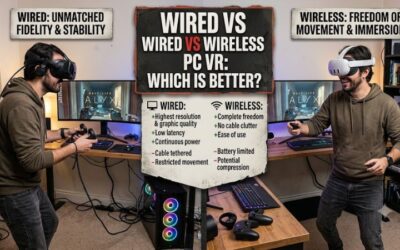
Wireless PCVR is useful for seated gaming when your router and PC network can sustain the stream, but it is not mandatory. Quest 3 supports wireless and USB PC connections, while Crystal Light and Beyond 2 use wired PC connections. A direct-cable remains the simpler route when minimizing streaming variables is the priority.
With best vr headset for seated gaming decisions, wireless-convenience should be weighed against image-path requirements. Quest 3 is the flexible option, but simulation-focused buyers may prefer DisplayPort headsets. The right choice depends on whether cable freedom or direct image transport matters more to you.
How much GPU power does seated PC VR need?
GPU needs vary sharply by headset and game, so there is no single graphics-card requirement for seated VR. Pimax publishes a higher recommended GPU tier for flight and racing, while Bigscreen specifies an RTX 2070 or RX 5700 XT-class minimum. Sony recommends RTX 3060 or RX 6600 XT-class hardware for stronger PS VR2 PC performance.
For best vr headset for seated gaming, match the PC to the headset’s published requirements and check the individual game’s SteamVR requirements. Higher headset resolution increases rendering-work, but load also depends on refresh-rate, render scale, reprojection, and game-engine. Avoid treating one benchmark result as a universal VR requirement.
Which headset is easiest to wear for long seated sessions?
Long-seated sessions make weight-distribution and lens-comfort especially important, but there is no universal comfort winner. Beyond 2 is 107 g, Quest 3 is 515 g, and Crystal Light is 815 g. Those figures describe different designs, so strap-balance and cable-placement still matter over long sessions.
For best vr headset for seated gaming, choose the lightest option that also satisfies your connection and optical needs. Beyond 2 suits an existing SteamVR setup, Crystal Light suits high-detail simulation, Quest 3 suits mixed standalone/PC use, and PS VR2 suits buyers who value OLED-contrast and a lower-headset price.
Final Thoughts
Choosing the best vr headset for seated gaming comes down to the setup around your chair as much as the headset itself. Quest 3 favors flexibility, PS VR2 favors OLED value, Crystal Light favors simulation detail, and Beyond 2 favors very low headset weight. Check your PC ports, GPU tier, SteamVR hardware, and cable tolerance before buying.