🛒 Best Price Today on Amazon
Prime members get fast, free shipping on everything above, plus member-only deals. New members get a 30-day free trial — cancel anytime.
For most new VR PCs, best cpu for vr gaming comes down to strong gaming performance, large cache, and a current platform rather than maximum core count; AMD’s Ryzen 7 9850X3D leads its current gaming-focused range, while Ryzen 5 9600X suits tighter budgets and Ryzen 9 models fit heavier workloads.
How to Choose a VR Gaming CPU
A good VR processor needs fast game-thread performance, enough scheduling headroom for the VR runtime, and consistent frame delivery. There is no universal VR CPU benchmark covering every headset and game, so conventional gaming results are useful evidence rather than direct measurements of every VR workload.
Prioritize gaming performance over core count
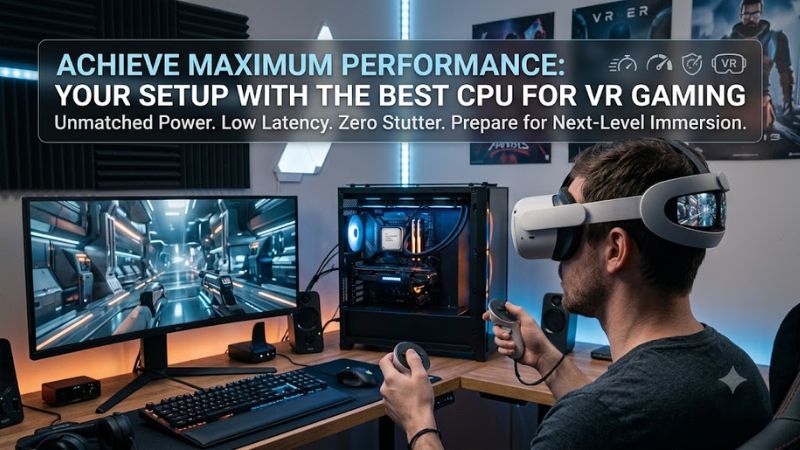
For the best cpu for vr gaming, prioritize strong per-core performance and cache before simply counting cores. VR applications still depend heavily on individual game and simulation threads, while the headset runtime and background services also consume CPU resources. A higher core count can help, but it does not automatically produce higher VR frame rates.
Tom’s Hardware’s 1080p CPU tests illustrate why gaming architecture matters. Its Ryzen 9 9950X3D results used an NVIDIA GeForce RTX 5090 FE and High/Ultra settings, with the 16-game geometric mean showing the processor essentially tied with the Ryzen 7 9800X3D. Those results are not VR benchmarks, but they provide controlled CPU-gaming evidence.
Large cache can matter in demanding games
Large L3 cache is particularly relevant when game workloads repeatedly access simulation, world-state, and other frequently used data. AMD’s Ryzen 7 9850X3D provides 96MB of L3 cache, while the Ryzen 9 9950X3D and 9900X3D provide 128MB. Cache capacity should be considered alongside architecture and clocks, not treated as a standalone VR requirement.
The best cpu for vr gaming therefore does not necessarily need the largest cache available. Tom’s Hardware found the Ryzen 9 9950X3D essentially tied with the Ryzen 7 9800X3D in its 16-game 1080p suite using an RTX 5090 FE, showing that extra cores and cache capacity do not automatically translate into a larger gaming advantage.
Match CPU capability to the headset and GPU
CPU requirements vary with the game, refresh target, graphics settings, and GPU. A demanding simulator can create substantially more CPU work than a relatively simple VR title, while a high-end GPU can expose CPU differences more clearly. The headset itself does not impose a universal processor requirement across every PC VR game.
For a practical build, the best cpu for vr gaming should be selected together with the graphics card rather than in isolation. CPU-focused benchmarks commonly use powerful GPUs and lower resolutions to expose processor differences; Tom’s Hardware notes that those differences shrink with weaker GPUs or higher resolutions and fidelity.
Check platform compatibility before buying
Current Ryzen 9000 desktop processors use AMD’s AM5 socket and DDR5 memory, while Intel’s Core Ultra 7 265K uses the FCLGA1851 socket and supports DDR5. A processor upgrade therefore can require a new motherboard and memory, depending on the existing system. PCIe 5.0 support is available on both current platforms through their respective processors.
For the best cpu for vr gaming, compatibility also means checking the motherboard BIOS support list, cooler mounting support, case clearance, and power supply capacity. AMD lists the Ryzen 7 9850X3D at 120W default TDP and recommends liquid cooling for optimal performance, while the Ryzen 9 9950X3D is rated at 170W and also has a liquid-cooling recommendation.
Top Picks
The current choices below focus on AMD’s Ryzen 9000 desktop generation because it includes the latest X3D gaming processors as of September 25, 2026. The benchmark figures cited here come from conventional PC gaming tests, not headset-specific VR testing, so they should be read as gaming-performance evidence rather than direct VR frame-time measurements.
| Product | Best For | Key Spec | Compatibility | Watch Out For |
| AMD Ryzen 7 9850X3D | Best Overall | 8 cores, 16 threads; 96MB L3 | AM5, DDR5, PCIe 5.0 | 120W TDP; cooler required |
| AMD Ryzen 5 9600X | Best Value | 6 cores, 12 threads; 32MB L3 | AM5, DDR5, PCIe 5.0 | Less CPU headroom for heavy simulation |
| AMD Ryzen 9 9950X3D | Best For VR + Creation | 16 cores, 32 threads; 128MB L3 | AM5, DDR5, PCIe 5.0 | 170W TDP; unnecessary for many gaming-only PCs |
| AMD Ryzen 9 9900X3D | Best For 12-Core Builds | 12 cores, 24 threads; 128MB L3 | AM5, DDR5, PCIe 5.0 | Higher cost than simpler gaming CPUs |
AMD Ryzen 7 9850X3D — Best Overall
The Ryzen 7 9850X3D is the clearest gaming-first choice in AMD’s current desktop lineup. It has 8 cores, 16 threads, a 4.7GHz base clock, up to 5.6GHz boost, 96MB L3 cache, a 120W default TDP, AM5 compatibility, DDR5 support, and PCIe 5.0 connectivity. AMD launched it on January 29, 2026.
For the best cpu for vr gaming, its main weakness is platform and cooling cost rather than a lack of gaming capability. Tom’s Hardware’s 2026 review found only a 3% gaming-performance increase over the Ryzen 7 9800X3D while reporting higher power consumption, so buyers upgrading from a recent X3D processor should not expect a dramatic generational change.
AMD Ryzen 5 9600X — Best Value
The Ryzen 5 9600X provides 6 cores, 12 threads, up to 5.4GHz boost, 32MB L3 cache, and a 65W default TDP on AM5 with DDR5. AMD recommends a premium air cooler for optimal performance, and the chip supports PCIe 5.0. It is therefore a relatively straightforward foundation for a new mainstream VR gaming PC.
Its limitation for the best cpu for vr gaming is lower core and cache capacity than the X3D models. Tom’s Hardware measured the 9600X at an average 163 FPS in its 1080p gaming suite with an RTX 4090, while its broader review found the processor strong at its price point. Those are flat-screen gaming measurements, not VR results, so headset performance will depend on the complete system.
AMD Ryzen 9 9950X3D — Best For VR + Creation
The Ryzen 9 9950X3D targets users who want gaming performance alongside substantial multi-core capacity. It combines 16 cores, 32 threads, up to 5.7GHz boost, 128MB L3 cache, a 170W default TDP, AM5, DDR5, and PCIe 5.0. AMD recommends liquid cooling, making the complete platform more substantial than a mainstream gaming build.
For the best cpu for vr gaming, its extra cores are most useful when VR gaming is only one part of the workload. Tom’s Hardware measured it across 16 games at 1080p with an RTX 5090 FE and High/Ultra settings, finding it 37% ahead of Intel’s Core Ultra 9 285K and essentially tied with the Ryzen 7 9800X3D. The weakness is that gaming alone does not necessarily use its full core count.
AMD Ryzen 9 9900X3D — Best For 12-Core Builds
The Ryzen 9 9900X3D sits between mainstream gaming CPUs and AMD’s 16-core models, offering 12 cores, 24 threads, up to 5.5GHz boost, 128MB L3 cache, and a 120W default TDP. It uses AM5 and DDR5 and supports PCIe 5.0, while AMD recommends liquid cooling for optimal performance.
Its real weakness for the best cpu for vr gaming is positioning: twelve cores can be useful for streaming, creation, or heavy multitasking, but gaming alone may not justify moving beyond an 8-core X3D processor. Tom’s Hardware’s 16-game 1080p suite used an RTX 5090 FE and found the 9900X3D 28% faster on average than Intel’s Core Ultra 9 285K, while also noting competition from AMD’s own processors.
FAQ
The right choice depends on the VR games you play, GPU, headset refresh target, existing platform, and whether the PC also handles workloads such as streaming or content creation. There is no single CPU specification that determines VR performance, and direct VR benchmarks remain less standardized than conventional CPU gaming suites.
Is an X3D CPU necessary for VR gaming?
No, an X3D processor is not a universal requirement for PC VR, because CPU needs vary by game, GPU, headset refresh rate, and workload. A conventional Ryzen 5 9600X can provide strong gaming performance, while X3D models add larger cache capacity and target workloads that benefit from it.
For the best cpu for vr gaming, X3D becomes more relevant when the system is designed around demanding CPU-heavy games or high-refresh targets. It should still be viewed as a performance option rather than a VR compatibility requirement. The graphics card, headset connection method, game engine, and runtime configuration remain important parts of the overall system.
Is 8 cores enough for PC VR?
Eight cores are enough for many gaming systems because VR does not automatically require a large desktop processor. The Ryzen 7 9850X3D has 8 cores and 16 threads, while its gaming-oriented design also includes 96MB of L3 cache. More cores become useful when additional workloads run alongside the game.
The best cpu for vr gaming therefore depends on what else the PC does. A dedicated gaming machine can have different requirements from a system that simultaneously records, streams, compiles, renders, or runs other demanding software. Those workloads are where processors such as the Ryzen 9 9950X3D become easier to justify.
Does a faster CPU increase VR FPS?
A faster CPU can increase VR performance when the game is CPU-limited, but it cannot compensate for a GPU limitation. Tom’s Hardware explicitly notes that CPU benchmark differences become smaller with weaker graphics cards or higher resolutions and fidelity, because the GPU becomes a larger part of the performance equation.
This is why choosing the best cpu for vr gaming should begin with the complete system rather than an isolated FPS claim. If monitoring shows the GPU consistently limiting frame delivery, moving to a faster CPU may have little effect in that workload. CPU-limited simulation-heavy titles can behave differently.
Which CPU should existing AM5 owners consider?
Existing AM5 owners should first check their motherboard BIOS support and current CPU before deciding whether an upgrade is worthwhile. The Ryzen 7 9850X3D is compatible with AM5 and DDR5, while AMD lists support across A620, B650/B650E, X670/X670E, B840, B850, X870, and X870E chipsets, subject to motherboard support.
For the best cpu for vr gaming, an upgrade makes more sense when the existing processor is actually limiting the target VR workload. Owners of recent X3D processors should compare their current CPU against the newer chip’s documented performance rather than assuming a new generation will produce a large difference; Tom’s Hardware found the 9850X3D only 3% ahead of the 9800X3D in its gaming review.
Final Thoughts
The best cpu for vr gaming in September 2026 is primarily a question of workload and platform balance: the Ryzen 7 9850X3D targets gaming-first systems, the Ryzen 5 9600X keeps platform demands lower, and Ryzen 9 X3D models suit users combining VR with heavier multi-core work.