🛒 Best Price Today on Amazon
Prime members get fast, free shipping on everything above, plus member-only deals. New members get a 30-day free trial — cancel anytime.
The intel core ultra 7 265k review: gaming performance and price question is more complicated in 2026 because Arrow Lake has been replaced by newer Intel options. The 265K remains a capable 20-core desktop CPU, but its gaming position depends heavily on the street price and the cost of moving to LGA1851 and DDR5.
How to Choose an Intel Gaming CPU
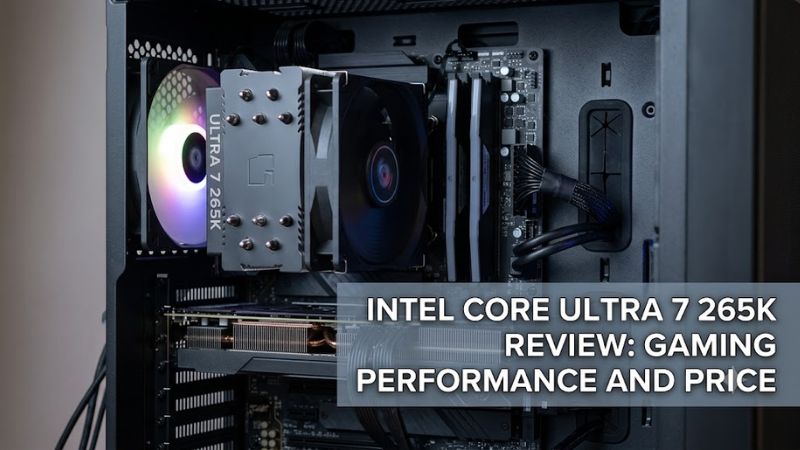
For the 265K, four factors matter most: gaming frame rates, total platform cost, memory compatibility, and workload mix. The chip uses LGA1851, requires DDR5, and supports PCIe 5.0, so an upgrade from an older LGA1700 system needs a new motherboard as well. Its 125W base power and 250W maximum turbo power also make cooling and board quality relevant.
Gaming Performance Comes First
The intel core ultra 7 265k review: gaming performance and price verdict is weakened by its original gaming results. TechSpot’s 14-game average placed it 8% behind the Core i7-14700K and 4% behind the Ryzen 9 9900X, while the Ryzen 7 7800X3D was substantially faster in several CPU-limited games.
That does not make the 265K unsuitable for gaming. Performance varies considerably by game, graphics card, resolution, and settings, and CPU differences shrink when a system becomes GPU-limited. For example, TechSpot recorded the 265K ahead of the 14700K in The Last of Us Part 1, showing why one benchmark should not define the whole processor.
Platform Compatibility Matters
The 265K uses Intel’s FCLGA1851 socket and supports DDR5 memory up to 6400 MT/s according to Intel’s specification. It also provides 24 PCIe lanes and supports PCIe 5.0 and 4.0, while compatible LGA1851 boards include B860 and Z890 models. DDR4 motherboards and LGA1700 boards are not compatible.
For a new build, this platform can provide modern connectivity without requiring a high-end Z890 board unless overclocking features are important. For an existing LGA1700 owner, however, the motherboard replacement changes the value equation substantially. A 265K purchase should therefore be judged as a CPU-plus-platform decision rather than a processor-only upgrade.
Price Changes the Verdict
The intel core ultra 7 265k review: gaming performance and price becomes more favorable when the CPU is discounted below its original positioning. Intel lists a recommended customer price of 394–404, while current market tracking has placed the 265K around $269 in August 2026. Actual retailer pricing can vary, so buyers should compare the CPU against newer LGA1851 alternatives before committing.
That comparison is particularly important because Intel launched the Core Ultra 7 270K Plus at $299 in 2026. TechSpot’s testing found the newer chip considerably faster than the 265K in both productivity and gaming, while Tom’s Hardware measured a 10% gaming improvement over the older processor in its own 1080p suite.
Match the CPU to the Workload
The 265K is more interesting for buyers who combine gaming with rendering, compiling, compression, or other heavily threaded work. Its 20 cores consist of 8 Performance-cores and 12 Efficient-cores, with 20 total threads, 30 MB of Smart Cache, and boost frequencies reaching 5.5 GHz.
Gaming-focused buyers have stronger alternatives because AMD’s X3D processors continue to lead many CPU-limited workloads. A productivity-heavy user can place greater value on the 265K’s core count and Intel platform features, while a competitive gamer targeting very high frame rates should compare X3D options before buying into LGA1851.
Top Picks for Gaming and Mixed Use
The intel core ultra 7 265k review: gaming performance and price ultimately favors buying the chip only when its discounted price creates a meaningful saving over newer processors. The following choices cover different priorities, with platform compatibility and gaming behavior considered alongside specifications. Benchmark comparisons are not interchangeable because each review uses its own test suite.
| Product | Best For | Key Spec | Compatibility | Watch Out For |
| Intel Core Ultra 7 270K Plus | Best Overall | 24 cores, up to 5.5 GHz | LGA1851, DDR5 | Higher power than 265K |
| Intel Core Ultra 7 265K | Best Value at a discount | 20 cores, up to 5.5 GHz | LGA1851, DDR5 | Older gaming performance |
| AMD Ryzen 7 9800X3D | Best Gaming | 8 cores, 3D V-Cache | AM5, DDR5 | Higher CPU cost |
| AMD Ryzen 5 7600X3D | Best Budget Gaming | 6 cores, 3D V-Cache | AM5, DDR5 | Availability varies |
Best Overall: Core Ultra 7 270K Plus
The Core Ultra 7 270K Plus is the strongest direct replacement for the 265K because it retains LGA1851 compatibility while increasing the configuration to 24 cores and 24 threads. Its maximum boost remains 5.5 GHz, while Efficient-core boost rises to 4.7 GHz. TechSpot measured it 23% ahead of the 265K in Cinebench 2026 multi-core performance.
It suits buyers building a new Intel system who want gaming plus substantial productivity performance. Tom’s Hardware found it 10% faster than the 265K in its 17-game 1080p suite using an RTX 5090, although it remained behind the Ryzen 7 9800X3D. Buyers should not choose it if the goal is maximum gaming performance regardless of productivity or platform preference.
Best Value: Core Ultra 7 265K
The 265K becomes the value choice when its street price is sufficiently below the newer 270K Plus. It provides 20 cores, 20 threads, a 5.5 GHz maximum turbo frequency, 30 MB of Smart Cache, and a 125W processor base power rating. Those specifications remain useful for mixed gaming and workstation workloads.
Its real weakness is gaming performance relative to newer competition. TechSpot’s 14-game average put it behind the 14700K and 9900X, while GamesRadar’s later measurements showed respectable 1440p results but continued competition from AMD. Do not buy it at a price close to a 270K Plus or strong X3D alternative.
Best For Gaming: Ryzen 7 9800X3D
The Ryzen 7 9800X3D is the stronger choice when gaming performance is the primary requirement. Current 2026 market tracking places it around $430, while recent retail reporting has shown prices below its former $479 level. Its AM5 platform uses DDR5 and provides a different upgrade path from Intel’s LGA1851 ecosystem.
The trade-off is that its eight-core design does not target the same heavily threaded workloads as Intel’s higher-core-count options. Tom’s Hardware’s 2026 testing still found the 270K Plus 20% behind the 9800X3D in its 17-game suite, illustrating the gaming gap. A buyer focused mainly on productivity should consider other CPUs instead.
Best For Budget Gaming: Ryzen 5 7600X3D
The Ryzen 5 7600X3D is attractive when gaming value matters more than workstation throughput. Tom’s Hardware reported it around $200 and found it roughly 4% faster for gaming than the 270K Plus while costing about $100 less in the comparison. That makes it a particularly relevant alternative for a gaming-first system.
Its weakness is its lower core count, making it less appropriate for buyers whose workloads regularly use many CPU threads. It also requires an AM5 motherboard rather than LGA1851, so it is not a drop-in alternative for an existing Intel platform. Buyers should choose it when gaming is the priority and the lower platform entry cost matters.
Intel Core Ultra 7 265K FAQ
Is the Core Ultra 7 265K good for gaming?
Yes, the Core Ultra 7 265K is capable of modern PC gaming, but it is not among the strongest gaming-focused CPUs in 2026. Independent testing found substantial variation between games, with some results competitive against older Intel and AMD processors while others showed clear gaps to X3D chips.
The intel core ultra 7 265k review: gaming performance and price therefore depends heavily on what you play and what you pay. At 1440p or 4K with a GPU-limited workload, CPU differences can become smaller, while high-refresh 1080p gaming exposes larger processor gaps. That makes the 265K easier to justify for mixed-resolution gaming than for esports-focused systems.
How much does the Core Ultra 7 265K cost?
The Core Ultra 7 265K originally carried Intel’s 394–404 recommended customer price, but 2026 market tracking has placed it around $269. Actual retail prices change, and buyers should compare the complete platform cost with newer LGA1851 CPUs before purchasing.
A discounted 265K can make sense when its price is clearly below the Core Ultra 7 270K Plus, especially if the buyer already owns compatible LGA1851 hardware. A new system should receive more scrutiny because the motherboard and DDR5 costs remain part of the purchase, while AMD alternatives use AM5 instead.
Does the Core Ultra 7 265K require DDR5?
Yes, the Core Ultra 7 265K platform uses DDR5 memory, and Intel officially lists support for memory speeds up to DDR5-6400 MT/s. The processor uses the FCLGA1851 socket, so older DDR4 LGA1700 boards cannot be reused with this CPU.
Memory selection still needs to match the motherboard’s validated configurations and the intended speed. Intel’s official specification establishes the processor’s supported memory class, while motherboard firmware and board design can affect which memory kits operate at higher profiles. Buyers should check the motherboard QVL when selecting faster DDR5 kits.
Is the Core Ultra 7 265K worth buying in 2026?
The Core Ultra 7 265K is worth considering only at a sufficiently discounted price and when its mixed-use strengths fit the build. Its 20-core configuration, 5.5 GHz boost, DDR5 platform, and PCIe 5.0 support remain relevant, but newer Intel and AMD CPUs have improved the gaming value equation.
For a new gaming PC, the Core Ultra 7 270K Plus is the more natural Intel comparison because it uses the same LGA1851 ecosystem and substantially improves performance. The 9800X3D and 7600X3D also deserve consideration for gaming-first builds, particularly when high frame rates matter more than Intel-specific platform features.
Final Thoughts
The intel core ultra 7 265k review: gaming performance and price conclusion is straightforward: it remains a capable mixed-use CPU, but its gaming value is highly price-sensitive. A large discount can make the 265K reasonable, while a small gap to newer LGA1851 or X3D options makes those alternatives easier to justify for a new gaming build.