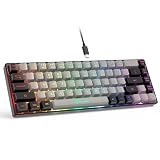
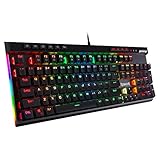
- Top Pick: Redragon Mechanical Gaming Keyboard Wired, 11 Programmable Backlit Modes, Hot-Swappable Red Switch, Anti-Ghosting, Double-Shot PBT Keycaps, Light Up Keyboard for PC Mac
- Best Value: Razer BlackWidow V4 X Mechanical Gaming Keyboard, Yellow Switches, Black
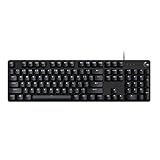
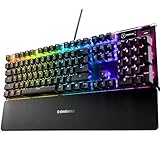
- Premium Choice: Logitech G413 SE Full-Size Mechanical Gaming Keyboard – Black
Sub-$50 mechanical keyboards used to mean a compromise you could feel in every keystroke: mushy stabilizers, greasy ABS keycaps that shine within a month, and switches soldered in place with no upgrade path. That’s changed. Hot-swap sockets, double-shot PBT, and pre-lubed switches have all trickled down into the budget tier, and in 2026 the gap between a $45 board and a $120 board is narrower than it has ever been.
The catch is that the budget category is also where the most corner-cutting happens, and marketing copy rarely tells you which corners. This guide covers what actually matters at this price — switch type, keycap material, hot-swap support, and connectivity — then reviews five boards that hold up under daily gaming use without pushing past $50.
As an Amazon Associate we earn from qualifying purchases at no extra cost to you. Product prices and availability are accurate as of the date shown and are subject to change.





⚡ Save on Your Next PC — Amazon Prime
Prime members get fast free shipping on the systems above, plus early access to Prime Day & Black Friday PC deals. New members get a 30-day free trial.
Watch: Best Mechanical Keyboard Under $50 — Video Review
How to Choose Mechanical Keyboard Under $50
- Switch type: Linear switches (red, yellow, or similar) are the default for gaming because they actuate smoothly with no tactile bump to push through. Tactile browns suit mixed typing and gaming; clicky blues are satisfying but loud enough to annoy anyone sharing your room.
- Keycap material: Double-shot PBT is the single biggest quality signal under $50. It resists the oily shine that plagues cheap ABS caps, and because the legends are moulded rather than printed, they never wear off. If a listing doesn’t mention PBT, assume ABS.
- Hot-swap sockets: A hot-swappable PCB lets you pull switches out with a puller and drop in new ones — no soldering. On a budget board this is genuine future-proofing: if you dislike the stock switches, a $15 switch set transforms the board rather than replacing it.
- Layout and size: Full-size gives you a numpad; TKL drops it for mouse room; 75% compacts everything while keeping arrows and a function row. Under $50 you can get any of these, so choose by desk space and whether you actually use the numpad.
- Anti-ghosting and N-key rollover: Full NKRO or at least 26-key rollover ensures simultaneous presses all register — essential for movement plus abilities in fast games. Most mechanical boards handle this well, but confirm rather than assume on the cheapest models.
The Best Picks Reviewed
Redragon Hot-Swappable Mechanical Keyboard
This is the value benchmark for the category: hot-swap sockets, double-shot PBT keycaps, and linear red switches at a price where most competitors offer none of the three. Anti-ghosting is solid across gaming inputs, and the 11 backlight modes are more presentation than substance, but the fundamentals here are genuinely good.
AULA F75 Pro Wireless
The most feature-dense board on this list — 75% layout, hot-swap PCB, pre-lubed Reaper switches, a volume knob, and triple connectivity via 2.4GHz, Bluetooth 5.0, and USB-C. The pre-lubed switches are the standout, delivering a smoothness out of the box that budget boards almost never manage, and the compact layout frees up meaningful mouse space.
Razer BlackWidow V4 X
Razer’s Yellow linear switches are light and fast with a short actuation distance, which makes this a strong pick if rapid repeated inputs are your priority. Build quality and Synapse software integration are a step above generic budget boards, though it typically sits at the top of this price bracket — buy on a sale and it’s excellent value.
Redragon K580
A full-size board with dedicated macro keys and a media wheel, which is a rare combination at this price and genuinely useful if you play MMOs or stream. RGB per-key lighting is bright and the software is serviceable; the keycaps are the main compromise, but everything else punches well above the cost.
Logitech G413 SE
The conservative choice: tactile mechanical switches, an aluminium top plate, PBT keycaps, and white-only backlighting instead of RGB. It’s a durable, no-nonsense full-size board from a brand with reliable support, and the lack of flashy features keeps the price down without hurting the typing experience.
Frequently Asked Questions
Are mechanical keyboards under $50 actually worth it?
Yes, provided you buy carefully. The build quality gap has narrowed considerably, and boards in this range now routinely include PBT keycaps and hot-swap sockets. You’ll give up premium acoustics, gasket mounting, and aluminium cases, but the switch feel and durability advantages over membrane boards are fully intact.
What’s the difference between the Logitech G413 SE and the G213 Prodigy?
The G413 SE is a true mechanical keyboard with individual switches under each key. The G213 Prodigy uses a mecha-dome design — a membrane keyboard tuned to feel more tactile. The G213 is comfortable and spill-resistant, but if you specifically want mechanical, the G413 SE is the one to pick.
Does hot-swap matter if I never plan to change switches?
It still helps. If a single switch fails after a year, hot-swap turns a dead keyboard into a two-minute repair with a spare switch. That alone often justifies choosing a hot-swap board over an equivalent soldered one at the same price.
Is wireless worth it in this price range?
It has become viable. Boards like the AULA F75 Pro offer 2.4GHz connections with latency low enough for most gaming, and the flexibility of Bluetooth for laptops and tablets is a real convenience. For competitive play, a wired connection remains the safest choice.
Final Thoughts
For most buyers, the Redragon hot-swappable board is the smartest purchase here — PBT keycaps and a hot-swap PCB give it a longer useful life than anything else near the price. If you want a compact desk setup with wireless flexibility, the AULA F75 Pro is the more exciting board and its pre-lubed switches feel a tier above their cost. And if you’d rather have a straightforward, well-built full-size keyboard from an established brand, the Logitech G413 SE remains a dependable, boring-in-the-best-way pick.