- Top Pick: Sceptre New 22-Inch Gaming Monitor, FHD 1080p, Up to 144Hz, HDMI, DisplayPort, Built-in Speakers, Machine Black (E225W-FW144 Series, 2026)
- Best Value: Samsung 27" Odyssey G5 (G51F) Series QHD (1440P) Gaming Monitor
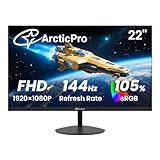
- Premium Choice: ArcticPro 22 Inch Gaming Monitor 144Hz, FHD Computer Monitor, 105% sRGB
Shopping for a gaming monitor under $200 means navigating a market flooded with panels that all claim high refresh rates and vivid color, yet deliver wildly different real-world experiences. The specs on the box rarely tell you whether a panel’s response time holds up in fast motion, whether the “144Hz” figure requires DisplayPort to unlock, or whether the stand will wobble every time you nudge your desk. At this price point, every manufacturer has cut something — the question is whether they cut the right things.
This guide covers six monitors that genuinely land under $200 in 2026, spanning 22-inch budget speed demons, 24-inch curved options, and a 27-inch QHD panel that punches well above its price bracket. We’ve focused on what actually matters for gaming — refresh rate, panel type, connectivity, and color accuracy — and flagged where each display makes its compromises so you can pick the one whose tradeoffs you can live with.
As an Amazon Associate we earn from qualifying purchases at no extra cost to you. Product prices and availability are accurate as of the date shown and are subject to change.







⚡ Save on Your Next PC — Amazon Prime
Prime members get fast free shipping on the systems above, plus early access to Prime Day & Black Friday PC deals. New members get a 30-day free trial.
Watch: Best Gaming Monitor Under $200 — Video Review
How to Choose Gaming Monitor Under $200
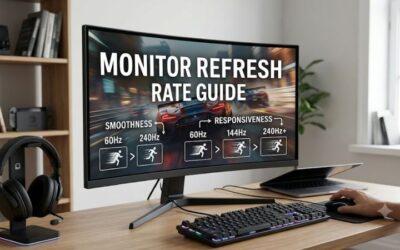
- Refresh rate over resolution: At this budget, a 144Hz 1080p panel will feel dramatically smoother in competitive shooters than a 60Hz 1440p one. Prioritize frames unless you play slower, visually driven games.
- Check the port for peak refresh: Many budget monitors only hit their advertised maximum over DisplayPort, capping HDMI at 120Hz or lower. Confirm your GPU has the right output before buying.
- Panel type sets your expectations: IPS gives you the best color and viewing angles, VA delivers deeper contrast for single-player immersion, and TN prioritizes raw speed. There is no universally correct answer — match it to what you play.
- Adaptive sync is non-negotiable: AMD FreeSync (and G-Sync Compatible support) eliminates screen tearing without the input lag penalty of V-Sync. Nearly every monitor here includes it, so don’t settle for one that doesn’t.
- Budget for a stand or mount: Sub-$200 monitors almost always ship with tilt-only stands. Verify VESA compatibility if ergonomics matter to you, and factor an arm into your total spend.
The Best Picks Reviewed
Samsung 27″ Odyssey G5 (G51F) QHD
This is the value outlier of the group — a 27-inch 1440p panel with Odyssey-series gaming credentials at a price that usually buys you 1080p. The extra resolution genuinely transforms text clarity and open-world detail, though you’ll want at least a mid-range GPU to drive QHD at high frame rates comfortably.
Sceptre 27-inch Prime (E275W-FW100T)
Sceptre’s 27-inch Prime pairs 100Hz with a claimed 1ms response and full 100% sRGB coverage, making it the strongest pick here for players who want screen real estate without stepping up to QHD. Dual HDMI plus DisplayPort means you can leave a console permanently connected alongside your PC.
Sceptre 22-inch 144Hz (E225W-FW144)
If frame rate is your only priority, this is the cheapest reliable route to 144Hz in 2026. The 22-inch panel is small by modern standards, but that compactness is an advantage for esports players who prefer keeping the entire playfield within a single glance — just plan on DisplayPort to unlock the full refresh rate.
Sceptre Curved 24-inch (C248W-1920RN)
The aggressive R1500 curve wraps noticeably at typical desk distance, and 98% sRGB coverage keeps colors credible for a curved budget panel. It’s the most immersive option here for story-driven and racing games, though the modest refresh rate makes it a poorer fit for competitive shooters.
ArcticPro 22 Inch 144Hz
ArcticPro undercuts nearly everything else while still delivering 144Hz and a respectable 105% sRGB gamut, which is unusual color coverage at this tier. It’s a sensible secondary display or a first monitor for a budget build, provided you accept a basic stand and minimal extras.
Frequently Asked Questions
Is 1080p still acceptable for gaming in 2026?
Absolutely, particularly at 22 to 24 inches where pixel density remains sharp. Below $200, a well-executed 1080p panel at a high refresh rate almost always delivers a better gaming experience than a compromised higher-resolution one.
Do I need 144Hz, or is 100Hz enough?
For competitive shooters, the jump from 60Hz to 100Hz is transformative and the step to 144Hz is a meaningful refinement on top. For single-player and slower-paced games, 100Hz is comfortably sufficient and lets you spend the savings on panel size or resolution.
Will these monitors work with PS5 and Xbox Series X?
Yes, all connect via HDMI and will run at 1080p or 1440p depending on the panel. Note that budget monitors rarely support HDMI 2.1, so 120Hz console output may be limited or unavailable depending on the specific model and resolution.
Are built-in speakers worth considering?
Treat them as a convenience rather than a feature. The integrated speakers on several picks here are fine for system sounds and casual video, but any dedicated headset or desktop speaker set will be a substantial upgrade for gaming.
Final Thoughts
For most buyers, the Samsung Odyssey G5 (G51F) is the standout — getting 27 inches of QHD gaming under $200 is the kind of value that rarely appears at this tier, and it’s the pick with the longest useful lifespan. Competitive players chasing frames on a tighter budget should go with the Sceptre 22-inch 144Hz, while anyone prioritizing immersion in single-player games will get more enjoyment out of the curved Sceptre C248W-1920RN. All three represent genuine value rather than cut corners dressed up as bargains.