Walk into any 2026 battlestation build thread and you’ll find the same argument playing out: should your next display wrap around you, or stay perfectly flat? Curved panels have gone from premium novelty to budget-shelf standard in just a few years, and the price gap that once made the decision easy has all but closed. Today a 27-inch 240Hz curved panel can cost less than a flat 144Hz model did in 2022.
That makes the choice less about money and more about how you actually play. Curvature changes viewing geometry, panel size ceilings, and even how a monitor behaves on a cramped desk — while flat screens still own competitive shooters, content creation, and multi-monitor arrays. Below we break down where each design genuinely wins, and which panels are worth your attention right now.
As an Amazon Associate we earn from qualifying purchases.





⚡ Save on Your Next PC — Amazon Prime
Prime members get fast free shipping on the systems above, plus early access to Prime Day & Black Friday PC deals. New members get a 30-day free trial.
Watch: Curved vs Flat Gaming Monitor: 2026 Guide — Video Review
Quick Verdict
Buy a curved monitor if you play immersive single-player games, sit within arm’s reach of a large or ultrawide panel, and want the most screen real estate your desk can hold. Buy flat if you’re a competitive FPS player, do photo or video work where straight lines must stay straight, or plan to run two or three displays side by side. For most people gaming alone at a desk, curved is now the safer default.
Key Differences
- Viewing geometry: A curve like 1500R or 1800R keeps every part of the screen roughly equidistant from your eyes, reducing off-axis colour shift at the edges. Flat panels lose a little contrast and accuracy toward the corners on large sizes.
- Immersion: Curved displays fill more peripheral vision, which pays off in racing sims, RPGs and flight sims. Flat panels present a more neutral, “window” style image.
- Line accuracy: Flat wins outright for CAD, spreadsheets, photo editing and anything with long horizontal rules — a curve subtly bows straight lines.
- Reflections: Curved glass can smear light sources across a wider arc; flat panels reflect more predictably and are easier to position away from windows.
- Multi-monitor setups: Flat panels butt together cleanly. Curved screens create awkward angles unless you buy matching models and mount them on arms.
- Size ceiling: Curvature makes 32-inch and 34-inch ultrawides usable up close. A flat 34-inch at the same distance forces constant head-turning.
Why Buy a Curved Gaming Monitor
Curvature earns its keep as screens get bigger. On a 32-inch panel like the SANSUI 32-inch Curved 240Hz, the bend keeps the far edges of a 1080p image from falling off-axis, so HUD elements in the corners stay crisp and evenly lit. Pair that with a 240Hz refresh rate and you get a display that’s genuinely fast enough for ranked play while still feeling cinematic in story-driven games. The 27-inch SANSUI Curved 240Hz with its tighter 1500R curve, 130% sRGB coverage and 4000:1 contrast is the sweet spot for most desks — aggressive enough to feel wraparound, small enough to take in at a glance.
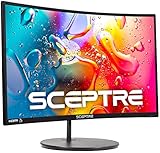
The strongest case for curved, though, is ultrawide. The Sceptre 34-inch Curved Ultrawide WQHD runs 3440 × 1440 at up to 180Hz with a 1500R curve, and that combination is genuinely transformative in sims and open-world titles. A flat panel of the same width simply doesn’t work at typical desk distances. If your budget is tighter, the Samsung 27-inch Essential S3 (S36GD) with its gentler 1800R curve and the compact Sceptre C248W-1920RN 24-inch are both easy, low-risk entry points.
Why Buy a Flat Gaming Monitor
Flat panels remain the honest choice for competitive play. In tactical shooters you’re tracking a small centre-screen crosshair, not soaking in peripheral detail, and many pros find any curvature adds a distracting sense of motion at the edges during fast flicks. Flat 24-inch and 27-inch esports monitors are also where you’ll find the most aggressive response-time tuning, backlight strobing and 360Hz-plus options.
Flat also wins for anyone whose monitor does double duty. If you edit photos, cut video, draft in CAD or stare at spreadsheets all day, a flat panel’s geometric accuracy matters more than immersion. And if you’re building a two- or three-screen array, flat displays sit flush against each other without the wedge-shaped gaps curved bezels create. That said, if a mild curve doesn’t bother you, something like the SANSUI 27-inch Curved 160Hz splits the difference well for mixed work-and-play use.
Which Should You Buy?
- For competitive FPS: pick flat, or the smallest, fastest curve you can find — the 27-inch SANSUI Curved 240Hz is a reasonable compromise.
- For sims and open-world games: pick curved ultrawide. The Sceptre 34-inch C345B-QUT168 is the obvious pick here.
- For a big-screen budget setup: pick curved. The SANSUI 32-inch Curved 240Hz gives you size and speed together.
- For creative work: pick flat, every time — straight lines have to stay straight.
- For a small or shared desk: pick a modest curve. The Sceptre 24-inch C248W-1920RN or Samsung Essential S3 both fit tight spaces.
Frequently Asked Questions
Does a curved monitor actually reduce eye strain?
Potentially, yes. Keeping the whole panel at a consistent focal distance means less refocusing as your eyes move across the screen. The effect is subtle on 24-inch models and much more noticeable at 32 inches and above.
What do 1500R and 1800R mean?
They describe the radius of the curve in millimetres. A 1500R panel is part of a circle with a 1.5-metre radius, so it’s more aggressively curved than an 1800R display. Lower numbers mean a deeper curve and a closer ideal viewing distance.
Is a curved monitor bad for competitive gaming?
No, but it offers no advantage either. Refresh rate, response time and input lag matter far more. A 240Hz curved panel will beat a 144Hz flat one in every measurable way that affects your aim.
Can you wall-mount a curved monitor?
Yes. Most curved gaming monitors, including the Sceptre C248W-1920RN, ship with standard VESA mounting points. Just allow extra clearance, since the panel edges sit further from the wall than a flat screen.
Final Verdict
For the majority of gamers in 2026, curved is the better buy — the price premium has evaporated, and the immersion benefit is real once you’re at 27 inches or larger. Stay flat only if you compete seriously, create professionally, or run multiple screens. Otherwise, match the curve to the size: 1800R for 27-inch, 1500R for 32-inch and ultrawide.