🛒 Best Price Today on Amazon
Prime members get fast, free shipping on everything above, plus member-only deals. New members get a 30-day free trial — cancel anytime.
HDR streaming through Sunshine and Moonlight lets you play PC games on another device while preserving HDR10 color and brightness information. However, enabling HDR on your gaming PC is only part of the process. This guide covers host requirements, client compatibility, configuration, calibration, and common problems.
1. What Sunshine Game Streaming HDR Setup Really Comes Down To
A successful Sunshine game streaming HDR setup requires three things: an HDR-enabled host, compatible 10-bit video encoding and decoding, and an HDR-capable client display. Sunshine handles game capture and streaming on the host PC, while Moonlight receives the video. If any part of this chain lacks HDR support, the picture may arrive in SDR or display incorrect brightness and colors.
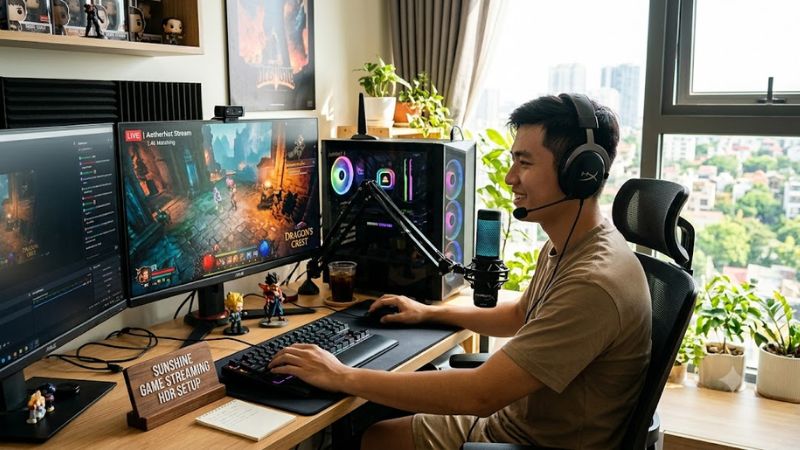
Understand How HDR Works With Sunshine and Moonlight
Sunshine is the open-source game-streaming host, and Moonlight is the client application used to connect to it. HDR information travels alongside the encoded video, so both ends must support the necessary HDR format and video capabilities.
Unlike simply increasing brightness, HDR10 uses a wider color range and higher brightness information than standard dynamic range (SDR). A compatible streaming chain must preserve that information instead of converting it into an SDR image during capture, encoding, decoding, or display output.
Check Your Host GPU and HDR Display
Sunshine officially supports HDR streaming on Windows hosts using Intel, AMD, and NVIDIA GPUs capable of encoding HEVC Main 10 or AV1 10-bit profiles. Your GPU must support the appropriate hardware encoding path, rather than merely advertising HDR output through its display connector.
Windows HDR must also be active on the host. An HDR-capable monitor connected to the gaming PC can provide the necessary display environment. If the PC normally runs headless, an appropriate EDID emulator may be needed to make Windows recognize an HDR-capable display.
GitHub+1
Verify Moonlight Client Compatibility
Your streaming device needs more than an HDR-compatible screen. It must also decode the selected 10-bit video format and output HDR to its connected display. For example, an HDR television connected to an incompatible streaming device does not automatically make the entire connection HDR-capable.
Check the client device’s GPU or media decoder, Moonlight version, operating system, and display connection. On Windows, also verify that HDR is enabled in the client operating system when using windowed streaming. Requirements vary across Windows, Android, macOS, Linux, and other supported platforms.
GitHub+1
Understand the Difference Between HDR and SDR
HDR streaming is not automatically better in every situation. HDR encoding can affect image quality or encoding performance on some GPUs, and differences between the host and client displays can make the same game’s brightness settings look noticeably different.
SDR remains a reasonable fallback if your client cannot decode HDR correctly, your display does not support HDR10, or you experience visual artifacts. Prioritize a correctly displayed image over forcing HDR through an incompatible setup.
2. How to Configure Sunshine Game Streaming HDR: Step by Step
Start with the Windows host before changing Moonlight settings. Confirm that the host display supports HDR, activate Windows HDR, and verify that the GPU supports a suitable 10-bit encoder. Then configure the client and calibrate the game. This order makes it easier to identify which part of the streaming chain is responsible when HDR does not work.
GitHub+1
Step 1: Enable HDR on the Windows Host
On the gaming PC, open Settings > System > Display > HDR. Select the display connected to the host and turn on Use HDR if Windows exposes the option. The exact controls can vary depending on the connected monitor, graphics driver, and Windows version.
Keep Sunshine running with the HDR-capable display active. If you use an EDID emulator, verify that Windows recognizes the display’s HDR capabilities before connecting Moonlight. Do not assume that an HDR-capable GPU alone activates HDR in Windows.
Step 2: Configure Sunshine and Confirm Encoding Support
Install and launch a current compatible Sunshine release, then access its web interface to confirm that the host is operating normally. Sunshine’s HDR capability depends on the GPU’s supported encoding profiles, so check whether the hardware supports HEVC Main 10 or AV1 10-bit encoding.
You do not need to change random encoder parameters just to activate HDR. Start with Sunshine’s normal configuration and establish a working SDR connection first. This provides a useful baseline if HDR subsequently produces a black screen, color artifacts, or connection problems.
Step 3: Enable HDR in Moonlight
Open Moonlight on your receiving device, connect to the Sunshine host, and open the streaming settings. Enable the HDR option if it is available. Choose a resolution and refresh rate supported by both the host and client rather than assuming the highest available option will work correctly.
If the HDR option is missing or unavailable, check the client decoder, operating-system HDR state, display capabilities, and Moonlight compatibility. Some clients have platform-specific requirements. Avoid forcing HDR through unsupported settings because this does not add missing hardware decoding or display capabilities.
Step 4: Calibrate Windows and In-Game HDR
After HDR streaming works, calibrate the client display using Windows HDR Calibration where supported. Sunshine’s documentation recommends streaming the calibration application to the client and saving an HDR calibration profile for the streaming display.
Next, open an HDR-compatible game and adjust its peak brightness, paper white, and other available HDR controls according to the receiving display. Host and client displays may have significantly different brightness capabilities, so settings that look appropriate on the gaming monitor might appear washed out or too dark on the television.
GitHub+1
| Setting or Step | Where | Effect | Risk |
| Windows HDR | Host: Settings > System > Display > HDR | Activates HDR on the host display | Incorrect display selection can leave HDR unavailable |
| Sunshine encoder | Sunshine host and supported GPU encoding path | Enables compatible 10-bit video encoding | Unsupported profiles can prevent HDR streaming |
| Moonlight HDR | Client streaming settings | Requests HDR output instead of SDR | Incompatible clients may show artifacts or unavailable controls |
| HDR calibration | Windows HDR Calibration and in-game settings | Adjusts brightness and color presentation | Poor calibration can make highlights or shadows look incorrect |
3. Sunshine HDR Troubleshooting and FAQ
Even when every device supports HDR, configuration differences can cause problems. The most useful approach is to identify whether the issue originates on the host, in the encoder, in Moonlight, or on the receiving display. Test one change at a time and retain an SDR configuration as a comparison point.
Why Is Moonlight HDR Option Missing?
A missing HDR option usually indicates that one of the required components is not reporting compatible HDR capabilities. Check whether Windows HDR is enabled on the host, whether the GPU supports HEVC Main 10 or AV1 10-bit encoding, and whether the receiving device supports HDR decoding and output.
Also check the physical display connection. An HDR television connected through a device or adapter that does not support the required HDR output may receive only SDR. Update Moonlight if necessary, reconnect to Sunshine, and check whether the HDR option becomes available.
Fix Washed-Out Colors or Incorrect Brightness
Washed-out colors often occur when the host is operating in HDR but the client is receiving an SDR stream. First, confirm that Moonlight’s HDR option is enabled. Then verify that the client display has entered HDR mode rather than simply displaying an HDR source as SDR.
If the stream is genuinely HDR, revisit Windows and in-game calibration. Different displays have different peak brightness capabilities, so avoid copying brightness settings from another monitor. Test a dark scene, a bright highlight, and a normal daylight scene to identify whether the problem involves shadow detail or excessive brightness.
Fix Black Screens and HDR Visual Artifacts
Some HDR configurations can produce flashing colors, a black screen, or a stream that does not start immediately. Moonlight’s documentation also identifies possible scaling artifacts when the streaming resolution differs from the host display resolution.
Try the following diagnostic sequence:
- Disconnect the current Moonlight session.
- Confirm HDR remains enabled on the Windows host.
- Reconnect using a resolution supported by the host display.
- If the stream remains blank, toggle Windows HDR off and back on, then reconnect.
- If artifacts continue, temporarily disable HDR in Moonlight and compare the SDR stream.
These checks help isolate the issue without immediately changing drivers, reinstalling Sunshine, or modifying Windows registry settings.
GitHub+1
What Doesn’t Help
Increasing the in-game brightness slider cannot compensate for an incompatible HDR decoder. Similarly, changing Sunshine’s bitrate does not create missing HDR support. Bitrate adjustments can affect compression quality, but they do not replace the required 10-bit encoding and decoding capabilities.
Avoid installing unofficial HDR patches or forcing unsupported encoder profiles as an initial troubleshooting step. Older games using NVIDIA-specific NVAPI HDR instead of native Windows HDR support may also have compatibility problems with Sunshine streaming. In those cases, SDR may be the more practical option.
GitHub+1
4. FAQ
Does Sunshine Support HDR Streaming?
Yes, Sunshine officially supports HDR streaming on Windows hosts with compatible Intel, AMD, or NVIDIA GPUs. The GPU must support HEVC Main 10 or AV1 10-bit encoding, and the receiving Moonlight client must also support HDR decoding and output.
Linux HDR support is experimental and requires additional compatibility, including an appropriate capture backend and HDR-capable desktop environment.
Do I Need an HDR Monitor Connected to My Gaming PC?
You generally need an HDR-capable display or a suitable EDID emulator connected to the host so Windows can activate HDR. An EDID emulator can be useful for a headless gaming PC, but it must correctly report HDR display capabilities.
The receiving device also needs its own HDR-compatible display. These are separate requirements, so check both ends before troubleshooting Sunshine.
Does HDR Streaming Reduce Gaming Performance?
It can affect encoding performance or image quality on some GPUs compared with SDR streaming. The actual impact depends on the GPU, encoder, resolution, frame rate, and streaming configuration.
If you experience inconsistent frame delivery or visual artifacts, compare HDR and SDR using the same game, resolution, and streaming conditions. This helps determine whether HDR encoding contributes to the problem.
Can I Use Sunshine HDR With an Android TV or Apple TV?
Yes, provided the device, Moonlight client, video decoder, and connected television meet the relevant HDR requirements. Android devices need compatible HEVC Main10 decoding and an HDR10-capable display. Apple devices also have platform-specific HDR compatibility requirements.
Do not assume every Android TV or Apple TV configuration supports HDR streaming simply because its television supports HDR10. Verify the receiving device’s actual decoding and output capabilities.
Final Thoughts
A successful Sunshine game streaming HDR setup depends on compatibility across the entire streaming chain, not just an HDR-capable gaming GPU. Start with Windows HDR, verify 10-bit encoding, enable HDR in Moonlight, and calibrate the receiving display. If problems persist, compare SDR before changing hardware or advanced settings.