🛒 Best Price Today on Amazon
Prime members get fast, free shipping on everything above, plus member-only deals. New members get a 30-day free trial — cancel anytime.
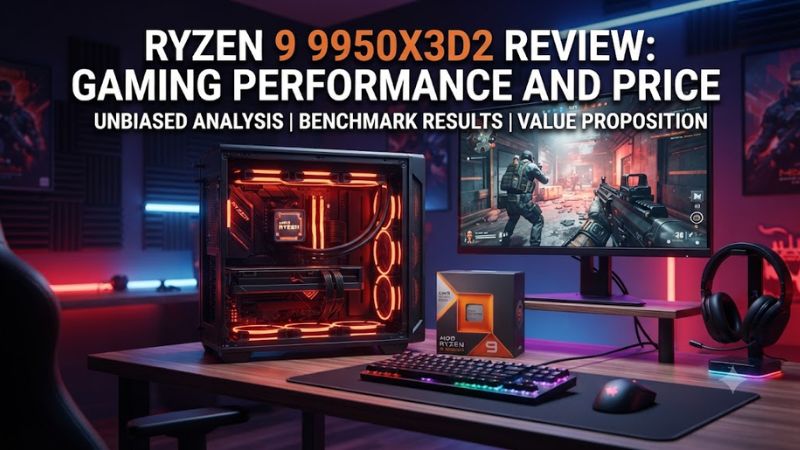
As of October 6, 2026, the Ryzen 9 9950X3D2 review: gaming performance and price points to a real $899 flagship, but its gaming uplift over the cheaper 9950X3D is small. The dual-CCD 3D V-Cache design is more interesting for cache-sensitive creator and developer workloads than for ordinary gaming builds.
How to Choose a Ryzen 9 9950X3D2 Class CPU
The key buying question is not whether the Ryzen 9 9950X3D2 is fast, because it is, but whether its extra cache and higher power budget justify the premium. Independent 1080p gaming results show only a sub-1% lead over the 9950X3D in one 17-game suite, making value the central issue. The answer depends on whether the system is gaming-first or built around demanding professional software.
16-core performance needs
Choose the 9950X3D2 when you genuinely need 16 Zen 5 cores and want large cache capacity on both CCDs. Its 16-core/32-thread layout, 4.3 GHz base clock and up to 5.6 GHz boost suit heavy parallel work while keeping gaming performance in the flagship tier. That combination is aimed at users who can keep many threads busy for long periods.
For buyers focused mainly on games, those 16 cores are rarely the reason to spend $899. The 9950X3D already supplies 16 cores and 3D V-Cache for less, while the 9850X3D uses eight cores and targets gaming directly. That makes the 9950X3D2 a specialist choice. In other words, the extra cores are useful, but they are not a gaming requirement.
Cache-sensitive workloads
The 9950X3D2 carries 192MB of L3 cache and 208MB of total cache, with 3D V-Cache on both CCDs. AMD positions the design for demanding developer, creator and memory-intensive workloads where keeping more data close to the cores can reduce memory pressure. This is the central technical point in the Ryzen 9 9950X3D2 review: gaming performance and price.
Gaming can benefit from large cache, but the benchmark evidence is much less dramatic than the cache increase suggests. Tom’s Hardware recorded 211.3 FPS versus 209.6 FPS for the 9950X3D across 17 games at 1080p, using a GeForce RTX 5090 to expose CPU differences. That result puts the cache advantage into useful perspective for buyers.
AM5 and DDR5 compatibility
Platform compatibility is straightforward: the 9950X3D2 uses AM5 and DDR5, with PCIe 5.0 support and 24 usable PCIe lanes. AMD lists A620, B650, B650E, B840, B850, X670, X670E, X870 and X870E chipsets as compatible, subject to motherboard BIOS support. The Ryzen 9 9950X3D2 review: gaming performance and price therefore starts with the platform, not the CPU alone.
It is not an upgrade for an AM4 or DDR4 system because the processor requires an AM5 DDR5 platform. Existing AM5 owners have the simpler path, but they should still check the board maker’s CPU support list and BIOS version before installing a 200W processor. BIOS validation is especially important on older AM5 boards before a purchase.
Cooling and power headroom
Cooling is a major buying criterion because AMD rates the chip at 200W and lists 95°C as its maximum operating temperature. AMD does not include a cooler and recommends liquid cooling for optimal performance, so the CPU price does not represent the complete upgrade cost. The Ryzen 9 9950X3D2 review: gaming performance and price must therefore include cooling in the budget.
A 360mm liquid cooler is a sensible high-end pairing when sustained heavy workloads matter, while case radiator clearance still has to be checked. Power planning also deserves attention: the processor itself is rated at 200W, so the CPU choice should be considered alongside the GPU and the power supply. The final radiator choice should follow the case maker’s clearance limits.
Top Picks for the 9950X3D2 Buying Decision
The table below separates the $899 9950X3D2 from cheaper AM5 alternatives using current tracked prices and independent results. These are buying positions, not a laboratory ranking: the right choice depends on gaming priority, threaded workloads, platform ownership and how much extra cache your software can use. The comparison is most useful when the CPU is considered as part of a complete AM5 system.
| Product | Best For | Key Spec | Compatibility | Watch Out For |
| Ryzen 9 9950X3D2 | Best Overall | 16C/32T, 192MB L3 | AM5, DDR5 | $899 for small gaming gains |
| Ryzen 9 9950X3D | Best Value | 16C/32T, 128MB L3 | AM5, DDR5 | Less cache on second CCD |
| Ryzen 7 9850X3D | Best For Gaming | 8C/16T, 96MB L3 | AM5, DDR5 | Fewer cores for heavy work |
| Ryzen 9 9950X | Best For Productivity Value | 16C/32T, 64MB L3 | AM5, DDR5 | No 3D V-Cache |
Best Overall: Ryzen 9 9950X3D2
The 9950X3D2 earns the Best Overall slot only for buyers who want one premium AM5 CPU for gaming plus specialized, cache-sensitive workloads. It has 16 cores, 32 threads, 192MB of L3 cache and a 200W default TDP, giving it unusually broad capability at the top of AMD’s desktop range. That is why the Ryzen 9 9950X3D2 review: gaming performance and price favors mixed workloads more than gaming alone.
Its real weakness is price efficiency: TechSpot tracked the processor at about $895 in September 2026, while Newegg currently lists $899. The chip should not be bought by a mainstream gamer who would rather put hundreds of dollars toward a faster GPU, display or other system component. The value warning is clear for ordinary players.
Best Value: Ryzen 9 9950X3D
The Ryzen 9 9950X3D is the stronger value alternative because it keeps 16 cores and 3D V-Cache while costing substantially less. TechSpot’s September 2026 tracker showed about $644, and Tom’s Hardware found the 9950X3D2 less than 1% ahead in a 17-game 1080p geomean. For a new AM5 build, that price difference can be redirected into graphics hardware.
Its weakness is the asymmetric cache layout, with 3D V-Cache on only one CCD, so workloads that specifically benefit from cache access across both chiplets can favor the newer design. Buyers should skip it only when their software has a verified reason to use the 9950X3D2’s dual-cache arrangement. This is why its value depends on workload rather than cache capacity alone.
Best For Gaming: Ryzen 7 9850X3D
The Ryzen 7 9850X3D is the cleaner gaming pick because eight Zen 5 cores and 96MB of L3 cache are enough for a high-end gaming system, while its $484 tracked price in September 2026 is far below the 9950X3D2. It also uses the same AM5 and DDR5 platform. Its lower core count also leaves room in the budget for a stronger graphics card.
The trade-off is capacity for heavily threaded creator work: it has 8 cores and 16 threads rather than 16 and 32. A buyer who regularly renders, compiles or encodes alongside gaming should consider the 9950X3D instead, while a gaming-first buyer should not pay for cores they will rarely use. The gaming-first choice is therefore easier to justify at this price.
Best For Productivity Value: Ryzen 9 9950X
The Ryzen 9 9950X is the productivity-value pick when applications care more about 16 Zen 5 cores than 3D V-Cache. TechSpot’s September 2026 tracker showed about $499, and its 16-core/32-thread design keeps the same AM5 and DDR5 foundation while using a 170W TDP. That makes the Ryzen 9 9950X3D2 review: gaming performance and price especially relevant to creators choosing between cache and core-focused value.
Its real weakness for gaming is the lack of 3D V-Cache, which can leave it behind X3D parts in CPU-limited titles. It is a poor match for someone buying primarily for maximum gaming frame rates, but it can make more sense than the $899 flagship when professional software does not respond to extra cache. Buyers should not select the flagship solely because its cache figure is larger.
FAQ About the Ryzen 9 9950X3D2
The short answer is that the 9950X3D2 is a niche flagship rather than a value-focused gaming CPU. Its dual-CCD 3D V-Cache design is technically distinctive, but independent gaming data shows only a small advantage over the 9950X3D, while the price premium remains substantial. The Ryzen 9 9950X3D2 review: gaming performance and price therefore favors the cheaper X3D models for most gaming systems.
Is the Ryzen 9 9950X3D2 worth it for gaming?
No, the Ryzen 9 9950X3D2 is usually not worth its premium for gaming alone. Tom’s Hardware measured 211.3 FPS for it versus 209.6 FPS for the 9950X3D across 17 games at 1080p, so the extra cache does not translate into a large average gaming gain. The Ryzen 9 9950X3D2 review: gaming performance and price is strongest when the CPU will also serve demanding non-gaming workloads.
It can make sense for a buyer who also has a cache-sensitive professional workload and wants one CPU for both jobs. For a gaming-only system, the 9850X3D or 9950X3D leaves more budget for the graphics card, and that often has a larger effect on real game performance. That makes workload balance more important than chasing a larger cache number.
How much does the Ryzen 9 9950X3D2 cost?
The Ryzen 9 9950X3D2 launched with a $899 suggested price, and AMD’s direct store lists it at $899. Newegg also shows an $899 listing, while TechSpot’s September 2026 tracker recorded about $895, so the flagship remains close to its launch tier. The Ryzen 9 9950X3D2 review: gaming performance and price should use the current retail picture, not only the launch MSRP.
That pricing matters because the 9950X3D was tracked around $644 in September 2026. The difference is large enough that buyers should compare complete system priorities rather than treating the 9950X3D2 as an automatic replacement for the older flagship. The premium is particularly difficult to justify when gaming performance is already close.
What motherboard and RAM does it need?
The Ryzen 9 9950X3D2 requires an AM5 motherboard and DDR5 memory, and it supports PCIe 5.0 with 24 usable CPU PCIe lanes. AMD lists a broad set of AM5 chipsets, including B650, B650E, B840, B850, X670, X670E, X870 and X870E, with BIOS support still dependent on the board. The Ryzen 9 9950X3D2 review: gaming performance and price also depends on whether the existing motherboard is suitable for the processor.
A DDR4 motherboard cannot be reused, and an AM4 board is not compatible either. AMD rates official memory support up to DDR5-5600 depending on DIMM configuration, while independent review systems commonly use DDR5-6000 EXPO kits, so buyers should follow the motherboard QVL for their chosen memory. Memory kits should be checked against the board’s support list rather than assumed compatible from the CPU alone.
Does the Ryzen 9 9950X3D2 need liquid cooling?
Yes, liquid cooling is the appropriate approach for a high-end 9950X3D2 build because AMD recommends a liquid cooler for optimal performance. The processor has a 200W default TDP, reaches a specified 95°C maximum operating temperature and ships without a boxed thermal solution. The Ryzen 9 9950X3D2 review: gaming performance and price therefore needs to account for cooling as part of the purchase.
The exact radiator size depends on the case and workload, so it should not be presented as a universal requirement. A quality 360mm AIO is a sensible premium pairing for sustained all-core work, but the key checks are AM5 mounting support, radiator clearance, airflow and the cooler maker’s capacity guidance. Case airflow and motherboard power delivery also affect the practical build decision.
Final Thoughts
The Ryzen 9 9950X3D2 review: gaming performance and price verdict is straightforward: this is a technically ambitious $899 AM5 flagship with real value only for a narrow audience. Its dual 3D V-Cache helps specialized workloads, but the gaming uplift over the 9950X3D is too small to justify the premium for most players. For most gamers, the 9950X3D or 9850X3D is the more rational destination for the budget.