🛒 Best Price Today on Amazon
Prime members get fast, free shipping on everything above, plus member-only deals. New members get a 30-day free trial — cancel anytime.
The ryzen 9 5900 review: gaming performance and price question comes down to whether its 12 cores justify buying an older AM4 processor in 2026. AMD’s Ryzen 9 5900 combines a 65W default TDP with strong multithreaded potential, but its OEM-only availability makes pricing and warranty important. Gamers should compare its performance, platform costs, and alternatives before choosing one.
How to Choose a Ryzen 9 Processor for Gaming
The Ryzen 9 5900 is most attractive to buyers who already own a compatible AM4 motherboard and need both gaming and productivity performance. It has 12 cores, 24 threads, a maximum boost clock of 4.7 GHz, and 64MB of L3 cache according to AMD. Its AM4 socket and DDR4 memory support make it a potential upgrade for an existing system, but a BIOS update may be necessary.
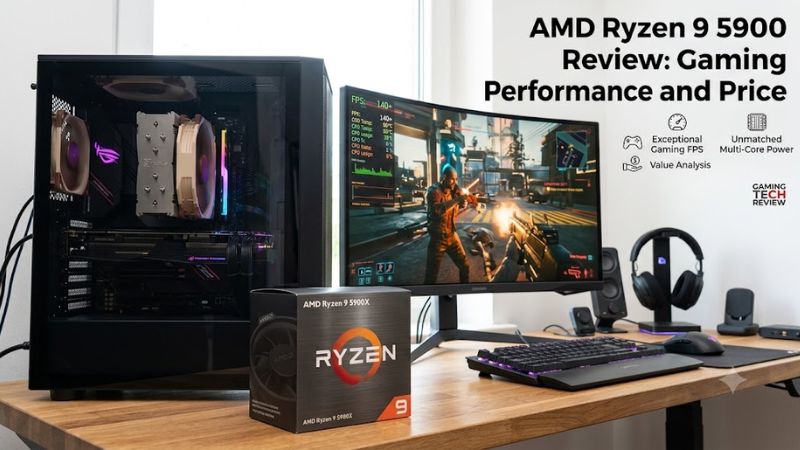
Gaming performance and frame rates
For gaming, the Ryzen 9 5900 has enough processing resources for demanding titles, multitasking, and background applications. However, its core count alone does not determine frame rates: game-engine design, graphics settings, memory configuration, and GPU performance also matter. Buyers targeting very high refresh rates should compare single-thread performance and gaming-focused cache designs instead of assuming that more cores always produce higher FPS.
The ryzen 9 5900 review: gaming performance and price decision also requires care when interpreting published benchmarks. Tom’s Hardware tested the closely related Ryzen 9 5900X, not the OEM-only Ryzen 9 5900. Its historical gaming results therefore provide architectural context rather than direct measurements of the non-X model. The two processors should not be treated as interchangeable when quoting frame rates.
Productivity and multitasking workloads
The processor’s 12 cores and 24 threads are useful for workloads such as compiling code, rendering, encoding video, and running several demanding applications together. These tasks can benefit from parallel processing more than games that rely heavily on a small number of fast CPU threads. Its 65W default TDP is also lower than that of some higher-power desktop processors, although actual package power depends on workload and motherboard settings.
For a mixed gaming and productivity PC, the Ryzen 9 5900 can make sense when its purchase price is competitive with newer alternatives. Buyers who mainly play games should weigh that advantage against processors designed around higher gaming performance. If rendering or encoding is a regular part of the workload, compare application-specific results rather than relying on a single synthetic score or core-count comparison.
AM4 motherboard and memory compatibility
The Ryzen 9 5900 uses AMD’s AM4 socket, supports DDR4 memory, and provides PCIe 4.0 connectivity. It does not support DDR5, so a DDR5 motherboard cannot be used with this processor. Existing AM4 owners should check the motherboard manufacturer’s CPU support list and required BIOS version before purchasing, particularly when upgrading from an earlier Ryzen generation.
Memory compatibility is only one part of the platform decision. The motherboard must support the specific CPU, and the power delivery and cooling setup should suit the intended workload. AMD lists a maximum operating temperature of 95°C, but this is a thermal limit rather than a recommended sustained target. A discrete graphics card is required because the Ryzen 9 5900 has no integrated graphics.
Price, availability, and upgrade value
The standard Ryzen 9 5900 is an OEM-only processor, so its retail availability differs from that of mainstream boxed CPUs. Some listings may involve tray processors or components removed from prebuilt computers. That makes seller reputation, return rights, warranty coverage, and confirmation of the exact model especially important. Do not assume a listing for the Ryzen 9 5900X is the same product.
Value depends on the complete upgrade cost, not just the CPU listing. Someone who already owns a supported AM4 motherboard and DDR4 memory may avoid spending money on a new platform. A new-build buyer must compare the processor, motherboard, memory, cooling, and warranty together. If the 5900 costs close to a newer platform with better gaming performance, its older socket becomes a harder trade-off to justify.
Top Picks: Ryzen 9 5900 and Its Alternatives
The right choice depends on whether you are upgrading an existing AM4 system, building a workstation, or prioritizing gaming above other workloads. The comparison below distinguishes the OEM-only Ryzen 9 5900 from related processors and an AM4 gaming-focused alternative. Current prices are not included because reliable, comparable live retail prices could not be confirmed for every model; check the exact SKU and seller before comparing offers.
| Product | Best For | Key Spec | Compatibility | Watch Out For |
| AMD Ryzen 9 5900 | Efficient mixed workloads | 12 cores, 24 threads; 65W default TDP | AM4, DDR4, PCIe 4.0 | OEM-only availability |
| AMD Ryzen 9 5900X | Gaming and productivity | 12 cores, 24 threads; up to 4.8 GHz boost | AM4, DDR4, PCIe 4.0 | Higher 105W default TDP |
| AMD Ryzen 9 5950X | Heavier multithreaded workloads | 16 cores, 32 threads; up to 4.9 GHz boost | AM4, DDR4, PCIe 4.0 | May cost too much for gaming alone |
| AMD Ryzen 7 5800X3D | Gaming-focused AM4 upgrades | 8 cores, 16 threads; 3D V-Cache | AM4, DDR4, PCIe 4.0 | Availability and pricing can be difficult |
Specifications: AMD’s official Ryzen 9 5900 documentation and published Ryzen 5000-series specifications. Confirm the precise processor model and motherboard support before buying.
Best Overall: AMD Ryzen 9 5900
The Ryzen 9 5900 is a sensible option for an existing AM4 owner who needs substantial multithreaded capacity without moving to a newer platform. Its 12-core, 24-thread design can handle gaming alongside background workloads, and the 65W default TDP is attractive for buyers who want to manage power and cooling requirements carefully. Its strongest advantage is the combination of core count and platform reuse.
However, this processor is not automatically the best choice for every gaming PC. OEM-only availability complicates the purchase, and used or tray listings can carry different warranty conditions. Buyers who need a straightforward retail purchase, maximum gaming frame rates, or a clearly documented warranty should compare other models first. The 5900 is most appealing when its verified condition and total price make it a worthwhile upgrade.
Best Value Alternative: AMD Ryzen 9 5900X
The Ryzen 9 5900X is worth comparing because it shares the 12-core, 24-thread configuration while offering a maximum boost clock of up to 4.8 GHz. Tom’s Hardware’s published review reported strong gaming and application performance for the 5900X, including results against competing processors from its launch period. Those results are useful historical evidence, but they do not establish how the CPU compares with every current-generation competitor.
Its main drawback is the 105W default TDP, compared with 65W for the non-X Ryzen 9 5900. Cooling, motherboard settings, and case airflow therefore deserve attention when planning a system around it. It may be the better purchase when both models are similarly priced and the buyer values its higher clock specification, but the price difference and actual workload should determine the decision.
Best for Heavy Multithreading: AMD Ryzen 9 5950X
The Ryzen 9 5950X offers 16 cores and 32 threads, making it a useful comparison for users whose workloads regularly scale across many CPU threads. Rendering, encoding, and other parallel tasks may benefit from its additional cores over a 12-core processor. It also belongs to the AM4 generation, so an existing compatible DDR4 platform may remain usable after checking motherboard support and BIOS requirements.
The additional cores are less compelling when a PC is used primarily for gaming. A larger core count does not guarantee better frame rates, and the 5950X can be an unnecessary expense if the main workload does not use its extra processing capacity. Buyers should compare application benchmarks, cooling requirements, and the actual price of available units before choosing it over the Ryzen 9 5900.
Best for Gaming-Focused AM4 Upgrades: AMD Ryzen 7 5800X3D
The Ryzen 7 5800X3D is an important alternative for AM4 owners who prioritize gaming. Its 3D V-Cache design gives it a different performance profile from conventional Ryzen 5000 processors, and its eight cores can be sufficient for many gaming workloads. Published comparisons have identified it as a particularly strong gaming option within the AM4 family, although results vary by game, GPU, and resolution.
Its disadvantage is availability: finding a reasonably priced unit can be difficult, and a premium listing may erase its value advantage. It also has fewer cores than the Ryzen 9 5900, which can matter for heavily threaded production tasks. Choose it when gaming performance is the priority and its verified market price makes sense, rather than assuming it is the best option for every mixed-use system.
Frequently Asked Questions
The Ryzen 9 5900 remains relevant for buyers considering an AM4 upgrade, but its value depends on the purchase price, the existing system, and the workload. These answers cover the key decisions about gaming, compatibility, power, and buying the processor in 2026.
Is the Ryzen 9 5900 good for gaming in 2026?
Yes, the Ryzen 9 5900 can deliver capable gaming performance when paired with a suitable graphics card and configured correctly. Its 12 cores and 24 threads also provide room for multitasking, although newer gaming-focused CPUs may deliver higher frame rates in CPU-limited situations.
For an existing AM4 system, it may offer a practical route to stronger multitasking without replacing the motherboard and DDR4 memory. Buyers building a new PC should compare current gaming benchmarks at their target resolution before committing to an older platform.
What is the difference between the Ryzen 9 5900 and 5900X?
The Ryzen 9 5900 has 12 cores, 24 threads, a maximum boost clock of 4.7 GHz, and a 65W default TDP. The Ryzen 9 5900X also has 12 cores and 24 threads, but its maximum boost clock reaches 4.8 GHz and its default TDP is 105W.
The 5900X may be preferable when its price is competitive and higher power limits are acceptable. The non-X 5900 can suit buyers who value its lower default TDP, but the final choice should reflect actual pricing, warranty coverage, cooling, and workload performance.
Does the Ryzen 9 5900 need a graphics card?
Yes, the Ryzen 9 5900 requires a discrete graphics card because it does not include integrated graphics. A compatible NVIDIA GeForce or AMD Radeon card can provide gaming output, subject to the GPU’s own requirements and the system’s power supply and physical clearance.
Check that the motherboard, power supply, and case support the chosen graphics card before purchasing components. The CPU supports PCIe 4.0, but the graphics card and motherboard determine the actual connection configuration and available expansion features.
How much should you pay for a Ryzen 9 5900?
There is no single reliable current price to recommend because the Ryzen 9 5900 is an OEM-only model, and available listings can differ in condition, warranty, and included accessories. Compare the exact model against the 5900X and newer alternatives using the complete purchase cost rather than the advertised CPU price alone.
For a used or tray processor, verify the seller’s return policy, serial or model identification, and motherboard support before paying. If a newer CPU and platform offer better gaming performance for a similar total cost, the older AM4 processor may not be the sensible purchase.
Final Thoughts
The ryzen 9 5900 review: gaming performance and price verdict is straightforward: this 12-core AM4 CPU deserves consideration for existing DDR4 systems that need gaming and productivity capacity. Its OEM-only status makes seller verification essential, while newer gaming-focused processors may offer better frame rates. Compare the complete upgrade cost and warranty before buying.